


Analysis of Adverse Events during Intrahospital Transportation of Critically Ill Patients
- PMID: 29062574
- PMCID: PMC5618745
- DOI: 10.1155/2017/6847124
Analysis of Adverse Events during Intrahospital Transportation of Critically Ill Patients
Abstract
Purpose: To describe adverse events occurring during intrahospital transportation of adult patients hospitalized in an Intensive Care Unit (ICU) and to evaluate the association with morbidity and mortality.
Method: Prospective cohort study from July 2014 to July 2015. Data collection comprised clinical data, prognostic scores, length of stay, and outcome at hospital discharge. Data was collected on transport and adverse events. Adverse events were classified according to the World Health Organization following the degree of damage. The level of significance was set at 5%.
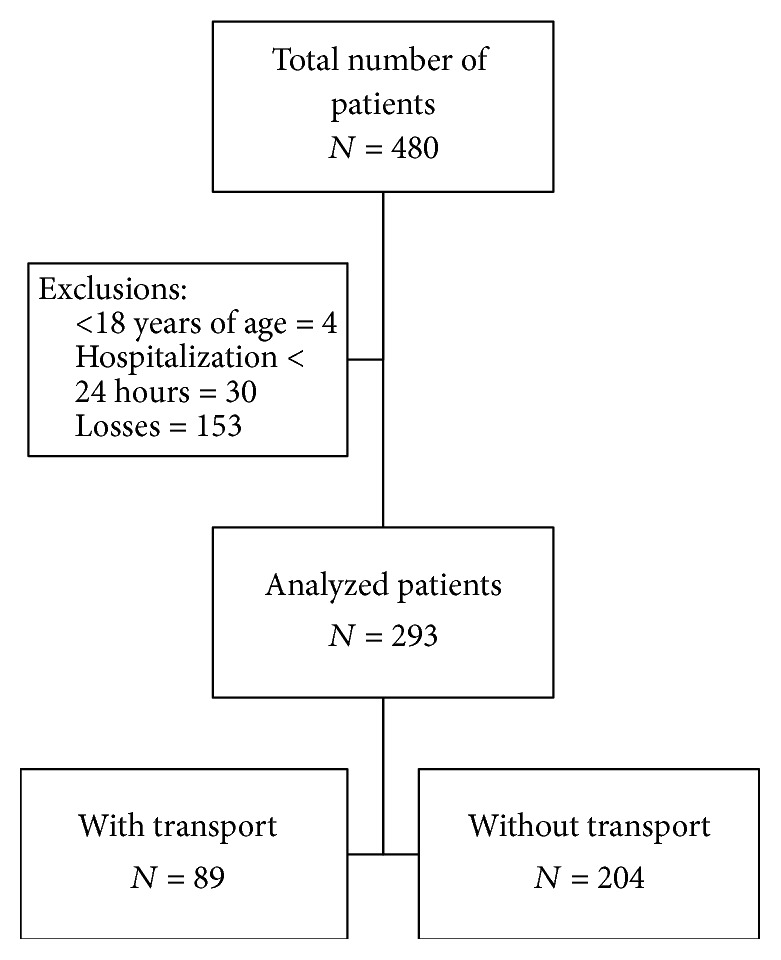
Results: A total of 293 patients were analyzed with follow-up of 143 patient transportations and records of 86 adverse events. Of these events, 44.1% were related to physiological alterations, 23.5% due to equipment failure, 19.7% due to team failure, and 12.7% due to delays. Half of the events were classified as moderate. The mean time of hospital stay of the group with adverse events was higher compared to patients without adverse events (31.4 versus 16.6 days, resp., p < 0.001).
Conclusions: Physiological alterations were the most frequently encountered events, followed by equipment and team failures. The degree of damage associated with adverse events was classified as moderate and associated with an increase in the length of hospital stay.
References
-
- Pedreira L. C., Santos I. M., Farias M. A., Sampaio E. S., Barros C. S. M. A. Coelho ACC.Knowledge of the nurse intra-hospital transport of critical patients. UERJ Nursing Journal. 2014:22–533.
-
- Beckmann U., Gillies D. M., Berenholtz S. M., Wu A. W., Pronovost P. Incidents relating to the intra-hospital transfer of critically ill patients: an analysis of the reports submitted to the Australian Incident Monitoring Study in Intensive Care. Intensive Care Medicine. 2004;30(8):1579–1585. - PubMed
-
- Wilson P. Safe patient transportation: nurses can make a difference. Nursing times. 1998;94(26):66–67. - PubMed
LinkOut - more resources
Full Text Sources
Other Literature Sources
