Review
. 2017 Oct 25;69(5):587-597.

Evidence-based blood pressure reducing actions of electroacupuncture: mechanisms and clinical application

Affiliations
Review

Evidence-based blood pressure reducing actions of electroacupuncture: mechanisms and clinical application

John C Longhurst et al. Sheng Li Xue Bao. .

Abstract

Hypertension is a serious world-wide health problem as it increases cardiovascular atherosclerotic risk, stroke and attending morbidity and mortality. Both systolic and diastolic blood pressures and particularly systolic pressure increase with aging. The downsides from pharmacological therapy have led to consideration of additional treatments, including acupuncture, which evokes endogenous neural-hormonal systems to lower blood pressure. Using basic science studies to guide clinical approaches to research, it is apparent that low frequency, low intensity electroacupuncture reduces sympathetic outflow in approximately 70% of patients with mild to moderate hypertension who are off antihypertensive drugs. Systolic and, to a lesser extent, diastolic arterial blood pressures can be lowered over two to four weeks for prolonged periods, lasting as long as one month, after cessation of an eight weeks of once weekly stimulation. Many questions about long-term therapy, treatment of resistant patients and efficacy in patients on medication remain to be studied. Current data, however, suggest that there may be a role of acupuncture in treatment of hypertension.


Figures

Fig. 1
Fig. 1
Reflex increases in arterial blood pressure (AP) and myocardial wall thickening (Wth) are reduced with electroacupuncture (EA) in cats. At time points indicated by arrows, bradykinin (BK) was applied to surface of the gallbladder: a, baseline control measurement; b, a small branch of left anterior descending coronary artery (LAD) was ligated and the response to BK was examined; c, EA (0.5 ms, 4 Hz) was applied at P5-P6 on forelegs for 30 min and BK response was evaluated; d, opioid antagonist, naloxone, was administered intravenously and response to BK was measured. The fall in normalized wall thickening (%Wth) associated with reflexly increased sympathetic stimulation in presence of LAD ligation (b) was reversed by EA (c). A decline in AP response also was apparent (c). Intravenous administration of naloxone blocked the effects of EA; wall thickening declined, and AP response returned to normal (d). Sympathoinhibitory effects of EA at P5-P6 persist for at least 1 h in this model. Therefore, naloxone was administered at a time when sympathoinhibition by EA was expected to maintain improved %Wth and diminished AP response to BK stimulation[20].
Fig. 2
Fig. 2
Neuronal pathways, circuitry and synaptic transmission involved in electroacupuncture (EA)’s cardiovascular responses at acupoints P5-P6 and ST36-ST37 on sympathoexcitatory reflex responses elicited by activation of visceral afferents in cats and rats. Spinal visceral afferent pathways (orange arrows) ascending to medulla, midbrain and hypothalamus activate (+) cardiovascular neurons, which can be modified by 30 min EA at P5-P6 (activating median nerves, MN) and ST36-ST37 (activating deep peroneal nerves, DPN) to reduce (−) sympathetic outflow (blue arrows) that in turn influences cardiovascular function. Acupuncture influences neurons that regulate cardiovascular function in the paraventricular nucleus (PVN), arcuate nucleus (ARC), ventrolateral periaqueductal gray (vlPAG), nucleus raphe-pallidus (NR-P), rostral ventrolateral medullar (rVLM), and neurotransmitters beta-endorphin (β-End), acetylcholine (ACh), L-glutamate (L-Glu), gamma-butyric acid (GABA), enkephalin (Enk), serotonin 1A receptor (5-HT1A) that participate in the central neural processing during EA. Dyn = dynorphin, DH = dorsal horn, IML = intermediolateral column.
Fig. 3
Fig. 3
Repetitive electroacupuncture (EA) treatment (twice weekly) reduces blood pressure in cold-induced hypertension (CIH), an environmental model of sustained high blood pressure in rats[46]. Cold exposure increased systolic blood pressure (SBP; Panel A), diastolic blood pressure (DBP; Panel B) and heart rate (HR; Panel C) after four weeks and induced sustained hypertension by six weeks. BPs and HRs of rats in the hypertension and sham-EA groups remained elevated at 11 weeks. In contrast, elevated SBP and DBP but not HR in the EA group was reduced after six sessions of EA and remained low throughout EA treatment. BPs and HRs of normotensive rats remained stable throughout the study. SBP and DBP of EA-treated CIH rats, although beginning to return to pre-treatment levels were still significantly reduced for three days following termination of EA compared to sham-EA and CIH-rats. Values represent means ± SEM. ^, * and # indicate P < 0.05 compared with sham-EA, CIH and normotensive controls, respectively. Preproenkephalin (PPE) was measured by real-time polymerase chain reaction in EA-CIH, sham-EA-CIH, CIH and normotensive rats respectively in 9, 6, 6, and 6 rats at 72 h after termination of treatment. Group data (Panel D) show that PPE mRNA, 72 h after termination of EA treatment, was increased relative to controls. ^, * and # indicate significant differences (P < 0.05) compared respectively with CIH treated with sham-EA-CIH, CIH and the normotensive controls[42]. w, week(s).
Fig. 4
Fig. 4
Systolic (panel A, SBP), diastolic (panel B, DBP) and mean (panel C, MBP) blood pressures averaged over 24 h were reduced in 33 hypertensive patients treated with electroacupuncture (EA) bilaterally at PC5-6 + ST36-37 active acupoints for eight weeks. EA did not alter heart rate (panel D, HR). Significant BP reductions were observed by four weeks of treatment. *, indicates significant decrease in BP compared to BP prior to treatment[45]. w, week(s).
Fig. 5
Fig. 5
Group comparison of the changes in SBP and DBP at 2, 4, 6, 8 weeks with electroacupuncture (EA) treatment at active and control acupoints (see text for definitions[45]). The changes in SBP were different at week eight in the two groups of patients with treatment at PC5-6 + ST36-37 and LI6-7 + GB37-39 (panel A). Acupuncture treatment at PC5-6 + ST36-37 acupoints for eight weeks decreased average DBP compared to control treatment (panel B). *, indicates significant difference bettween the groups[45]. w, week(s).
Fig. 6
Fig. 6
Effect of EA on SBP was evaluated during eight weeks of EA (PC5-6 + ST36-37) in 22 patients. Average SBP was reduced from week two to eight during treatment. Onset of decreased peak SBP was at four weeks and remained reduced throughout treatment. *, displays significantly lowered SBP. w, week(s).
Fig. 7
Fig. 7
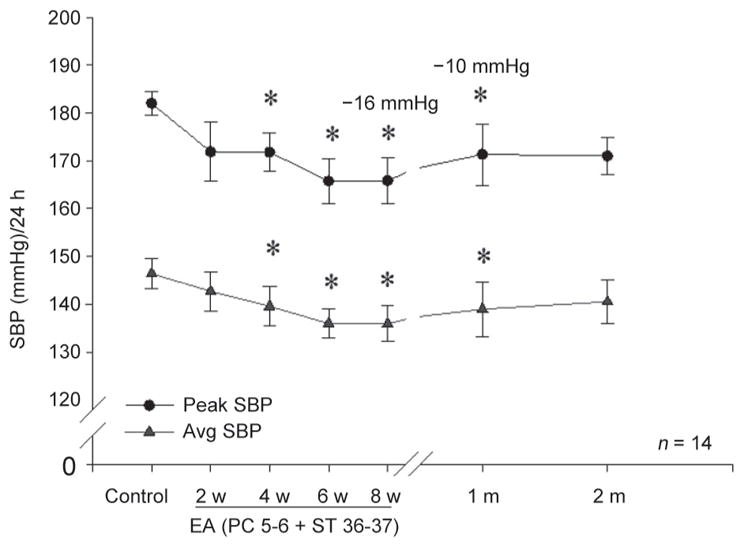
Effect of EA on SBP was evaluated for two months during the follow-up study in 14 patients. Peak and average SBPs were reduced for one-month following the EA (PC5-6 + ST36-37) therapy. Peak and average SBPs were reduced at weeks six and eight during EA treatment. Significant decrease in SBP is indicated with (*)[45]. w, week(s).
Fig. 8
Fig. 8
Pilot data showing action of EA over a six-month period assessed during monthly reinforcement therapy in subgroup of six hypertensive subjects. Following a course of eight weeks of weekly acupuncture therapy, continued monthly EA treatment maintained a low systolic blood pressure relative to pre-EA control (Significant decrease in SBP is indicated with *)[45]. w, week(s); m, month(s).
Fig. 9
Fig. 9
EA modulation of plasma norepinephrine and renin activity. Norepinephrine in 25 hypertensive patients was measured before and after eight weeks of treatment with EA at PC5-6 + ST36-37. Baseline norepinephrine was higher before EA (**P < 0.05) and decreased by 164 ng/mL in subjects responsive to EA (*P < 0.05). Norepinephrine was not altered by eight weeks of EA treatment in twelve patients unresponsive to EA. Renin activity in all 13 of 22 hypertensive patients responsive to EA at PC5-6+ST36-37 was decreased significantly after eight weeks of treatment (*P < 0.05). Nine low-responders to EA with lower renin activities before EA were unchanged by eight weeks of EA therapy[45]. w, week(s).

References

    1. Yoon SS, Carroll MD, Fryar CD. Hypertension Prevalence and Control Among Adults: United States, 2011–2014. NCHS Data Brief. 2015;(220):1–8. - PubMed
    1. Gao Y, Chen G, Tian H, Lin L, Lu J, Weng J, Jia W, Ji L, Xiao J, Zhou Z, Ran X, Ren Y, Chen T, Yang W. Prevalence of hypertension in china: a cross-sectional study. PLoS One. 2013;8:e65938. - PMC - PubMed
    1. Fryar CD, Chen TC, Li X. Prevalence of uncontrolled risk factors for cardiovascular disease: United States, 1999–2010. 2012;(103):1–8. - PubMed
    1. Roger VL, Go AS, Lloyd-Jones DM, Benjamin EJ, Berry JD, Borden WB, Bravata DM, Dai S, Ford ES, Fox CS, Fullerton HJ, Gillespie C, Hailpern SM, Heit JA, Howard VJ, Kissela BM, Kittner SJ, Lackland DT, Lichtman JH, Lisabeth LD, Makuc DM, Marcus GM, Marelli A, Matchar DB, Moy CS, Mozaffarian D, Mussolino ME, Nichol G, Paynter NP, Soliman EZ, Sorlie PD, Sotoodehnia N, Turan TN, Virani SS, Wong ND, Woo D, Turner MB. Heart disease and stroke statistics--2012 update: a report from the American Heart Association. Circulation. 2012;125:e2–e220. - PMC - PubMed
    1. Lewington S, Lacey B, Clarke R, Guo Y, Kong XL, Yang L, Chen Y, Bian Z, Chen J, Meng J, Xiong Y, He T, Pang Z, Zhang S, Collins R, Peto R, Li L, Chen Z. The burden of hypertension and associated risk for cardiovascular mortality in China. JAMA Intern Med. 2016;176:524–532. - PubMed