


Pulmonary Hypertension Due to Left Ventricular Cardiomyopathy: Is it the Result or Cause of Disease Progression?
- PMID: 29063280
- PMCID: PMC5846484
- DOI: 10.1007/s11897-017-0368-2
Pulmonary Hypertension Due to Left Ventricular Cardiomyopathy: Is it the Result or Cause of Disease Progression?
Abstract
Purpose of review: The purpose of this review is to define pulmonary hypertension in the setting of left heart disease (PH-LHD), discuss its epidemiology and pathophysiology, and highlight the cause and effect relationship it has with disease progression in the setting of cardiomyopathy.
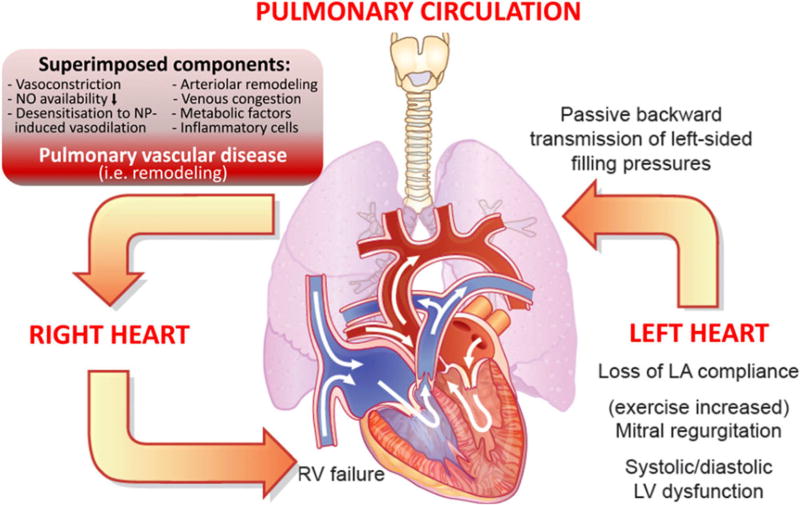
Recent findings: Both pulmonary hypertension (PH) and heart failure are becoming increasingly common. As such, PH-LHD is now the most common form of PH. The pathophysiology of the condition relates to backward transmission of elevated left ventricular filling pressures into the pulmonary circulation and, ultimately, right ventricular (RV) strain/dysfunction. It is evident that these pathophysiologic processes are both the effect and cause of left heart disease progression. In this review, we describe the complex relationship between disease progression in left ventricular cardiomyopathy and PH-LHD. Clinicians and researchers should take note of the importance of PH-LHD and RV dysfunction to appropriately risk stratify patients and develop therapies for the condition.
Keywords: Cardiomyopathy; Heart failure; Left heart disease; Pulmonary hypertension; Valvular heart disease; WHO group 2.
Conflict of interest statement
Figures
References
-
- Mazurek JA, Jessup M. Understanding heart failure. Heart Fail Clin. 2017;13:1–19. https://doi.org/10.1016/j.hfc.2016.07.001. - DOI - PubMed
-
- Mozaffarian D, Benjamin EJ, Go AS, Arnett DK, Blaha MJ, Cushman M, et al. Heart disease and stroke statistics—2016 update. Circulation. 2015 CIR.0000000000000350; https://doi.org/10.1161/CIR.0000000000000350. - DOI - PubMed
-
- Yancy CW, Jessup M, Bozkurt B, Butler J, Casey DE, Drazner MH, et al. 2013 ACCF/AHA Guideline for the Management of Heart Failure: a report of the American College of Cardiology Foundation/American Heart Association Task Force on Practice Guidelines. J Am Coll Cardiol. 2013;62:e147–239. https://doi.org/10.1016/j.jacc.2013.05.019. - DOI - PubMed
-
- Galiè N, Humbert M, Vachiery J-L, Gibbs S, Lang I, Torbicki A, et al. 2015 ESC/ERS guidelines for the diagnosis and treatment of pulmonary hypertension The Joint Task Force for the Diagnosis and Treatment of Pulmonary Hypertension of the European Society of Cardiology (ESC) and the European Respiratory Society (ERS): endorsed by: Association for European Paediatric and Congenital Cardiology (AEPC), International Society for Heart and Lung Transplantation (ISHLT) Eur Heart J. 2016;37:67–119. https://doi.org/10.1093/eurheartj/ehv317. This is an excellent recent guideline document on the topic of pulmonary hypertension. - DOI - PubMed
-
- Vachiéry J-L, Adir Y, Barberà JA, Champion H, Coghlan JG, Cottin V, et al. Pulmonary hypertension due to left heart diseases. J Am Coll Cardiol. 2013;62:D100–8. https://doi.org/10.1016/j.jacc.2013.10.033. - DOI - PubMed
Publication types
MeSH terms
Grants and funding
LinkOut - more resources
Full Text Sources
Other Literature Sources
Medical
Research Materials
