. 2017 Sep;32(9):807-850.
doi: 10.1007/s10654-017-0321-4. Epub 2017 Oct 24.

The Rotterdam Study: 2018 update on objectives, design and main results

Affiliations

The Rotterdam Study: 2018 update on objectives, design and main results

M Arfan Ikram et al. Eur J Epidemiol. 2017 Sep.

Abstract

The Rotterdam Study is a prospective cohort study ongoing since 1990 in the city of Rotterdam in The Netherlands. The study targets cardiovascular, endocrine, hepatic, neurological, ophthalmic, psychiatric, dermatological, otolaryngological, locomotor, and respiratory diseases. As of 2008, 14,926 subjects aged 45 years or over comprise the Rotterdam Study cohort. Since 2016, the cohort is being expanded by persons aged 40 years and over. The findings of the Rotterdam Study have been presented in over 1500 research articles and reports (see www.erasmus-epidemiology.nl/rotterdamstudy ). This article gives the rationale of the study and its design. It also presents a summary of the major findings and an update of the objectives and methods.

Keywords: Biomarkers; Cardiovascular diseases; Cohort study; Dermatological diseases; Endocrine diseases; Epidemiologic methods; Genetic epidemiology; Liver diseases; Neurological diseases; Oncology; Ophthalmic diseases; Otolaryngological diseases; Pharmacoepidemiology; Psychiatric diseases; Renal diseases; Respiratory diseases.


Figures
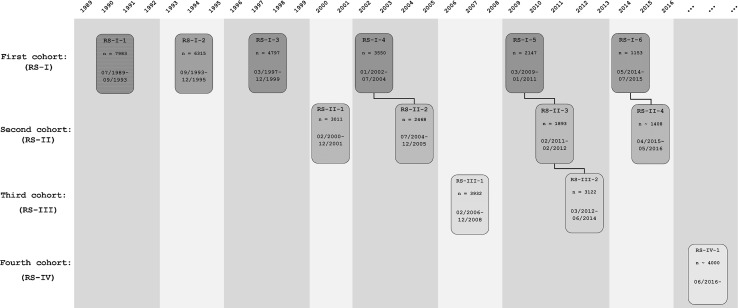
Fig. 1
Fig. 1
Diagram of examination cycles of the Rotterdam Study (RS). RS-I-1 refers to the baseline examination of the original cohort (pilot phase 07/1989–12/1989; cohort recruitment 01/1990–09/1993). RS-I-2, RS-I-3, RS-I-4, RS-I-5, and RS-I-6 refer to re-examinations of the original cohort members. RS-II-1 refers to the extension of the cohort with persons from the study district that had become 55 years since the start of the study or those of 55 years or over that migrated into the study district. RS-II-2, RS-II-3, and RS-II-4 refer to re-examinations of the extension cohort. RS-III-1 refers to the baseline examination of all persons aged 45 years and over living in the study district that had not been examined already (i.e., mainly comprising those aged 45–60 years). RS-III-2 refers to the first re-examination of this third cohort. Examination RS-I-4 and RS-II-2 were conducted as one project and feature an identical research program. Similarly, examinations RS-I-5, RS-II-3, and RS-III-2 share the same program items. Also, examinations RS-I-6 and RS-II-4 are conducted as one project. RS-IV-1 refers to the baseline visit of a new cohort, established in summer 2016

References

    1. Oeppen J, Vaupel JW. Demography. Broken limits to life expectancy. Science. 2002;296(5570):1029–1031. doi: 10.1126/science.1069675. - DOI - PubMed
    1. Peto R, Doll R. There is no such thing as aging. BMJ. 1997;315(7115):1030–1032. doi: 10.1136/bmj.315.7115.1030. - DOI - PMC - PubMed
    1. Hofman A, Grobbee DE, de Jong PT, van den Ouweland FA. Determinants of disease and disability in the elderly: the Rotterdam Elderly Study. Eur J Epidemiol. 1991;7(4):403–422. doi: 10.1007/BF00145007. - DOI - PubMed
    1. Hofman A, Breteler MM, van Duijn CM, Krestin GP, Pols HA, Stricker BH, et al. The Rotterdam Study: objectives and design update. Eur J Epidemiol. 2007;22(11):819–829. doi: 10.1007/s10654-007-9199-x. - DOI - PMC - PubMed
    1. Hofman A, van Duijn CM, Franco OH, Ikram MA, Janssen HL, Klaver CC, et al. The Rotterdam Study: 2012 objectives and design update. Eur J Epidemiol. 2011;26(8):657–686. doi: 10.1007/s10654-011-9610-5. - DOI - PMC - PubMed

Publication types
