


Engineering nucleic acid structures for programmable molecular circuitry and intracellular biocomputation
- PMID: 29064489
- PMCID: PMC11421837
- DOI: 10.1038/nchem.2852
Engineering nucleic acid structures for programmable molecular circuitry and intracellular biocomputation
Abstract
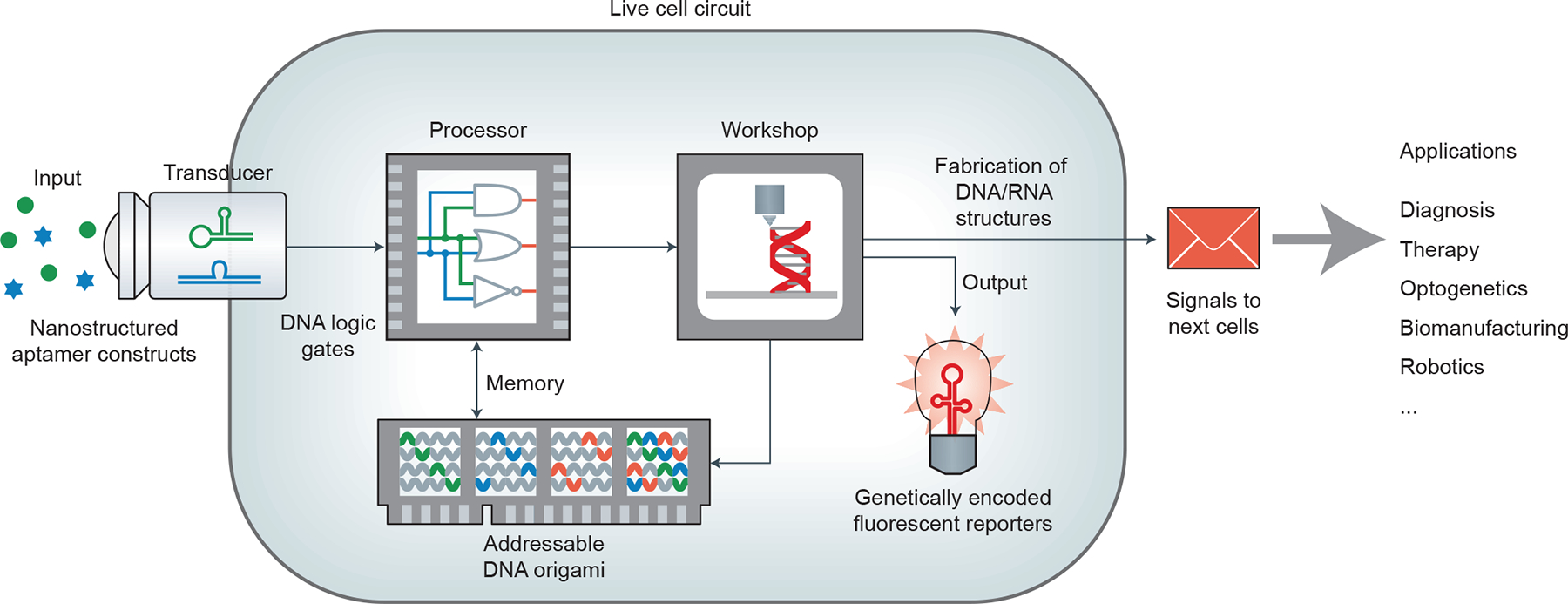
Nucleic acids have attracted widespread attention due to the simplicity with which they can be designed to form discrete structures and programmed to perform specific functions at the nanoscale. The advantages of DNA/RNA nanotechnology offer numerous opportunities for in-cell and in-vivo applications, and the technology holds great promise to advance the growing field of synthetic biology. Many elegant examples have revealed the potential in integrating nucleic acid nanostructures in cells and in vivo where they can perform important physiological functions. In this Review, we summarize the current abilities of DNA/RNA nanotechnology to realize applications in live cells and then discuss the key problems that must be solved to fully exploit the useful properties of nanostructures. Finally, we provide viewpoints on how to integrate the tools provided by DNA/RNA nanotechnology and related new technologies to construct nucleic acid nanostructure-based molecular circuitry for synthetic biology.
Conflict of interest statement
Competing financial interests
The authors declare no competing financial interests.
Figures


References
-
- Jones MR, Seeman NC & Mirkin CA Programmable materials and the nature of the DNA bond. Science 347, 1260901 (2015). - PubMed
-
- Gerling T, Wagenbauer KF, Neuner AM & Dietz H Dynamic DNA devices and assemblies formed by shape-complementary, non-base pairing 3D components. Science 347, 1446–1452 (2015). - PubMed
-
- Wilner OI et al. Enzyme cascades activated on topologically programmed DNA scaffolds. Nat. Nanotechnol 4, 249–254 (2009). - PubMed
Publication types
MeSH terms
Substances
Grants and funding
LinkOut - more resources
Full Text Sources
Other Literature Sources
