


Genetic diversity and connectivity in the East African giant mud crab Scylla serrata: Implications for fisheries management
- PMID: 29065166
- PMCID: PMC5655608
- DOI: 10.1371/journal.pone.0186817
Genetic diversity and connectivity in the East African giant mud crab Scylla serrata: Implications for fisheries management
Abstract
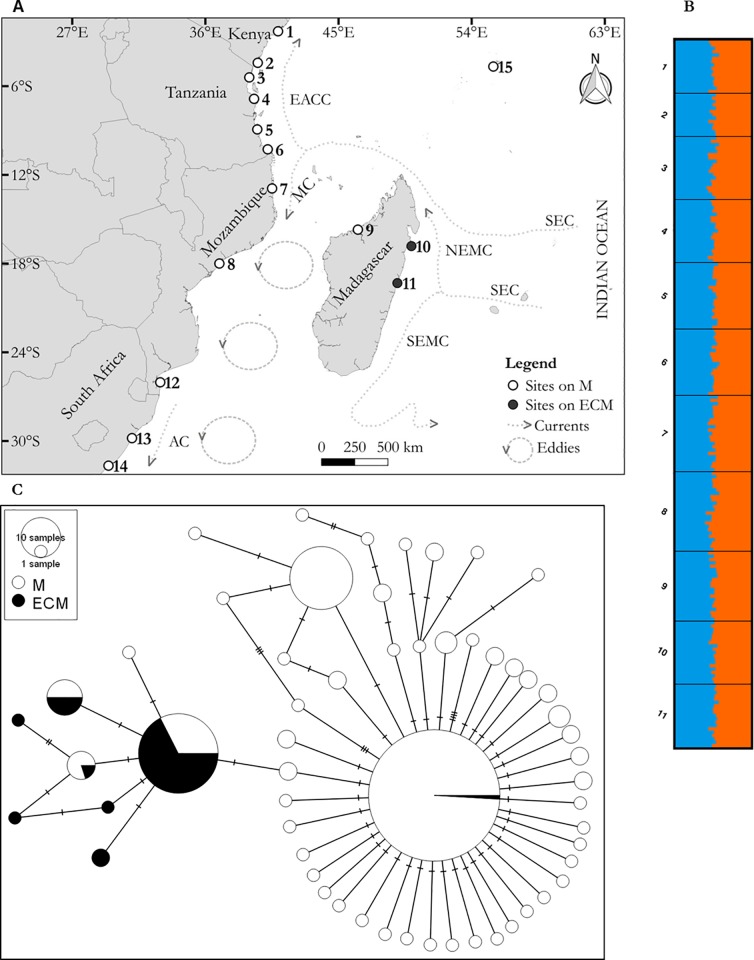
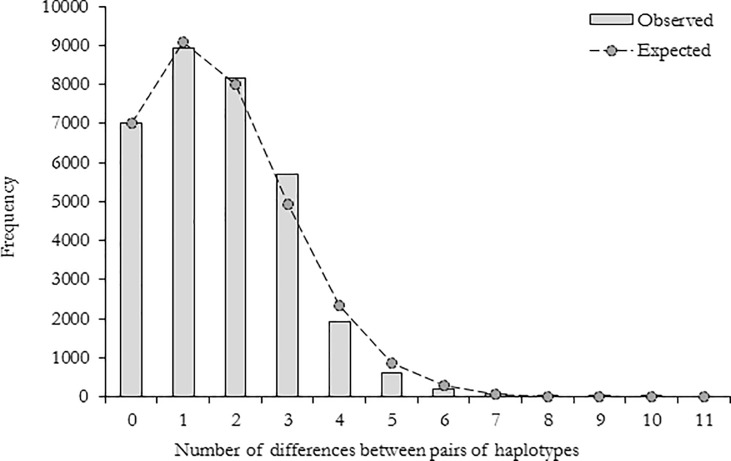
The giant mud crab Scylla serrata provides an important source of income and food to coastal communities in East Africa. However, increasing demand and exploitation due to the growing coastal population, export trade, and tourism industry are threatening the sustainability of the wild stock of this species. Because effective management requires a clear understanding of the connectivity among populations, this study was conducted to assess the genetic diversity and connectivity in the East African mangrove crab S. serrata. A section of 535 base pairs of the cytochrome oxidase subunit I (COI) gene and eight microsatellite loci were analysed from 230 tissue samples of giant mud crabs collected from Kenya, Tanzania, Mozambique, Madagascar, and South Africa. Microsatellite genetic diversity (He) ranged between 0.56 and 0.6. The COI sequences showed 57 different haplotypes associated with low nucleotide diversity (current nucleotide diversity = 0.29%). In addition, the current nucleotide diversity was lower than the historical nucleotide diversity, indicating overexploitation or historical bottlenecks in the recent history of the studied population. Considering that the coastal population is growing rapidly, East African countries should promote sustainable fishing practices and sustainable use of mangrove resources to protect mud crabs and other marine fauna from the increasing pressure of exploitation. While microsatellite loci did not show significant genetic differentiation (p > 0.05), COI sequences revealed significant genetic divergence between sites on the East coast of Madagascar (ECM) and sites on the West coast of Madagascar, mainland East Africa, as well as the Seychelles. Since East African countries agreed to achieve the Convention on Biological Diversity (CBD) target to protect over 10% of their marine areas by 2020, the observed pattern of connectivity and the measured genetic diversity can serve to provide useful information for designing networks of marine protected areas.
Conflict of interest statement
Figures
References
-
- Richmond MD, editor. A Field Guide to the sea shores of Eastern Africa and the Western Indian Ocean Islands. 2nd ed. Sida/SAREC-UDSM; 2002.
-
- Mirera DO. Trends in exploitation, development and management of artisanal mud crab (Scylla serrata-Forsskal-1775) fishery and small-scale culture in Kenya: An overview. Ocean Coast Manag. 2011;54: 844–855. doi: 10.1016/j.ocecoaman.2011.08.001 - DOI
-
- Ewel KC, Rowe S, McNaughton B, Bonine KM. Characteristics of Scylla spp. (Decapoda: Portunidae) and their mangrove forest habitat in Ngaremeduu Bay, Republic of Palau. Pacific Sci. 2009;63: 15–26. doi: 10.2984/1534-6188(2009)63[15:COSSDP]2.0.CO;2 - DOI
-
- Alberts-Hubatsch H, Lee SY, Meynecke J-O, Diele K, Nordhaus I, Wolff M. Life-history, movement, and habitat use of Scylla serrata (Decapoda, Portunidae): current knowledge and future challenges. Hydrobiologia. 2016;763: 5–21. doi: 10.1007/s10750-015-2393-z - DOI
-
- Meynecke J., Richards R. A full life cycle and spatially explicit individual-based model for the giant mud crab (Scylla serrata): a case study from a marine protected area. ICES J Mar Sci. 2014;71: 484–498. doi: 10.1093/icesjms/fst034 - DOI
MeSH terms
LinkOut - more resources
Full Text Sources
Other Literature Sources
