. 2017 Oct 21;18(10):2208.
doi: 10.3390/ijms18102208.

Human Globozoospermia-Related Gene Spata16 Is Required for Sperm Formation Revealed by CRISPR/Cas9-Mediated Mouse Models

Affiliations

Human Globozoospermia-Related Gene Spata16 Is Required for Sperm Formation Revealed by CRISPR/Cas9-Mediated Mouse Models

Yoshitaka Fujihara et al. Int J Mol Sci. .

Abstract

A recent genetic analysis of infertile globozoospermic patients identified causative mutations in three genes: a protein interacting with C kinase 1 (PICK1), dpy 19-like 2 (DPY19L2), and spermatogenesis associated 16 (SPATA16). Although mouse models have clarified the physiological functions of Pick1 and Dpy19l2 during spermatogenesis, Spata16 remains to be determined. Globozoospermic patients carried a homozygous point mutation in SPATA16 at 848G→A/R283Q. We generated CRISPR/Cas9-mediated mutant mice with the same amino acid substitution in the fourth exon of Spata16 to analyze the mutation site at R284Q, which corresponded with R283Q of mutated human SPATA16. We found that the point mutation in Spata16 was not essential for male fertility; however, deletion of the fourth exon of Spata16 resulted in infertile male mice due to spermiogenic arrest but not globozoospermia. This study demonstrates that Spata16 is indispensable for male fertility in mice, as well as in humans, as revealed by CRISPR/Cas9-mediated mouse models.

Keywords: genome editing; male infertility; mouse model; point mutation; spermatogenesis; testis.


Conflict of interest statement

The authors declare no conflict of interest.

Figures
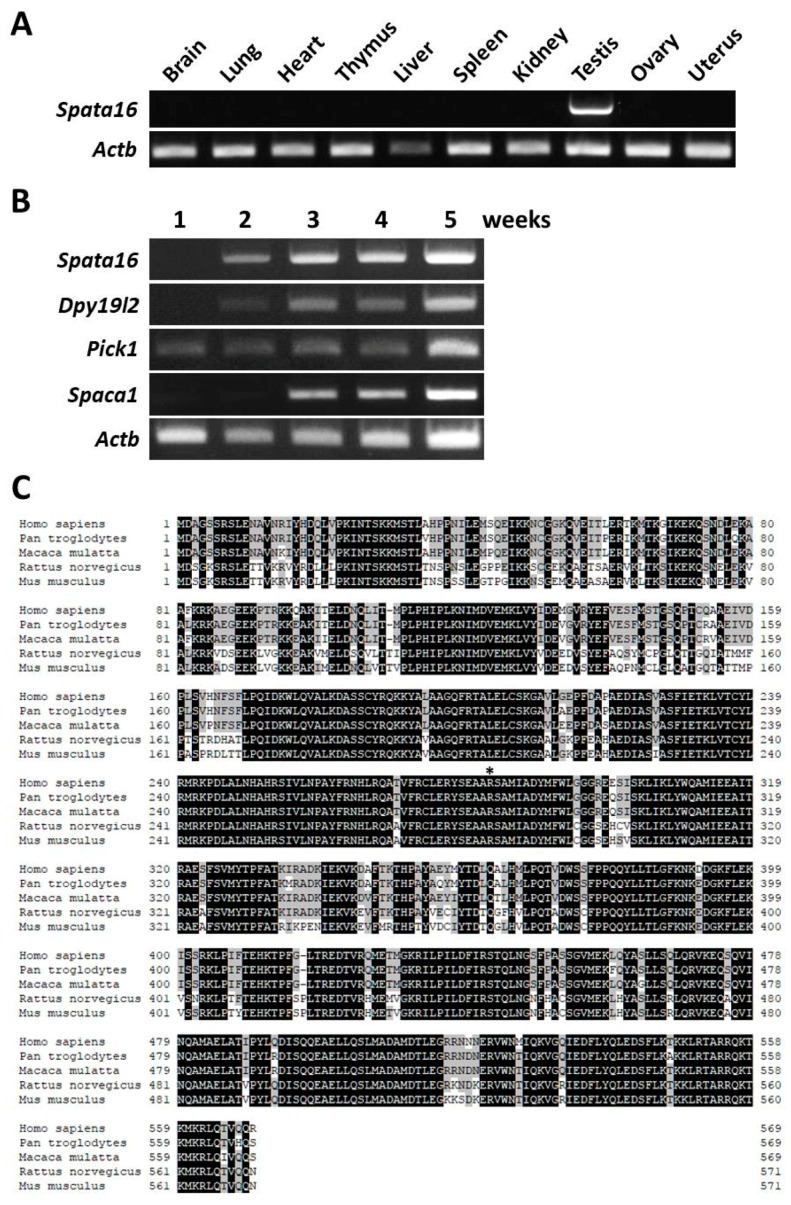
Figure 1
Figure 1
Characterization of mouse Spata16. (A) Testis-specific expression of Spata16 by multi-tissue RT-PCR analysis. The expression of mouse Spata16 was examined by RT-PCR using RNA isolated from various organs. Spata16 was only detected in the testis. The Actb gene was used as an expression control; (B) RT-PCR analysis of Spata16 and other globozoospermia-related genes in the mouse testis. Spata16 and Dpy19l2 were first expressed in a two-week-old testis. The onset of Spata16 expression occurred prior to that of Spaca1 encoding a sperm acrosomal protein; (C) Sequence similarity of SPATA16 protein in mammals. Black indicates a match in all species. Gray indicates a match among at least three species. The 283rd arginine residue of human SPATA16 as previously reported [3] is indicated by an asterisk. 79% of the SPATA16 amino acid sequence is identical between humans and mice.
Figure 2
Figure 2
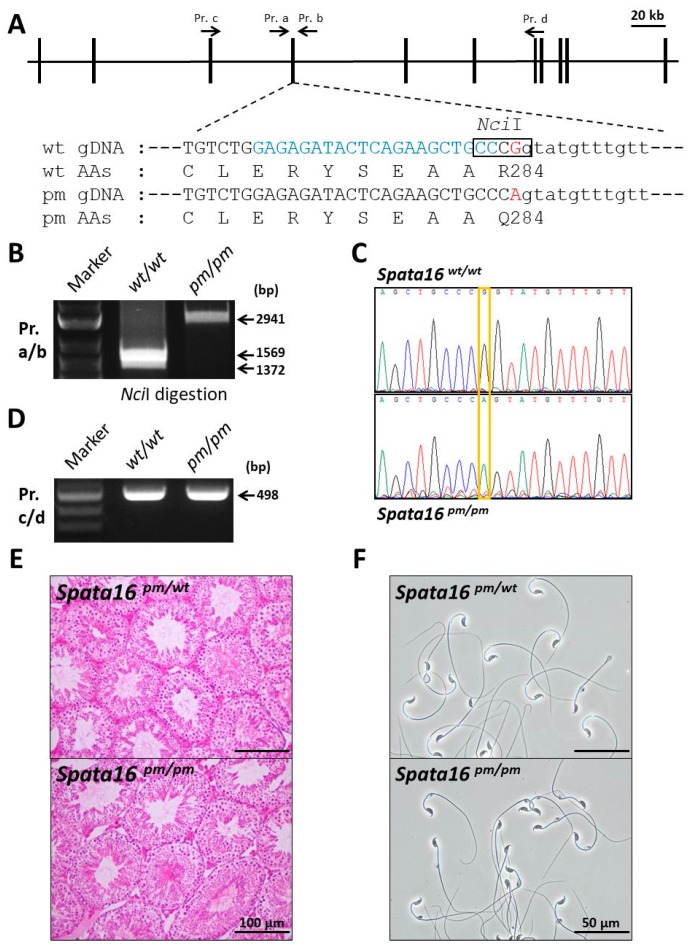
Targeted point mutation (851G→A, R284Q) of Spata16 by CRISPR/Cas9. (A) Targeting scheme of the point mutation (851G→A, R284Q) in the fourth exon of mouse Spata16. Spata16 consists of eleven exons. The point mutation was introduced into mouse ES cells using the HDR donor plasmid with 0.5 kb homology arms. Blue indicates the sgRNA sequence. Red indicates a G→A mutation at the last nucleotide (851st coding exon) of the fourth exon of Spata16. Capital and small letters indicate nucleotides of exons and introns, respectively; (B) The genotyping of point-mutant mice by NciI digestion. The NciI recognition site (5′-CCCGG-3′) was disrupted due to the G→A mutation of the fourth exon. In wild-type mice, two bands (1372 bp and 1569 bp) were detected after NciI digestion; (C) Direct sequencing of PCR products in Spata16pm/pm mice. The G→A mutation at the last nucleotide (851st coding exon) of the fourth exon is indicated by the orange square; (D) RT-PCR analysis of a testis in Spata16pm/pm mice. The 498-bp band was amplified from wild-type and Spata16pm/pm mice. A point mutation causing an inappropriate splicing was not found in Spata16pm/pm mouse testes; (E) Representative testicular histology sections stained with hematoxylin and eosin. Spermatogenesis in Spata16pm/pm mice looked normal compared with that in Spata16pm/wt mice. Scale bars: 100 μm; (F) Cauda epididymal spermatozoa from Spata16pm/wt and Spata16pm/pm mice. There were no sperm morphology differences between Spata16pm/wt and Spata16pm/pm mice. Spata16pm/pm males were fertile. Scale bars: 50 μm.
Figure 3
Figure 3
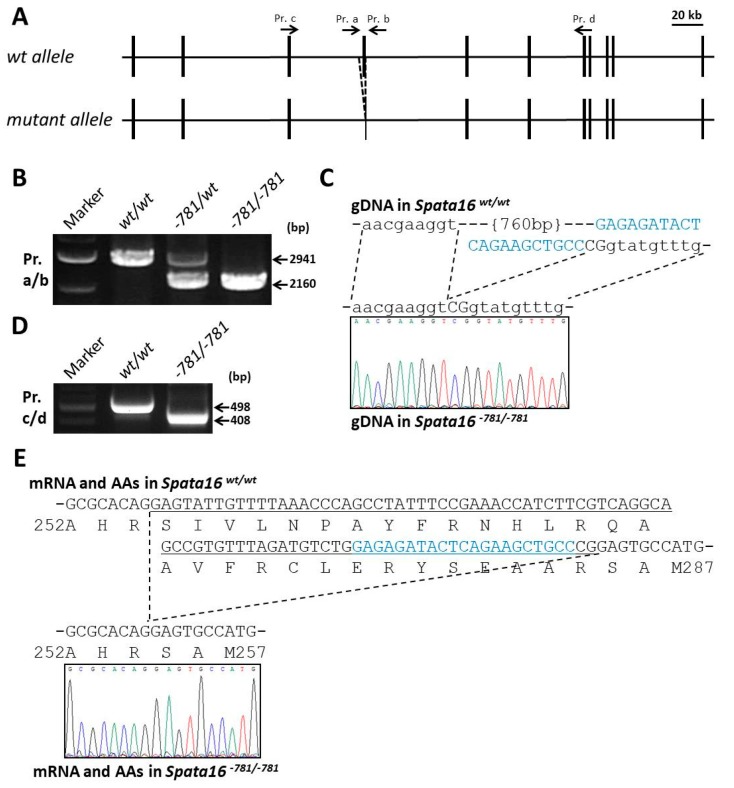
781-bp deletion of Spata16 by CRISPR/Cas9. (A) Targeting scheme of the 781-bp deletion in the mouse Spata16 locus; (B) The genotyping of Spata16−781/−781 mice by PCR analysis. Both the wild-type allele band at 2941 bp and the deleted allele band at 2160 bp were amplified by PCR; (C) Direct sequencing of the 781-bp deletion around the Spata16 fourth exon. Capital and small letters indicate nucleotides of the exon and intron, respectively. Blue indicates the sgRNA sequence; (D) RT-PCR analysis of a testis in Spata16−781/−781 mice. The 498-bp and 408-bp bands were amplified from wild-type and Spata16−781/−781 mice, respectively; (E) Direct sequencing of Spata16 mRNAs in wild-type and Spata16−781/−781 mice. The 781-bp deletion around the fourth exon in Spata16−781/−781 mice caused the mis-translation of the remaining 2 bp (5′-CG-3′) of the mutant fourth exon. Blue indicates the sequence of the sgRNA.
Figure 4
Figure 4
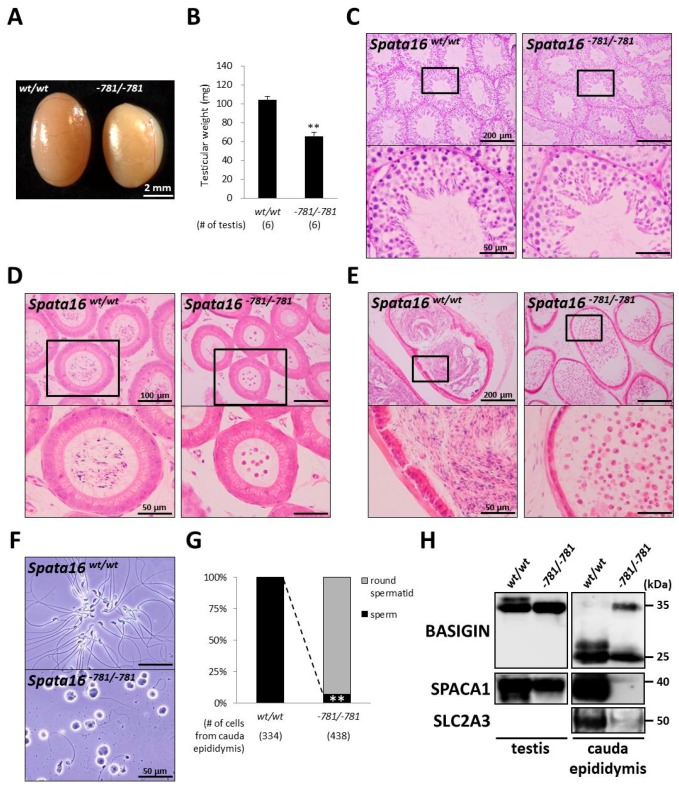
Spermiogenic arrest in Spata16−781/−781 mice. (A) Testes in wild-type and Spata16−781/−781 mice. Scale bar: 2 mm; (B) Testicular weights in wild-type and Spata16−781/−781 mice. Testicular weights in Spata16−781/−781 mice were significantly reduced compared with those in wild-type mice. ** p < 0.005; (C) PAS staining of testicular sections. Lower figures are magnified images of the boxes indicated in the upper figures. Scale bars: upper; 200 μm and lower; 50 μm; (D) HE stained sections of caput epididymis. Lower figures are magnified images of the boxes indicated in the upper figures. Scale bars: upper; 100 μm and lower; 50 μm; (E) HE stained sections of cauda epididymis. Lower figures are magnified images of the boxes indicated in the upper figures. Scale bars: upper; 200 μm and lower; 50 μm; (F) Observation of cells extracted from cauda epididymis. Scale bars: 50 μm; (G) Quantitative morphometric analysis of round spermatid and sperm from cauda epididymis. Dashed line indicates a significant reduction in sperm-like cells extracted from the cauda epididymis in Spata16−781/−781 mice. ** p < 0.005; (H) Immunoblot analysis of cell lysates collected from a testis and cauda epididymis. Sperm acrosomal protein SPACA1 remained in the Spata16−781/−781 mouse testis. In cauda epididymal lysates from Spata16−781/−781 mice, the aberrant retention of testicular BASIGIN was detected and sperm tail-specific protein SLC2A3 and SPACA1 were decreased. Spata16−781/−781 male mice were sterile because of a spermiogenic arrest. 20 μg of cell lysates were loaded in each lane.

References

    1. Elinati E., Kuentz P., Redin C., Jaber S., Vanden Meerschaut F., Makarian J., Koscinski I., Nasr-Esfahani M.H., Demirol A., Gurgan T., et al. Globozoospermia is mainly due to DPY19L2 deletion via non-allelic homologous recombination involving two recombination hotspots. Hum. Mol. Genet. 2012;21:3695–3702. doi: 10.1093/hmg/dds200. - DOI - PubMed
    1. Liu G., Shi Q.W., Lu G.X. A newly discovered mutation in PICK1 in a human with globozoospermia. Asian J. Androl. 2010;12:556–560. doi: 10.1038/aja.2010.47. - DOI - PMC - PubMed
    1. Dam A.H., Koscinski I., Kremer J.A., Moutou C., Jaeger A.S., Oudakker A.R., Tournaye H., Charlet N., Lagier-Tourenne C., van Bokhoven H., et al. Homozygous mutation in SPATA16 is associated with male infertility in human globozoospermia. Am. J. Hum. Genet. 2007;81:813–820. doi: 10.1086/521314. - DOI - PMC - PubMed
    1. Coutton C., Escoffier J., Martinez G., Arnoult C., Ray P.F. Teratozoospermia: Spotlight on the main genetic actors in the human. Hum. Reprod. Updat. 2015;21:455–485. doi: 10.1093/humupd/dmv020. - DOI - PubMed
    1. Dam A.H., Feenstra I., Westphal J.R., Ramos L., van Golde R.J., Kremer J.A. Globozoospermia revisited. Hum. Reprod. Updat. 2007;13:63–75. doi: 10.1093/humupd/dml047. - DOI - PubMed

MeSH terms