Review
. 2017 Oct 21;9(10):309.
doi: 10.3390/v9100309.

The Battle of RNA Synthesis: Virus versus Host

Affiliations
Review

The Battle of RNA Synthesis: Virus versus Host

Alex Harwig et al. Viruses. .

Abstract

Transcription control is the foundation of gene regulation. Whereas a cell is fully equipped for this task, viruses often depend on the host to supply tools for their transcription program. Over the course of evolution and adaptation, viruses have found diverse ways to optimally exploit cellular host processes such as transcription to their own benefit. Just as cells are increasingly understood to employ nascent RNAs in transcription regulation, recent discoveries are revealing how viruses use nascent RNAs to benefit their own gene expression. In this review, we first outline the two different transcription programs used by viruses, i.e., transcription (DNA-dependent) and RNA-dependent RNA synthesis. Subsequently, we use the distinct stages (initiation, elongation, termination) to describe the latest insights into nascent RNA-mediated regulation in the context of each relevant stage.

Keywords: Epstein-Barr virus; HIV-1; RNA polymerase II; RNA-dependent RNA polymerase; influenza; nascent RNA; respiratory syncytial virus; transcription.


Conflict of interest statement

The authors declare no conflict of interest.

Figures
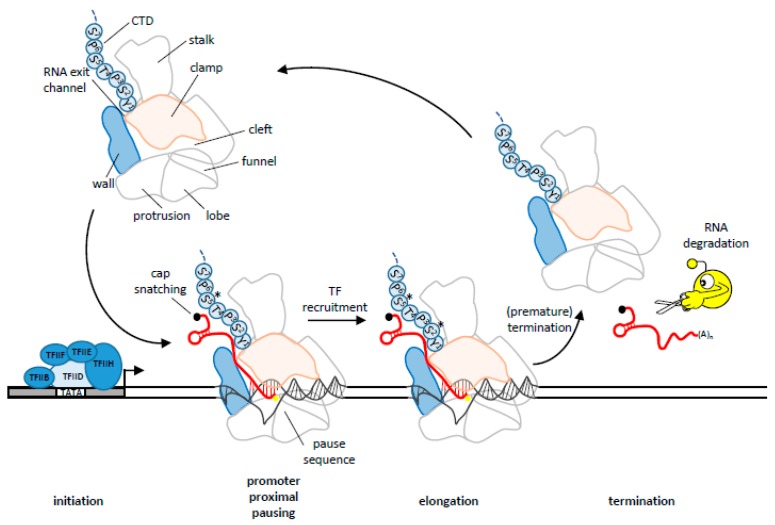
Figure 1
Figure 1
Transcription cycle. A cartoon depiction of RNA polymerase II (RNAPII) is shown in the upper left, with several domains and modules labelled. The clamp and wall (flap in prokaryotes) modules that make up the RNA-exit channel are depicted in pink and blue, respectively. The first repeat of the RNAPII C-terminal domain (CTD) is shown as a string of amino acids with their respective numbers. Next, the stages of the transcription cycle are shown, with the viral interfering mechanisms. First, general transcription factors assemble at the promoter and direct RNAPII towards the transcription start site. Transcription factor (TF) IIH phosphorylates the RNAPII at Ser5 (black asterisk). TFIIH opens the DNA template, forming the transcription bubble, permitting RNAPII to begin transcribing RNA in its active center (yellow dot). Upon transcribing the first 20–60 nucleotides, most RNAP will pause. Transcription factor recruitment regulates these transcription kinetics and phosphorylate RNAPII at Ser2. When the correct signal is encountered, RNAPII will terminate transcription and release the RNA. Some viruses encode endonucleases (yellow sphere with scissor) that can cleave RNAs, causing RNA degradation.
Figure 2
Figure 2
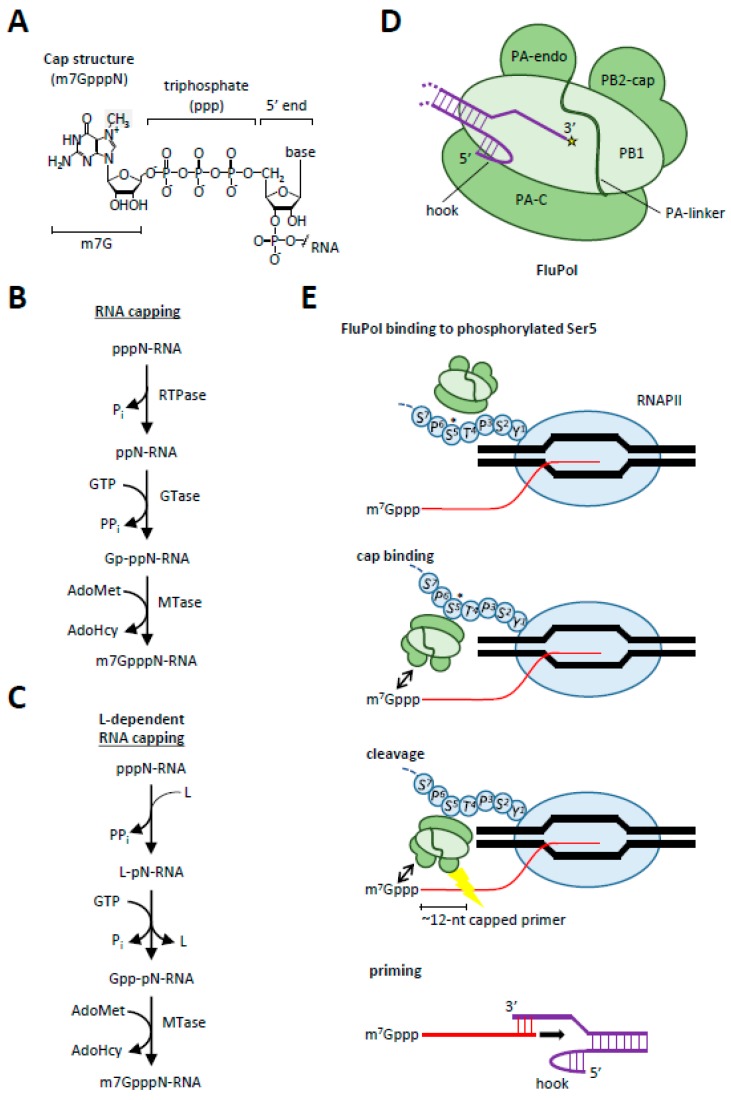
Capping mechanisms in RNA viruses. (A) The eukaryotic mRNA cap consists of a 7-methylguanosine linked to the initiator nucleoside of mRNA through the 5′-5′ triphosphate bridge. The methyl group at the N7 position of the guanosine is shaded gray; (B) the conventional RNA capping pathway; (C) the L-dependent capping pathway utilized by negative-sense ssRNA viruses; (D) the FluPol complex with the polymerase acidic endonuclease (PA-endo), PA C-terminal (PA-C), polymerase basic 2 cap-binding (PB2-cap) and PB1 domains indicated. The influenza viral RNA (vRNA; purple) is circularized with the extreme 5′ end docked in a pocket formed by PA-C and PB1 and the 3′ end loaded in the FluPol active center (yellow star); (E) the first step in cap-snatching is the recognition and binding of FluPol to the phosphorylated Ser5 of RNAPII through its PA-C domain. This will allow the PB2-cap domain to bind the cap and to direct the nascent RNA towards PA-endo. After cleavage the nascent RNA will be loaded into the active domain of FluPol where it will be used to prime the 3′ end of the vRNA, allowing elongation of the RNA primer from 5′ to 3′ direction (indicated with black arrow).
Figure 3
Figure 3
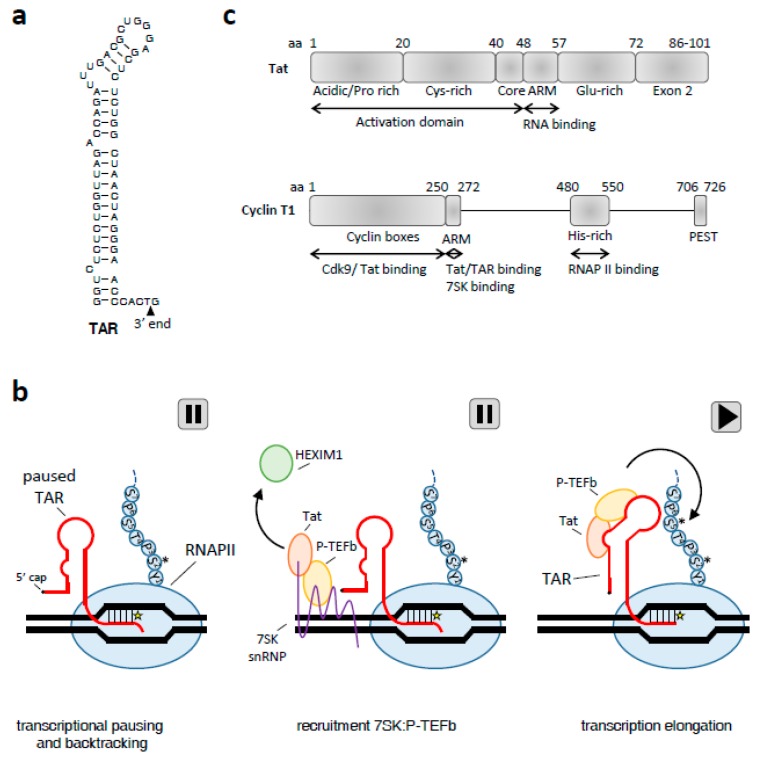
Factors involved in HIV-1 transcription and initiation. (a) Structure of the TAR hairpin; (b) model of RNAPII pausing (indicated with “II” button for pause) and reactivation (black triangle) upon TAR transcription. Phosphorylation of the CTD domain of RNAPII is indicated (black asterisk). The catalytic center of RNAPII is positioned at the yellow star. 7SK snRNA is depicted in purple. See the main text for more details; (c) domain organization of the viral Tat protein and positive transcription elongation factor b (P-TEFb) component Cyclin T1. Amino acid (aa) positions are indicated and the domain functions are described.
Figure 4
Figure 4
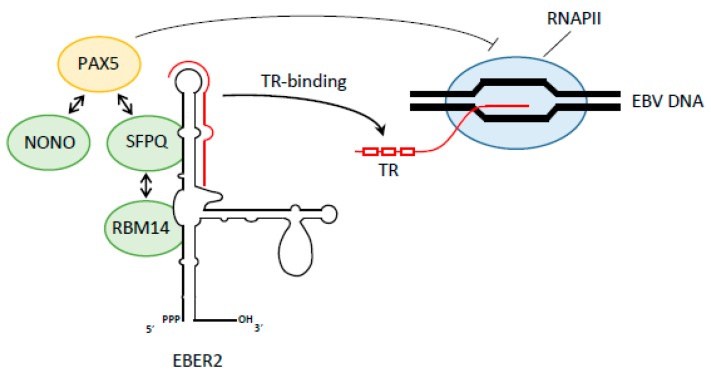
Factors involved in Epstein-Barr virus-encoded RNA (EBV EBER) transcription regulation. RNA structure of EBER2 non coding RNA (black) with the terminal region (TR) binding domain indicated in red. EBER2 recruits several protein factors to the nascent EBV RNA. See the text for more details.

References

    1. McLaughlin R.N., Malik H.S. Genetic conflicts: The usual suspects and beyond. J. Exp. Biol. 2017;220:6–17. doi: 10.1242/jeb.148148. - DOI - PMC - PubMed
    1. Emerman M., Malik H.S. Paleovirology—Modern consequences of ancient viruses. PLoS Biol. 2010;8:e1000301. doi: 10.1371/journal.pbio.1000301. - DOI - PMC - PubMed
    1. Blanco-Melo D., Gifford R.J., Bieniasz P.D. Co-option of an endogenous retrovirus envelope for host defense in hominid ancestors. Elife. 2017;6:e22519. doi: 10.7554/eLife.22519. - DOI - PMC - PubMed
    1. Iyer L.M., Balaji S., Koonin E.V., Aravind L. Evolutionary genomics of nucleo-cytoplasmic large DNA viruses. Virus Res. 2006;117:156–184. doi: 10.1016/j.virusres.2006.01.009. - DOI - PubMed
    1. Wei H., Zhou M.M. Viral-encoded enzymes that target host chromatin functions. Biochim. Biophys. Acta. 2010;1799:296–301. doi: 10.1016/j.bbagrm.2009.08.007. - DOI - PMC - PubMed

MeSH terms

LinkOut - more resources