


Patient-Specific Deep Architectural Model for ECG Classification
- PMID: 29065597
- PMCID: PMC5499251
- DOI: 10.1155/2017/4108720
Patient-Specific Deep Architectural Model for ECG Classification
Abstract
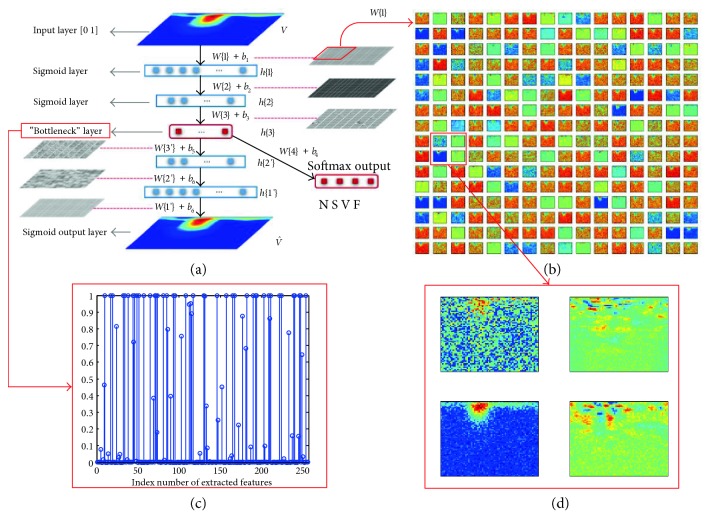
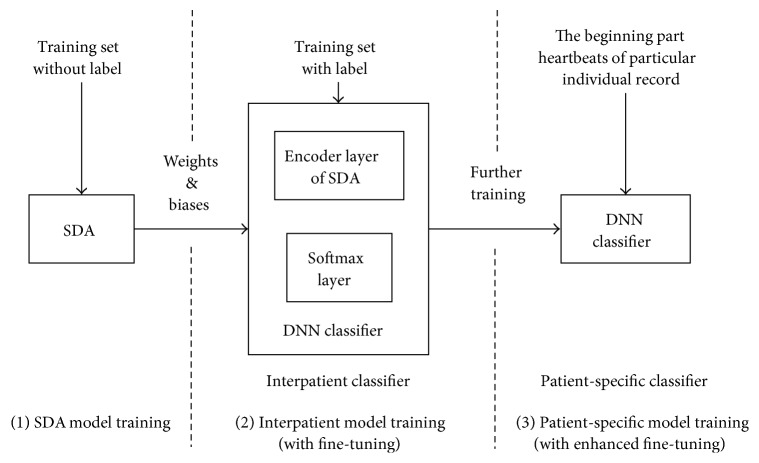
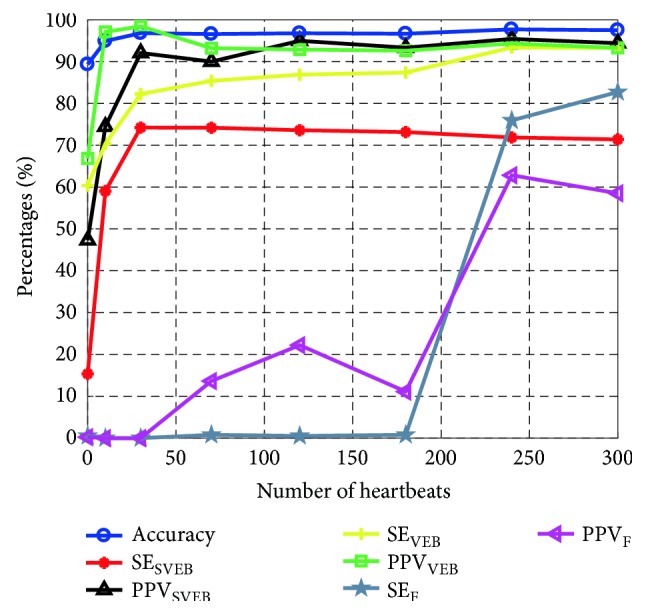
Heartbeat classification is a crucial step for arrhythmia diagnosis during electrocardiographic (ECG) analysis. The new scenario of wireless body sensor network- (WBSN-) enabled ECG monitoring puts forward a higher-level demand for this traditional ECG analysis task. Previously reported methods mainly addressed this requirement with the applications of a shallow structured classifier and expert-designed features. In this study, modified frequency slice wavelet transform (MFSWT) was firstly employed to produce the time-frequency image for heartbeat signal. Then the deep learning (DL) method was performed for the heartbeat classification. Here, we proposed a novel model incorporating automatic feature abstraction and a deep neural network (DNN) classifier. Features were automatically abstracted by the stacked denoising auto-encoder (SDA) from the transferred time-frequency image. DNN classifier was constructed by an encoder layer of SDA and a softmax layer. In addition, a deterministic patient-specific heartbeat classifier was achieved by fine-tuning on heartbeat samples, which included a small subset of individual samples. The performance of the proposed model was evaluated on the MIT-BIH arrhythmia database. Results showed that an overall accuracy of 97.5% was achieved using the proposed model, confirming that the proposed DNN model is a powerful tool for heartbeat pattern recognition.
Figures
Comment in
-
Machine Learning Theory and Applications for Healthcare.J Healthc Eng. 2017;2017:5263570. doi: 10.1155/2017/5263570. Epub 2017 Sep 27. J Healthc Eng. 2017. PMID: 29090076 Free PMC article. No abstract available.
References
-
- World Health Organization. Cardiovascular disease. 2013. http://www.who.int/cardiovascular_diseases/en/index.html.
-
- World Health Organization. From burden to “best buys”: reducing the economic impact of non-communicable disease in low-and middle-income countries. Program on the Global Demography of Aging. 2011 www.who.int/nmh/publications/best_buys_summary/en/
-
- Luo K., Li J., Wu J. A dynamic compression scheme for energy-efficient real-time wireless electrocardiogram biosensors. IEEE Transactions on Instrumentation and Measurement. 2014;63(9):2160–2169.
-
- Chen T., Mazomenos E. B., Maharatna K., Dasmahapatra S., Niranjan M. Design of a low-power on-body ECG classifier for remote cardiovascular monitoring systems. IEEE Journal on Emerging and Selected Topics in Circuits and Systems. 2013;3(1):75–85.
Publication types
MeSH terms
LinkOut - more resources
Full Text Sources
Other Literature Sources
Medical
