Review
. 2017 Nov;242(17):1714-1731.
doi: 10.1177/1535370217732766.

Circadian hormone control in a human-on-a-chip: In vitro biology's ignored component?

Affiliations
Review

Circadian hormone control in a human-on-a-chip: In vitro biology's ignored component?

Kevin J Cyr et al. Exp Biol Med (Maywood). 2017 Nov.

Abstract

Organs-on-Chips (OoCs) are poised to reshape dramatically the study of biology by replicating in vivo the function of individual and coupled human organs. Such microphysiological systems (MPS) have already recreated complex physiological responses necessary to simulate human organ function not evident in two-dimensional in vitro biological experiments. OoC researchers hope to streamline pharmaceutical development, accelerate toxicology studies, limit animal testing, and provide new insights beyond the capability of current biological models. However, to develop a physiologically accurate Human-on-a-Chip, i.e., an MPS homunculus that functions as an interconnected, whole-body, model organ system, one must couple individual OoCs with proper fluidic and metabolic scaling. This will enable the study of the effects of organ-organ interactions on the metabolism of drugs and toxins. Critical to these efforts will be the recapitulation of the complex physiological signals that regulate the endocrine, metabolic, and digestive systems. To date, with the exception of research focused on reproductive organs on chips, most OoC research ignores homuncular endocrine regulation, in particular the circadian rhythms that modulate the function of all organ systems. We outline the importance of cyclic endocrine regulation and the role that it may play in the development of MPS homunculi for the pharmacology, toxicology, and systems biology communities. Moreover, we discuss the critical end-organ hormone interactions that are most relevant for a typical coupled-OoC system, and the possible research applications of a missing endocrine system MicroFormulator (MES-µF) that could impose biological rhythms on in vitro models. By linking OoCs together through chemical messenger systems, advanced physiological phenomena relevant to pharmacokinetics and pharmacodynamics studies can be replicated. The concept of a MES-µF could be applied to other standard cell-culture systems such as well plates, thereby extending the concept of circadian hormonal regulation to much of in vitro biology. Impact statement Historically, cyclic endocrine modulation has been largely ignored within in vitro cell culture, in part because cultured cells typically have their media changed every day or two, precluding hourly adjustment of hormone concentrations to simulate circadian rhythms. As the Organ-on-Chip (OoC) community strives for greater physiological realism, the contribution of hormonal oscillations toward regulation of organ systems has been examined only in the context of reproductive organs, and circadian variation of the breadth of other hormones on most organs remains unaddressed. We illustrate the importance of cyclic endocrine modulation and the role that it plays within individual organ systems. The study of cyclic endocrine modulation within OoC systems will help advance OoC research to the point where it can reliably replicate in vitro key regulatory components of human physiology. This will help translate OoC work into pharmaceutical applications and connect the OoC community with the greater pharmacology and physiology communities.

Keywords: diurnal rhythms; endocrine; microformulator; organs-on-chips; pharmacology; toxicology.


Figures
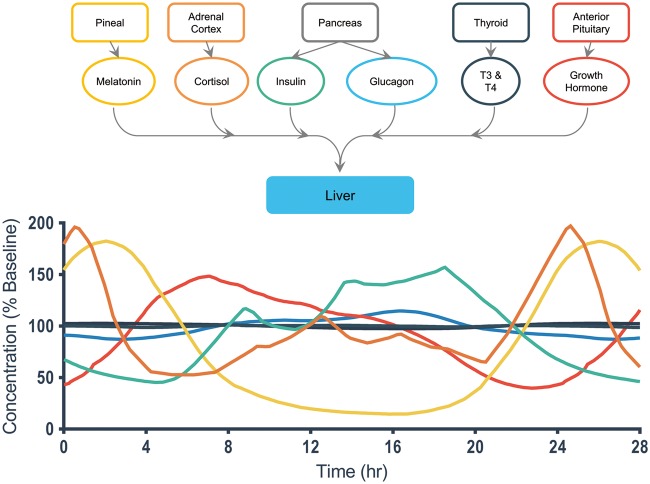
Figure 1.
Figure 1.
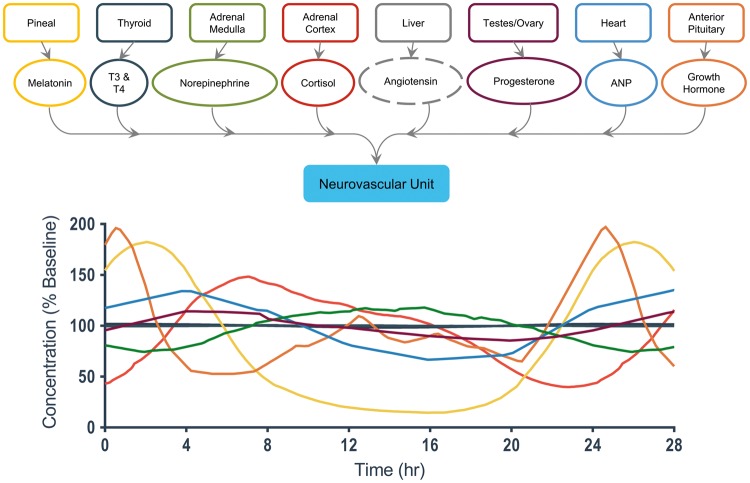
Hormones that play important roles in driving liver physiology over a 24-hour cycle. Multiple hormones contribute to the generation of time-dependent fluctuations in liver physiology. The top image illustrates the upstream endocrine organs that produce the most important hormones relevant to liver function. All of the upstream endocrine organs interact with the liver through hormone chemical messengers that change in concentration throughout the circadian cycle. The concentrations over time for the important target hormones were constructed by selecting data from the literature, smoothing the data using an end-capped approach to limit loss, and plotting each hormone over a 28-hour cycle to illustrate day-to-day changes over their 24-hour cycle. The hormones are color-coded to correspond with the graph below that depicts their relative concentration change, as a percentage of their normal baseline level, over the course of the day. Cortisol, melatonin, and growth hormone exhibit the most significant daily changes with three-fold or larger peak-to-valley changes in concentration over their cycle.
Figure 2.
Figure 2.
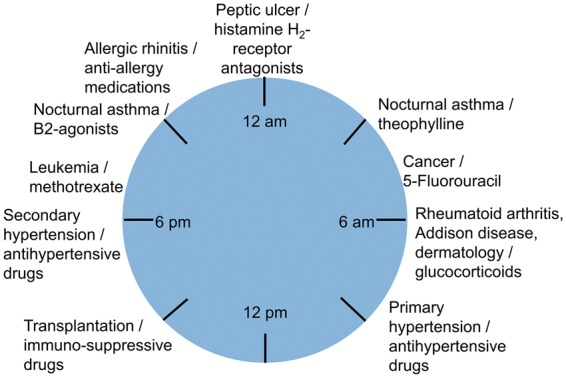
Time-dependent administration of pharmaceuticals whose responses are linked to the physiological clock. Different classes of drugs have optimal times when they should be administered based on their pharmacokinetic and pharmacodynamic properties. These time-dependent dosages are designed to correlate with changes in physiology that are, in turn, driven by changes in the circadian clock, indicating that the physiological clock is an important mechanism that must be included in the study of drug release and administration. (Adapted from Baraldo, 2008)
Figure 3.
Figure 3.
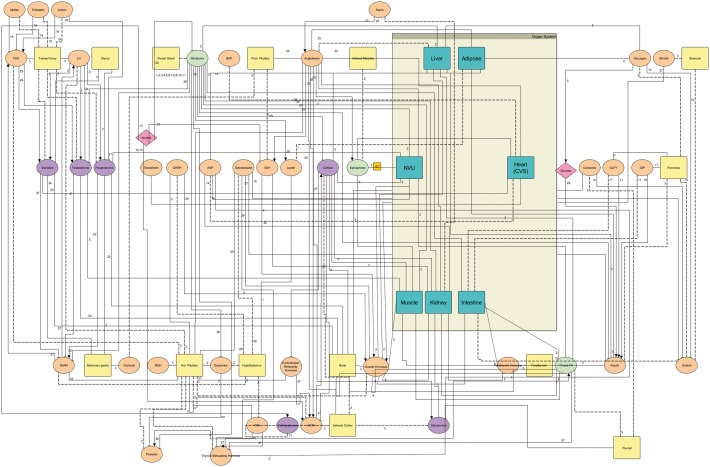
An end-organ connectome highlighting the interactions between chemical messengers. A high-level view of the chemical interactions between organ systems provides insights into the complexity driving organ physiology. The most important end-organ hormone interactions were selected from the literature and depicted using an integrated network based in yED. An interactive version of this map and a high-resolution plottable one are in the Supplementary Materials (Supplements S2 and S1, respectively).,, , –, ,, Key: Organ: square = tissue, light blue = target tissue; Signals: ellipse = chemical messenger (salmon = peptide hormone, green = amino acid hormone, purple = steroid hormone, pink = other), kite = nutrient; Regulation: arrow = upregulation, bar = downregulation, solid line = organ receiving the hormone, dotted line = organ releasing the hormone.
Figure 4.
Figure 4.
A detailed view of end-organ interactions for the neurovascular unit., –, ,, The hormones are color-coded to correspond with the graph below that depicts their relative concentration change, as a percentage of their normal baseline level, over the course of the day. Hormones that did not have significant literature support for a circadian oscillation are given a dashed line to denote a constant concentration.
Figure 5.
Figure 5.
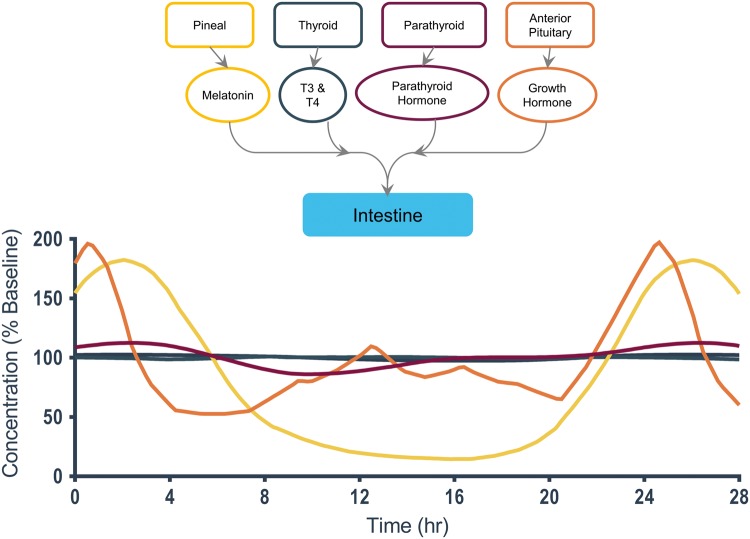
A detailed view of end-organ interactions for the intestine.,,
Figure 6.
Figure 6.
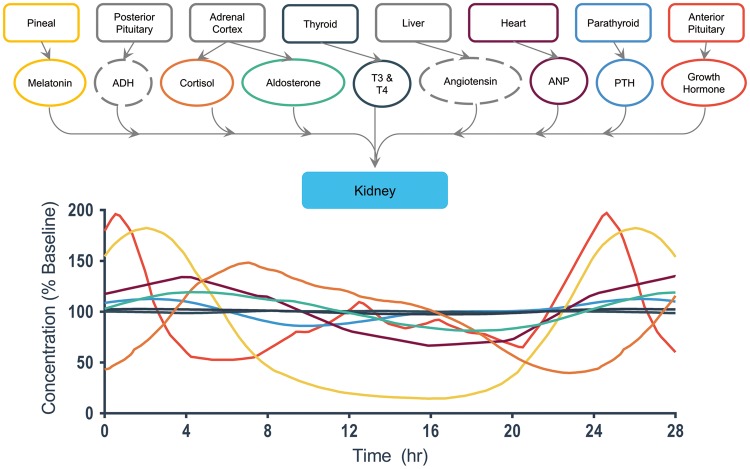
A detailed view of end-organ interactions for the kidney.,,,–
Figure 7.
Figure 7.
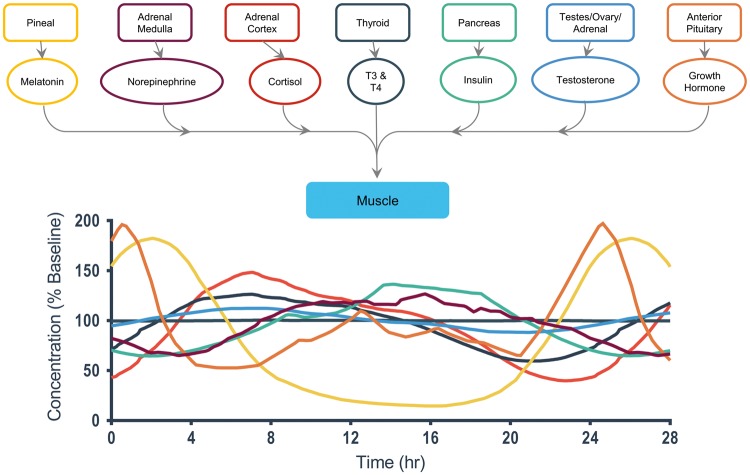
A detailed view of end-organ interactions for skeletal muscle., –, ,
Figure 8.
Figure 8.
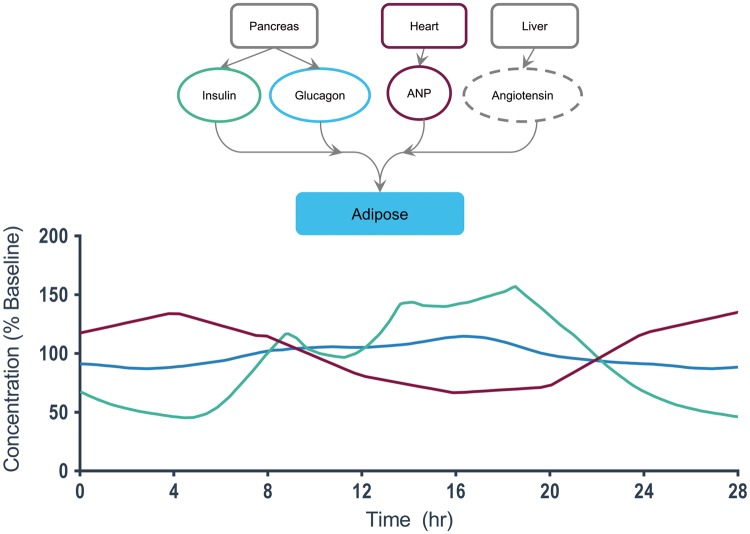
A detailed view of end-organ interactions for adipose tissue.–,
Figure 9.
Figure 9.
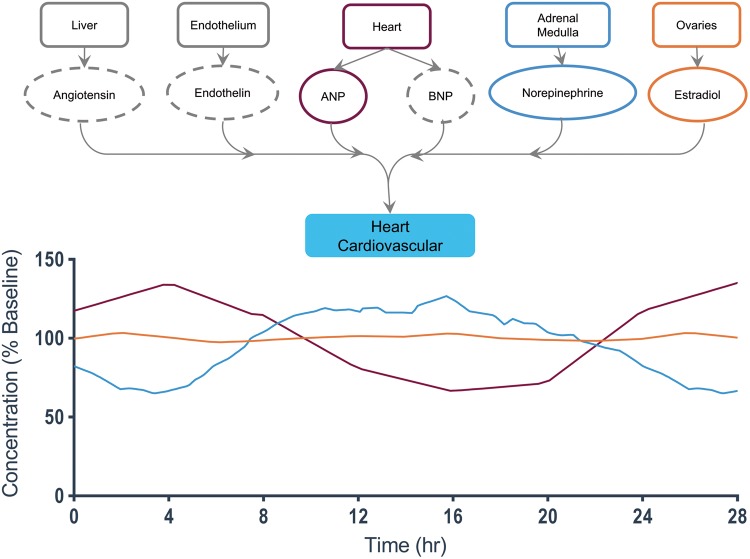
A detailed view of end-organ interactions for the heart/cardiovasculature.,, ,
Figure 10.
Figure 10.
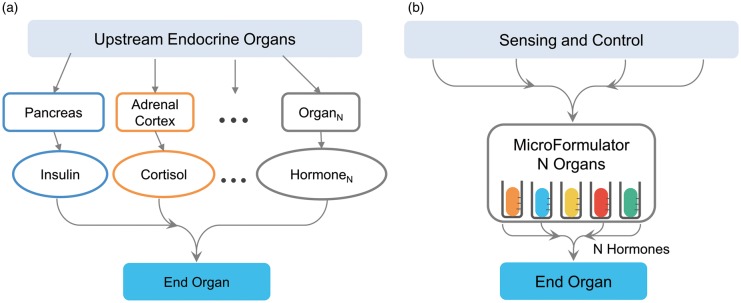
A missing endocrine system MicroFormulator (MES-µF) that could help recapitulate human endocrine regulation in vitro for microphysiological homunculi without the need to implement multiple, interlinked endocrine organs. A) Standard biology uses multiple endocrine organs (Organ1 to OrganN) to release numerous hormones (Hormone1 to HormoneN) that can engage with a targeted end organ. Instead of recreating the entire network of endocrine organs within an MPS homunculus, the MES-µF (B) combines the function of multiple endocrine organs into a single unit capable of recreating N endocrine organs by the time-dependent delivery of N hormones. The endocrine MicroFormulator contains a variety of vessels that each contain an important chemical messenger for the target organ. The MES-µF would either operate based upon an internally programmed clock or could sense the homeostatic state of the MPS homunculus in its entirety or simply that of a single target organ and adjust the hormone concentrations in a fashion similar to the feedback loops present in normal human biological endocrine modulation.

References

    1. Huh D, Torisawa YS, Hamilton GA, Kim HJ, Ingber DE. Microengineered physiological biomimicry: Organs-on-chips. Lab Chip. 2012; 12:2156–64 - PubMed
    1. Moraes C, Mehta G, Lesher-Perez SC, Takayama S. Organs-on-a-chip: A focus on compartmentalized microdevices. Ann Biomed Eng. 2012; 40:1211–27 - PubMed
    1. Moraes C, Labuz JM, Leung BM, Inoue M, Chun TH, Takayama S. On being the right size: scaling effects in designing a human-on-a-chip. Integr Biol. 2013; 5:1149–61 - PMC - PubMed
    1. Wikswo JP, Block III FE, Cliffel DE, Goodwin CR, Marasco CC, Markov DA, McLean DL, McLean JA, McKenzie JR, Reiserer RS, Samson PC, Schaffer DK, Seale KT, Sherrod SD. Engineering challenges for instrumenting and controlling integrated organ-on-chip systems. IEEE Trans Biomed Eng. 2013; 60:682–90 - PMC - PubMed
    1. Wikswo J, Curtis EL, Eagleton ZE, Evans BC, Kole A, Hofmeister LH, Matloff WJ. Scaling and systems biology for integrating multiple organs-on-a-chip. Lab Chip. 2013; 13:3496–511 - PMC - PubMed

Publication types

MeSH terms