


The mediating effects of childhood neglect on the association between schizotypal and autistic personality traits and depression in a non-clinical sample
- PMID: 29065890
- PMCID: PMC5655952
- DOI: 10.1186/s12888-017-1510-0
The mediating effects of childhood neglect on the association between schizotypal and autistic personality traits and depression in a non-clinical sample
Abstract
Background: Autistic personality traits (APT) and schizotypal personality traits (SPT) are associated with depression. However, mediating factors within these relationships have not yet been explored. Thus, the focus of the current study was to examine the effects of childhood neglect on the relationship between APT/SPT and depression.
Methods: This cross-sectional study was conducted on first-year students (N = 2469) at Hunan University of Chinese Medicine and Hengyang Normal College (Changsha, China). Participants completed surveys on APT, SPT, childhood neglect, abuse and depression.
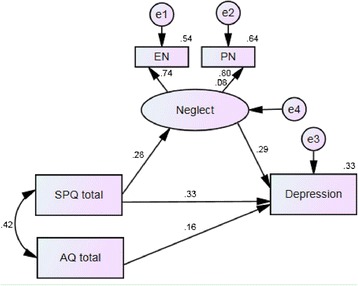
Results: Through correlational analyses, APT and SPT traits were positively correlated with childhood neglect and depression (p < 0.05). In a hierarchical regression analysis, among types of childhood maltreatment, emotional neglect (β = 0.112, p < 0.001) and physical neglect (β = 0.105, p < 0.001) were the strongest predictors of depression. Childhood neglect did not account for the relationships between APT/SPT and depression. Further analysis found that childhood neglect mediated the relationship between SPT and depression but not APT and depression.
Conclusions: Among types of childhood maltreatment, neglect was the strongest predicting factor for depression. Neglect did not account for the relationship between APT/SPT and depression but was a strong mediating factor between SPT and depression.
Keywords: APT; Depression; Mediating factor; Neglect; SPT.
Conflict of interest statement
Ethics approval and consent to participate
The Ethics Committee of the Second Hospital of Hunan University of Chinese Medicine approved the study. Table 1 displays the demographic characteristics of the participants. All participants provided written informed consent.
Consent for publication
Not applicable.
Competing interests
The authors declare that they have no competing interests.
Publisher’s Note
Springer Nature remains neutral with regard to jurisdictional claims in published maps and institutional affiliations.
Figures
References
-
- Onwuameze OE, Uga A, Paradiso S. Longitudinal assessment of clinical risk factors for depression in schizophrenia spectrum disorders. Ann Clin Psychiat. 2016;28(3):167–174. - PubMed
MeSH terms
LinkOut - more resources
Full Text Sources
Other Literature Sources
Medical
