. 2017 Oct 24;18(1):67.
doi: 10.1186/s40360-017-0172-3.

Glucagon-like peptide receptor agonists attenuate advanced glycation end products-induced inflammation in rat mesangial cells

Affiliations

Glucagon-like peptide receptor agonists attenuate advanced glycation end products-induced inflammation in rat mesangial cells

Jui-Ting Chang et al. BMC Pharmacol Toxicol. .

Erratum in

Abstract

Background: Hyperglycemia-induced advanced glycation end products (AGEs) and receptor for AGEs (RAGE) production play major roles in progression of diabetic nephropathy. Anti-RAGE effect of peroxisome proliferator-activated receptor-delta (PPARδ) agonists was shown in previous studies. PPARδ agonists also stimulate glucagon-like peptide-1 (GLP-1) secretion from human intestinal cells.

Methods: In this study, the individual and synergic anti-inflammatory effects of GLP-1 receptor (exendin-4) and PPARδ (L-165,041) agonists in AGE-treated rat mesangial cells (RMC) were investigated.

Results: The results showed both exendin-4 and L-165,041 significantly attenuated AGE-induced IL-6 and TNF-α production, RAGE expression, and cell death in RMC. Similar anti-inflammatory potency was seen between 0.3 nM exendin-4 and 1 μM L-165,041. Synergic effect of exendin-4 and L-165,041 was shown in inhibiting cytokines production, but not in inhibiting RAGE expression or cell death.

Conclusions: These results suggest that both GLP-1 receptor and PPARδ agonists have anti-inflammatory effect on AGE-treated rat mesangial cells.

Keywords: Diabetic nephropathy; Glucagon-like peptide; Mesangial cell; PPAR delta; Rage.


Conflict of interest statement

Ethics approval and consent to participate

Not applicable.

Consent for publication

Not applicable.

Competing interests

The authors declare that they have no competing interests.

Publisher’s Note

Springer Nature remains neutral with regard to jurisdictional claims in published maps and institutional affiliations.

Figures
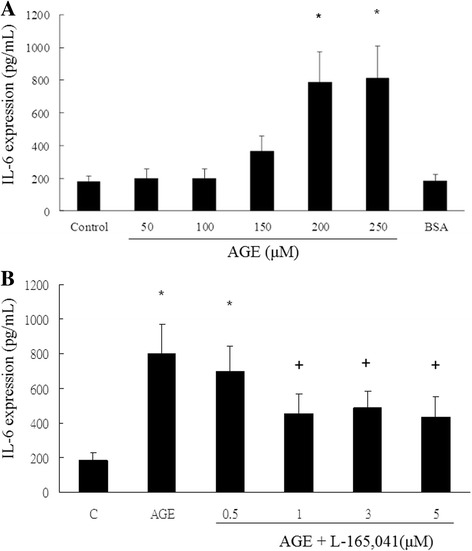
Fig. 1
Fig. 1
L-165,041 attenuates AGE-induced interleukin-6 (IL-6) production in rat mesangial cells. ELISA was used to measure IL-6 concentrations in cell culture supernatants. a AGE stimulated IL-6 production with a dose-dependent manner. A concentration of 200 μM of AGE was chosen for following experiments. b The AGE-induced IL-6 production was inhibited L-165,041 with a dose-dependent manner. A concentration of 1 μM was chosen for following experiments. (N = 6) *P < 0.05 when compared to control. +P < 0.05 when compared to AGE group
Fig. 2
Fig. 2
Exendin-4 and L-165,041 inhibit AGE-induced IL-6 (a) and TNF-α (b) production in RMC. The inhibitory action of L-165,041 was reversed by siRNA of PPARδ. L-165,041 and exendin-4 showed synergic effect in inhibiting IL-6 and TNF-α production. L-165,041 or exendin-4 alone had no influence on IL-6 or TNF-α production in the absence of AGE. (N = 6) *P < 0.05 when compared to control. +P < 0.05 when compared to AGE group. #P < 0.05 when compared to L-165,041 or exendin-4 group
Fig. 3
Fig. 3
Exendin-4 and L-165,041 inhibit AGE-induced RAGE mRNA (a) and protein (b) expression in RMC. AGE significantly induced RAGE mRNA and protein expression. Both exendin-4 and L-165,041 significantly attenuated AGE-induced RAGE expression. The inhibitory action of L-165,041 was reversed by siRNA of PPARδ. No synergic effect between L-165,041 and exendin-4 in inhibiting RAGE expression was noted. L-165,041 or exendin-4 alone did not change RAGE expression in the absence of AGE. (N = 6) *P < 0.05 when compared to control. +P < 0.05 when compared to AGE group
Fig. 4
Fig. 4
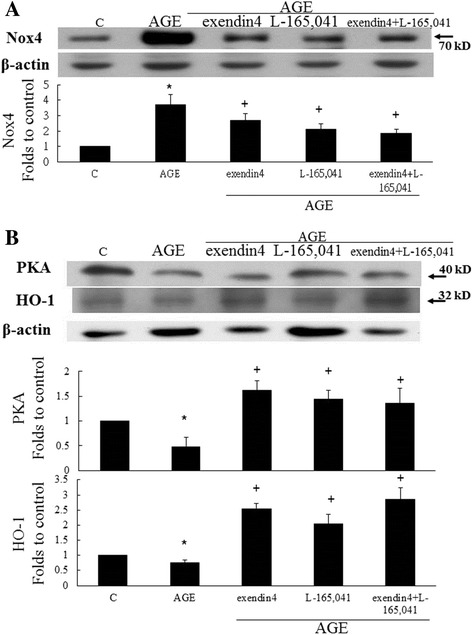
The effects of L-165,041 and exendin treatment on the NAPDH oxidase, PKA and HO-1 expressions. a AGE significantly increased the Nox4 expressions. Both L-165,041 and exendin significantly decreased AGE-induced Nox4. b After L-165,041 and exendin treatment, the levels of AGE-inhibited PKA and HO-1 expression significantly increased in mesangial cells. (N = 6) *P < 0.05 when compared to control. +P < 0.05 when compared to AGE group
Fig. 5
Fig. 5
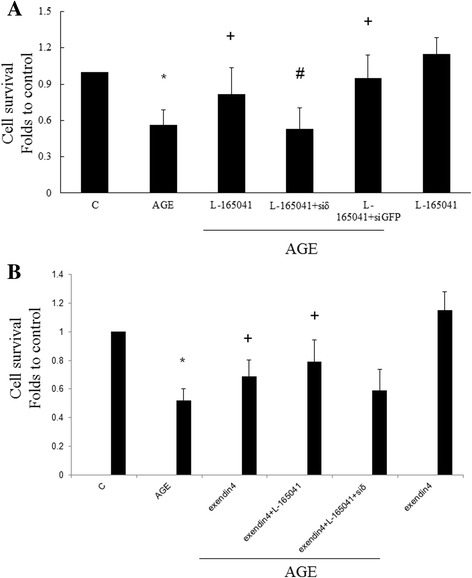
Exendin-4 and L-165,041 inhibit AGE-induced cell death of RMC. AGE enhanced death of RMC. Both exendin-4 (a) and L-165,041 (b) significantly attenuated AGE-induced cell death. The effect of L-165,041 was reversed by siRNA of PPARδ. No synergic effect between exendin-4 and L-165,041 in inhibiting AGE-induced cell death was noted. Exendin-4 or L-165,041 alone showed no influence on cell survival in the absence of AGE. (N = 6) *P < 0.05 when compared to control. +P < 0.05 when compared to AGE group

References

    1. Ansari A, Thomas S, Goldsmith D. Assessing glycemic control in patients with diabetes and end-stage renal failure. Am J Kidney Dis. 2003;41(3):523–531. doi: 10.1053/ajkd.2003.50114. - DOI - PubMed
    1. Yamagishi S, Matsui T. Advanced glycation end products, oxidative stress and diabetic nephropathy. Oxid Med Cell Longev. 2010;3(2):101–108. doi: 10.4161/oxim.3.2.11148. - DOI - PMC - PubMed
    1. Jiao B, Wang YS, Cheng YN, Gao JJ, Zhang QZ. Valsartan attenuated oxidative stress, decreased MCP-1 and TGF-beta1 expression in glomerular mesangial and epithelial cells induced by high-glucose levels. Biosci Trends. 2011;5(4):173–181. doi: 10.5582/bst.2011.v5.4.173. - DOI - PubMed
    1. Yamagishi S. Role of advanced glycation end products (AGEs) and receptor for AGEs (RAGE) in vascular damage in diabetes. Exp Gerontol. 2011;46(4):217–224. doi: 10.1016/j.exger.2010.11.007. - DOI - PubMed
    1. Yan SF, Ramasamy R, Schmidt AM. The RAGE axis: a fundamental mechanism signaling danger to the vulnerable vasculature. Circ Res. 2010;106(5):842–853. doi: 10.1161/CIRCRESAHA.109.212217. - DOI - PMC - PubMed

MeSH terms