


Comparative Genomic Profiling of Matched Primary and Metastatic Tumors in Renal Cell Carcinoma
- PMID: 29066084
- PMCID: PMC5910293
- DOI: 10.1016/j.euf.2017.09.016
Comparative Genomic Profiling of Matched Primary and Metastatic Tumors in Renal Cell Carcinoma
Abstract
Background: Next-generation sequencing (NGS) studies of matched pairs of primary and metastatic tumors in renal cell carcinoma (RCC) have been limited to small cohorts.
Objective: To evaluate the discordance in somatic mutations between matched primary and metastatic RCC tumors.
Design, setting, and participants: Primary tumor (P), metastasis (M), and germline DNA from 60 patients with RCC was subjected to NGS with a targeted exon capture-based assay of 341 cancer-associated genes. Somatic mutations were called using a validated pipeline.
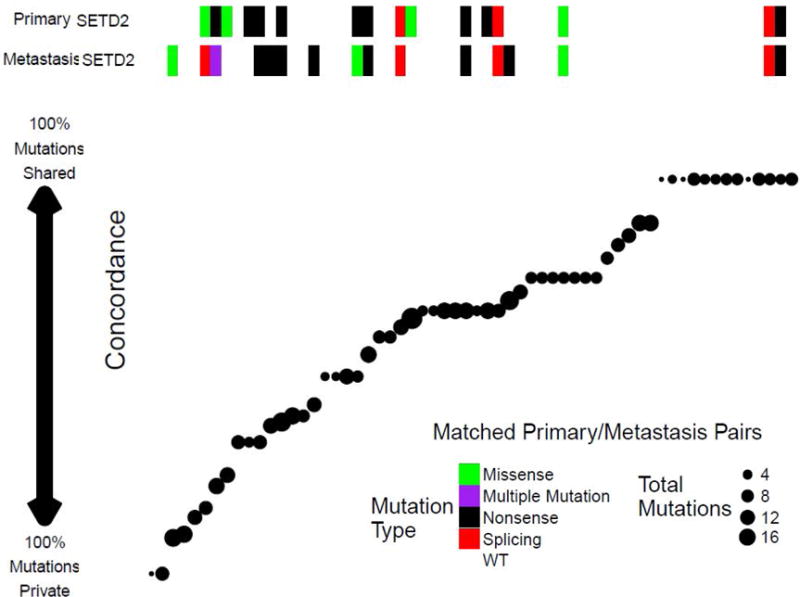
Outcome measurements and statistical analysis: Mutations were classified as shared (S) or private (Pr) in relation to each other within individual P-M pairs. The concordance score was calculated as (S-Pr)/(S+Pr). To calculate enrichment of Pr/S mutations for a particular gene, we calculated a two-sided p value from a binomial model for each gene with at least ten somatic mutation events, and also implemented a separate permutation test procedure. We adjusted p values for multiple hypothesis testing using the Benjamini-Hochberg procedure. The mutation discordance was calculated using Mann-Whitney U tests according to gene mutations or metastatic sites.
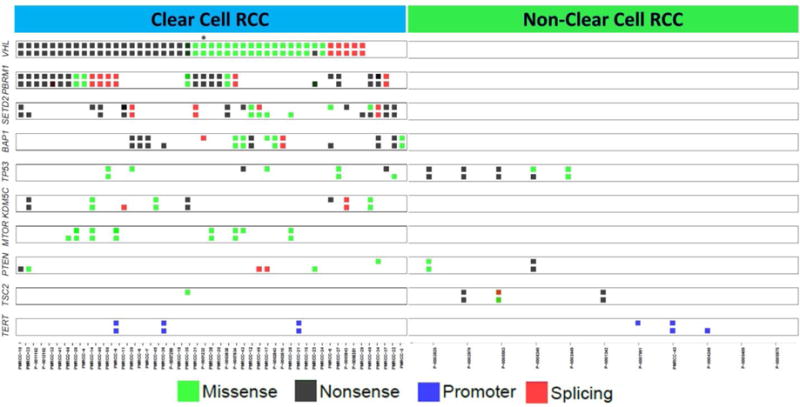
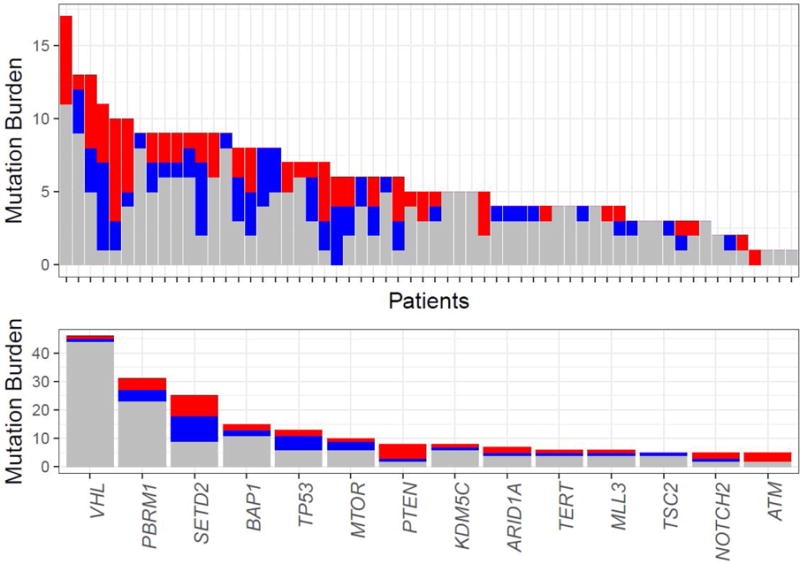
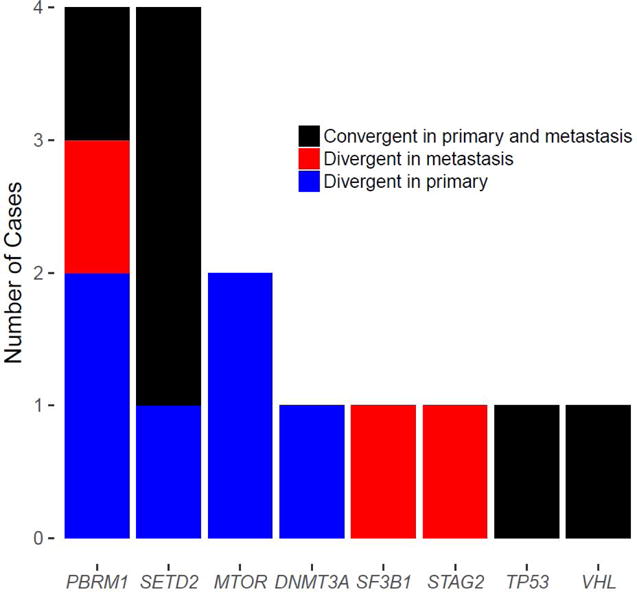
Results and limitations: Twenty-one pairs (35%) showed Pr mutations in both P and M samples. Of the remaining 39 pairs (65%), 14 (23%) had Pr mutations specific to P samples, 12 (20%) had Pr mutations to M samples, and 13 (22%) had identical somatic mutations. No individual gene mutation was preferentially enriched in either P or M samples. P-M pairs with SETD2 mutations demonstrated higher discordance than pairs with wild-type SETD2. We observed that patients who received therapy before sampling of the P or M tissue had higher concordance of mutations for P-M pairs than patients who did not (Mann-Whitney p=0.088).
Conclusions: Our data show mutation discordance within matched P-M RCC tumor pairs. As most contemporary precision medicine trials do not differentiate mutations detected in P and M tumors, the prognostic and predictive value of mutations in P versus M tumors warrants further investigation.
Patient summary: In this study we evaluated the concordance of mutations between matched primary and metastatic tumors for 60 kidney cancer patients using a panel of 341 cancer genes. Forty-seven patients carried nonidentical cancer gene mutations within their matched primary-metastatic pair. The mutation profile of the primary tumor alone could compromise precision in selecting effective targeted therapies and result in suboptimal clinical outcomes.
Keywords: Convergent evolution; Discordance; Genomics; Metastasis; Next-generation sequencing; Primary-metastasis tumor pairs; Renal cell carcinoma; Spatiotemporal divergence.
Copyright © 2017 European Association of Urology. Published by Elsevier B.V. All rights reserved.
Conflict of interest statement
Figures
References
-
- Choueiri TK, Motzer RJ. Systemic therapy for metastatic renal-cell carcinoma. N Engl J Med. 2017;376:354–66. - PubMed
Publication types
MeSH terms
Substances
Grants and funding
LinkOut - more resources
Full Text Sources
Other Literature Sources
Medical
Research Materials
Miscellaneous
