Review
. 2018 Jan:191:1-14.
doi: 10.1016/j.trsl.2017.09.002. Epub 2017 Oct 7.

Macrophage polarization and allergic asthma

Affiliations
Review

Macrophage polarization and allergic asthma

Arjun Saradna et al. Transl Res. 2018 Jan.

Abstract

Allergic asthma is associated with airway inflammation and airway hyperresponsiveness. Macrophage polarization has been shown to have a profound impact on asthma pathogenesis. On exposure to local microenvironments, recruited macrophages can be polarized into either classically activated (or M1) or alternatively activated (or M2) phenotypes. Macrophage polarization has been heavily associated with development of asthma. The process of regulation of macrophage polarization involves an intricate interplay between various cytokines, chemokines, transcriptional factors, and immune-regulatory cells. Different signals from the microenvironment are controlled by different receptors on the macrophages to initiate various macrophage polarization pathways. Most importantly, there is an increased attention on the epigenetic changes (eg, microRNAs, DNA methylation, and histone modification) that impact macrophage functional responses and M1/M2 polarization through modulating cellular signaling and signature gene expression. Thus, modulation of macrophage phenotypes through molecular intervention by targeting some of those potential macrophage regulators may have therapeutic potential in the treatment of allergic asthma and other allergic diseases. In this review, we will discuss the origin of macrophages, characterization of macrophages, macrophage polarization in asthma, and the underlying mechanisms regarding allergen-induced macrophage polarization with emphasis on the regulation of epigenetics, which will provide new insights into the therapeutic strategy for asthma.


Figures

Figure 1
Figure 1
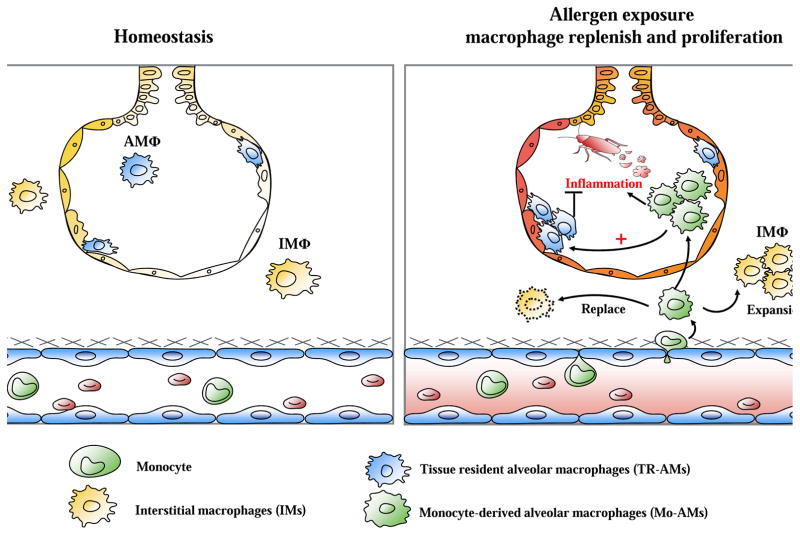
Schematic diagram of repopulation strategies of macrophages. During homeostasis, majority of resident macrophages (i.e., alveolar macrophages) are derived from embryonic progenitors with small contribution from blood monocyte-derived macrophages. However, after allergen exposure inflammatory mediators produced by damaged epithelial cells or activated resident innate immune cells cause the influx of blood monocytes, which then differentiate and expand in the airway and re-populate the alveolar macrophage niche, where both tissue-resident alveolar macrophages (TR-AMs, suppress inflammation) and monocyte-derived alveolar macrophages (Mo-AMs, promote inflammation) contribute to repopulation.
Figure 2
Figure 2
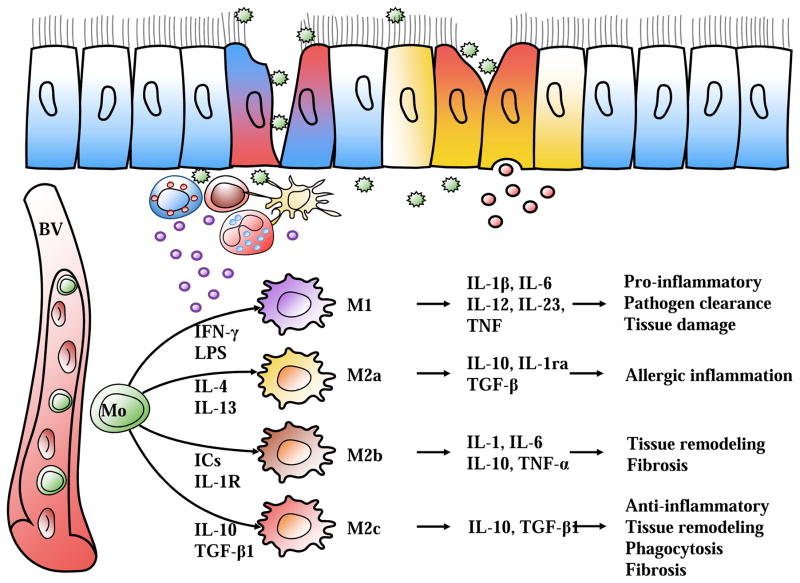
Schematic diagram of macrophage subtypes. Allergen exposure (i.e. cockroach allergen) activates lung epithelial cells and innate immune cells to produce a variety of cytokines, which direct specific macrophage polarization subtype. M1 subtype is generally considered to be pro-inflammatory, M2a subtype is induced by IL-4 and IL-13, which are critical mediators of allergic inflammation. M2b and M2c subtypes predominately participate in tissue remodeling and fibrosis. BV (blood vessel), Mo (monocyte).
Figure 3
Figure 3
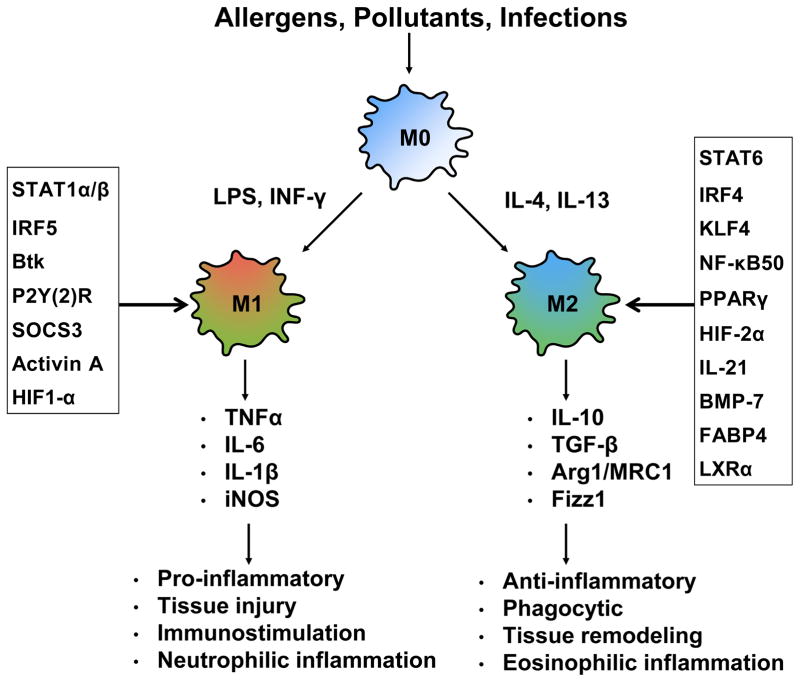
Schematic diagram of macrophage activation with the most related signaling molecules involved in M1/M2 macrophage polarization. Lung primary macrophages are different into M1 and M2 phenotypes after exposed to allergens, pollutants, and infections, which are regulated by signaling molecules (box), respectively. M1 and M2 macrophages play distinct roles in inflammation and tissue remodeling by secreting different inflammatory mediators.
Figure 4
Figure 4
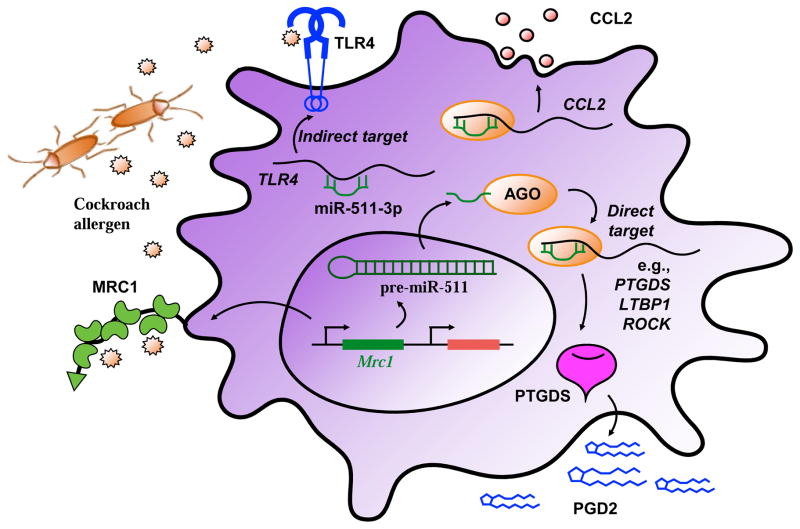
Schematic diagram of miR-511-3p in macrophage polarization. miR-511-3p is an intronic miRNA encoded by MRC1 gene. miR-511-3p is transcriptionally co-regulated with Mrc1 in macrophages. miR-511-3p can regulate macrophage polarization into M1 or M2 by binding its direct (e.g., PTGDS, LTBP1, ROCK, and CCL2) or indirect (e.g, TLR4) target genes. AGO (argonaute), PTGDS (prostaglandin D2 synthase), PGD2 (prostaglandin D2), LTBP1 (latent-transforming growth factor beta-binding protein 1), ROCK (Rho-associated protein kinase), CCL2 (C-C motif chemokine ligand 2), TLR4 (Toll-like receptor 4).

References

    1. Burbank AJ, Sood AK, Kesic MJ, Peden DB, Hernandez ML. Environmental determinants of allergy and asthma in early life. The Journal of allergy and clinical immunology. 2017;140(1):1–12. - PMC - PubMed
    1. Togias A, Fenton MJ, Gergen PJ, Rotrosen D, Fauci AS. Asthma in the inner city: the perspective of the National Institute of Allergy and Infectious Diseases. The Journal of allergy and clinical immunology. 2010;125(3):540–4. - PubMed
    1. Gergen PJ, Togias A. Inner city asthma. Immunology and allergy clinics of North America. 2015;35(1):101–14. - PMC - PubMed
    1. Sohn MH, Kim KE. The cockroach and allergic diseases. Allergy Asthma Immunol Res. 2012;4(5):264–9. - PMC - PubMed
    1. Olmedo O, Goldstein IF, Acosta L, et al. Neighborhood differences in exposure and sensitization to cockroach, mouse, dust mite, cat, and dog allergens in New York City. The Journal of allergy and clinical immunology. 2011;128(2):284–92. e7. - PMC - PubMed

Publication types