Comment
doi: 10.1083/jcb.201710068.
Epub 2017 Oct 24.
Cancer cells, on your histone marks, get SETDB1, silence retrotransposons, and go!
Affiliations
- PMID: 29066607
- PMCID: PMC5674904
- DOI: 10.1083/jcb.201710068
Item in Clipboard
Comment
Cancer cells, on your histone marks, get SETDB1, silence retrotransposons, and go!
J Cell Biol.
.
Abstract
Cancer cells thrive on genetic and epigenetic changes that confer a selective advantage but also need strategies to avoid immune recognition. In this issue, Cuellar et al. (2017. J. Cell Biol https://doi.org/10.1083/jcb.201612160) find that the histone methyltransferase SETDB1 enables acute myeloid leukemia cells to evade sensing of retrotransposons by innate immune receptors.
© 2017 Robbez-Masson et al.
Figures
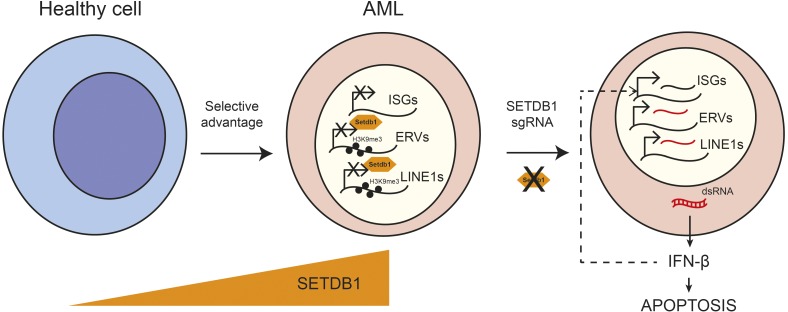
SETDB1 enables AML cells to evade innate immune sensing of retrotransposons. Cancer cells elevate their levels of SETDB1, which promotes the formation of H3K9me3-based heterochromatin at retrotransposons. This in turn prevents transcription of retrotransposon-derived dsRNA and its downstream recognition by cytosolic RNA sensors. Genetic ablation of SETDB1 leads to a type I IFN response, the subsequent activation of ISGs, and apoptosis. LINE1, long interspersed nuclear element 1; sgRNA, single-guide RNA.
Comment on
-
Silencing of retrotransposons by SETDB1 inhibits the interferon response in acute myeloid leukemia.J Cell Biol. 2017 Nov 6;216(11):3535-3549. doi: 10.1083/jcb.201612160. Epub 2017 Sep 8. J Cell Biol. 2017. PMID: 28887438 Free PMC article.
References
-
- Chiappinelli K.B., Strissel P.L., Desrichard A., Li H., Henke C., Akman B., Hein A., Rote N.S., Cope L.M., Snyder A., et al. 2015. Inhibiting DNA Methylation Causes an Interferon Response in Cancer via dsRNA Including Endogenous Retroviruses. Cell. 162:974–986. 10.1016/j.cell.2015.07.011 - DOI - PMC - PubMed
-
- Guler G.D., Tindell C.A., Pitti R., Wilson C., Nichols K., KaiWai Cheung T., Kim H.J., Wongchenko M., Yan Y., Haley B., et al. 2017. Repression of Stress-Induced LINE-1 Expression Protects Cancer Cell Subpopulations from Lethal Drug Exposure. Cancer Cell. 32:221–237.e13. 10.1016/j.ccell.2017.07.002 - DOI - PubMed
Publication types
MeSH terms
Substances
LinkOut - more resources
Full Text Sources
Other Literature Sources
Medical