Review
. 2017 May 2;3(3):291-300.
doi: 10.1016/j.trci.2017.04.001. eCollection 2017 Sep.

Sedentary behavior as a risk factor for cognitive decline? A focus on the influence of glycemic control in brain health

Affiliations
Review

Sedentary behavior as a risk factor for cognitive decline? A focus on the influence of glycemic control in brain health

Michael J Wheeler et al. Alzheimers Dement (N Y). .

Abstract

Cognitive decline leading to dementia represents a global health burden. In the absence of targeted pharmacotherapy, lifestyle approaches remain the best option for slowing the onset of dementia. However, older adults spend very little time doing moderate to vigorous exercise and spend a majority of time in sedentary behavior. Sedentary behavior has been linked to poor glycemic control and increased risk of all-cause mortality. Here, we explore a potential link between sedentary behavior and brain health. We highlight the role of glycemic control in maintaining brain function and suggest that reducing and replacing sedentary behavior with intermittent light-intensity physical activity may protect against cognitive decline by reducing glycemic variability. Given that older adults find it difficult to achieve current exercise recommendations, this may be an additional practical strategy. However, more research is needed to understand the impact of poor glycemic control on brain function and whether practical interventions aimed at reducing and replacing sedentary behavior with intermittent light intensity physical activity can help slow cognitive decline.

Keywords: Alzheimer's disease; Breaks in sedentary time; Cognitive function; Dementia; Diabetes; Exercise; Glucose metabolism; Light-intensity activity; Physical activity; Sedentary behavior; Sitting.


Figures
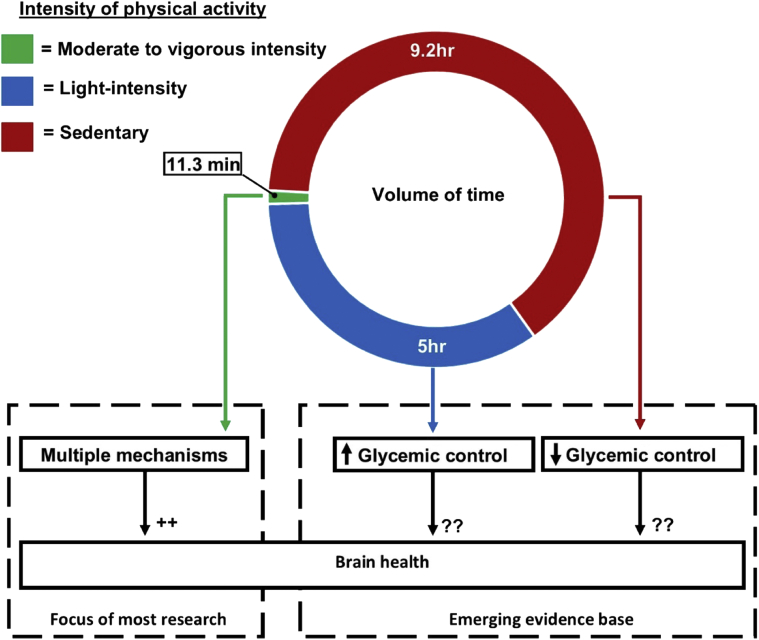
Fig. 1
Fig. 1
This figure is based on accelerometer data from the U.S. National Health and Nutrition Examination Survey, which shows how 1367 older, overweight adults (mean age = 70.5 years; mean body mass index = 29.7 kg/m2) allocate their time on average throughout the day . Most research on physical activity and brain health focuses on MVPA. However, only a very small proportion of the day is spent in MVPA. Emerging evidence suggests that replacing time spent in sedentary behavior with light-intensity physical activity can improve glycemic control. However, little is known about the implications of this for brain health. Abbreviation: MVPA, moderate to vigorous intensity physical activity.
Fig. 2
Fig. 2
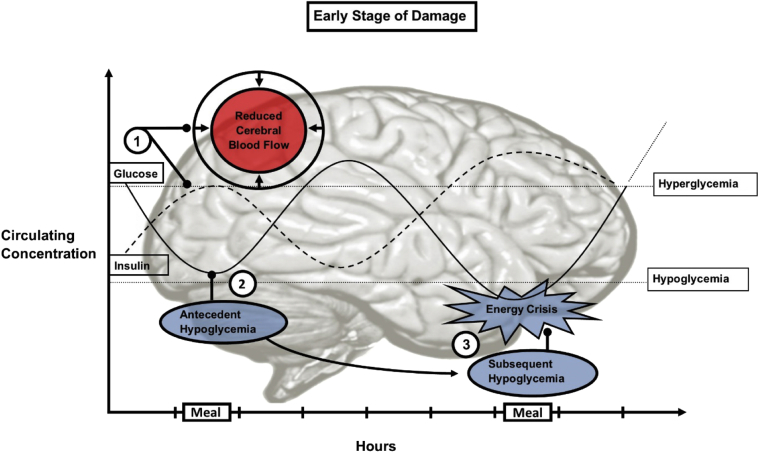
The effects of circulating glucose on the brain at an early stage of damage. This schematic illustrates circulating glucose excursions in response to meals in a hypothetical individual. (1) Acute hyperglycemia in this scenario causes a reduction in regional CBF and a spike in insulin levels to facilitate glucose clearance. (2) These two factors combine to result in a glucose nadir. This glucose nadir can act to impair endocrine counter-regulation to a subsequent dip in glucose, exaggerating the hypoglycemic episode. As this happens over the space of a day, there is not enough time for the brain to compensate via increased CBF or upregulation of glucose transporters. (3) The result is an exaggerated hypoglycemic episode, which can impair endothelial function. This hypoglycemic episode may also be mirrored in the central concentration, depriving neurons of glucose, resulting in an energy crisis. Such a pattern, if continued, may progressively damage the brain. Abbreviation: CBF, cerebral blood flow.
Fig. 3
Fig. 3
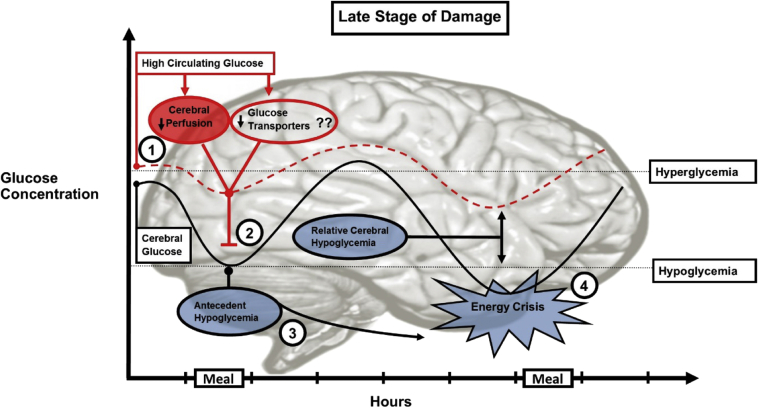
Brain exposure to glucose excursions at a late stage of damage. This schematic illustrates both circulating and central glucose excursions in response to meals in a hypothetical individual with increased fasting glucose level. (1) The increased time spent in hyperglycemia induces damage to pericytes and endothelial dysfunction of brain arterioles, resulting in chronic hypoperfusion and decreased blood to brain glucose transport. Downregulation of glucose transporters may also contribute to decreased glucose transport, although human evidence for this is lacking. (2) This protective mechanism works to lower central glucose relative to circulating concentration. This means that the brain may experience hypoglycemia at a normal circulating glucose level, a phenomenon known as relative cerebral hypoglycemia. (3) The ensuing exposure to hypoglycemia can disable endocrine counter-regulation to subsequent hypoglycemia. (4) Exposure to subsequent hypoglycemia is exaggerated and the ensuing energy crisis may induce neuroglycopenia and the accumulating damage could move the brain toward neuropathology.
Fig. 4
Fig. 4
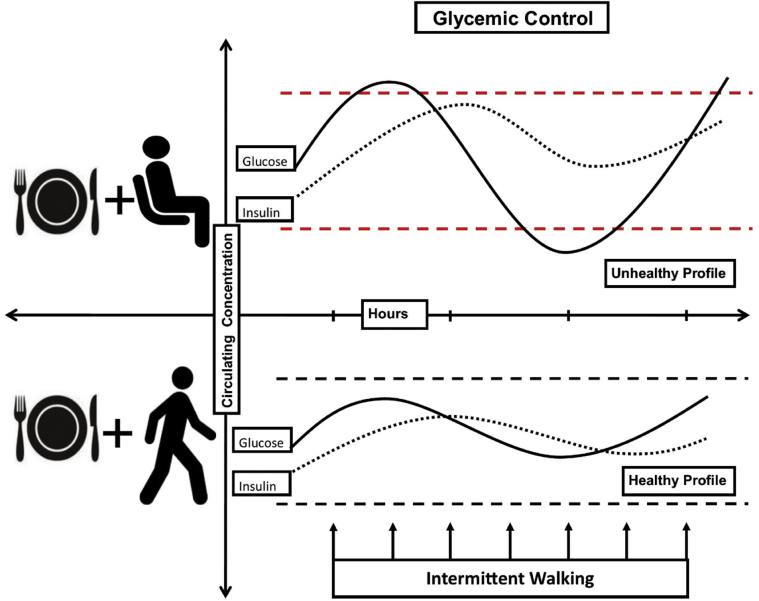
The effects of sedentary behavior versus light-intensity activity on postprandial glucose profile. This figure illustrates circulating glucose and insulin levels in response to a meal, in two hypothetical scenarios. Dashed lines represent the optimal glucose range between hyperglycemia and hypoglycemia. During prolonged sitting, a lack of contraction-stimulated glucose uptake leads to more extreme glucose excursions. In the presence of intermittent light-intensity activity, glucose levels are more likely to stay within the optimal range.

References

    1. Prince M., Bryce R., Albanese E., Wimo A., Ribeiro W., Ferri C.P. The global prevalence of dementia: a systematic review and metaanalysis. Alzheimers Dement. 2013;9 63–75.e2. - PubMed
    1. Wimo A., Jönsson L., Bond J., Prince M., Winblad B. The worldwide economic impact of dementia 2010. Alzheimers Dement. 2013;9 1–11.e3. - PubMed
    1. Brookmeyer R., Johnson E., Ziegler-Graham K., Arrighi H.M. Forecasting the global burden of Alzheimer’s disease. Alzheimers Dement. 2007;3:186–191. - PubMed
    1. Jensen C.S., Hasselbalch S.G., Waldemar G., Simonsen A.H. Biochemical markers of physical exercise on mild cognitive impairment and dementia: systematic review and perspectives. Front Neurol. 2015;6:187. - PMC - PubMed
    1. Zheng G., Xia R., Zhou W., Tao J., Chen L. Aerobic exercise ameliorates cognitive function in older adults with mild cognitive impairment: a systematic review and meta-analysis of randomised controlled trials. Br J Sports Med. 2016;50:1443. - PubMed