Review
. 2018 Jan;39(1):23-39.
doi: 10.1002/humu.23361. Epub 2017 Nov 11.

DCC mutation update: Congenital mirror movements, isolated agenesis of the corpus callosum, and developmental split brain syndrome

Affiliations
Review

DCC mutation update: Congenital mirror movements, isolated agenesis of the corpus callosum, and developmental split brain syndrome

Ashley P L Marsh et al. Hum Mutat. 2018 Jan.

Abstract

The deleted in colorectal cancer (DCC) gene encodes the netrin-1 (NTN1) receptor DCC, a transmembrane protein required for the guidance of commissural axons. Germline DCC mutations disrupt the development of predominantly commissural tracts in the central nervous system (CNS) and cause a spectrum of neurological disorders. Monoallelic, missense, and predicted loss-of-function DCC mutations cause congenital mirror movements, isolated agenesis of the corpus callosum (ACC), or both. Biallelic, predicted loss-of-function DCC mutations cause developmental split brain syndrome (DSBS). Although the underlying molecular mechanisms leading to disease remain poorly understood, they are thought to stem from reduced or perturbed NTN1 signaling. Here, we review the 26 reported DCC mutations associated with abnormal CNS development in humans, including 14 missense and 12 predicted loss-of-function mutations, and discuss their associated clinical characteristics and diagnostic features. We provide an update on the observed genotype-phenotype relationships of congenital mirror movements, isolated ACC and DSBS, and correlate this to our current understanding of the biological function of DCC in the development of the CNS. All mutations and their associated phenotypes were deposited into a locus-specific LOVD (https://databases.lovd.nl/shared/genes/DCC).

Keywords: ACC; DCC; NTN1; Netrin-1; agenesis of the corpus callosum; axon guidance; developmental split brain syndrome; horizontal gaze palsy with progressive scoliosis; mirror movements; mutation.


Figures

Figure 1
Figure 1
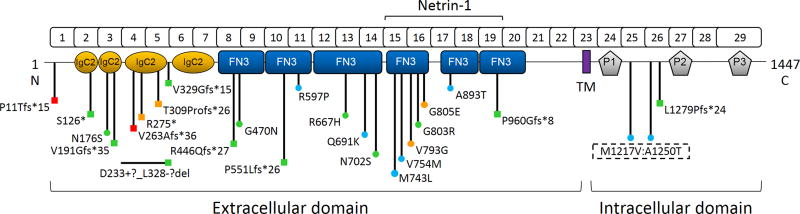
Linear DCC gene schematic with protein domain structure depicting the location of all reported mutations. Square, predicted loss-of-function; circle, missense mutation; red, DSBS; green, MMs; blue, iACC; orange, MMs and iACC. The NTN1 binding region is indicated. IgC2, immunoglobulin-like type C2 domain; FN3, fibronectin type III –like domain; TM, transmembrane domain; P1–3, conserved P motifs. The NP_005206.2 reference sequence is used. Image modified from Marsh et al. 2017.
Figure 2
Figure 2
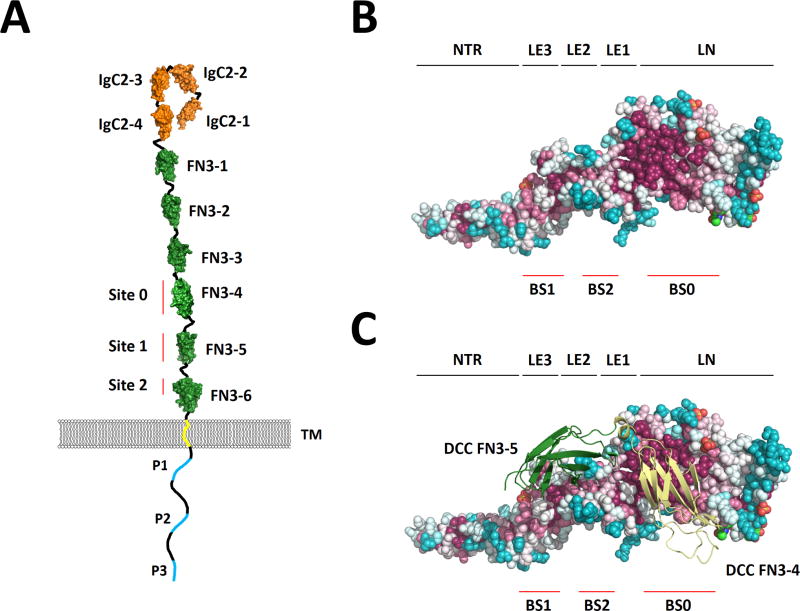
(A) Schematic drawing of DCC with protein domain structure depicting the location of the NTN1 binding sites (BS) 0, 1 and 2. (B) Structure of NTN1 protein depicting the location of its DCC binding sites BS0, BS1 and BS2. (C) NTN1 residues (colored spheres) that bind the 4th and 5th FN3 domains of DCC (yellow and green ribbons, respectively) are conserved throughout evolution. Conserved residues are colored red, non-conserved residues are colored blue. IgC2, immunoglobulin-like type C2 domain; FN3, fibronectin type III –like domain; P1–3, conserved P motifs; NTR, netrin-like domain; LE, laminin-type epidermal growth factor-like domain; LN, laminin-like domain.
Figure 3
Figure 3
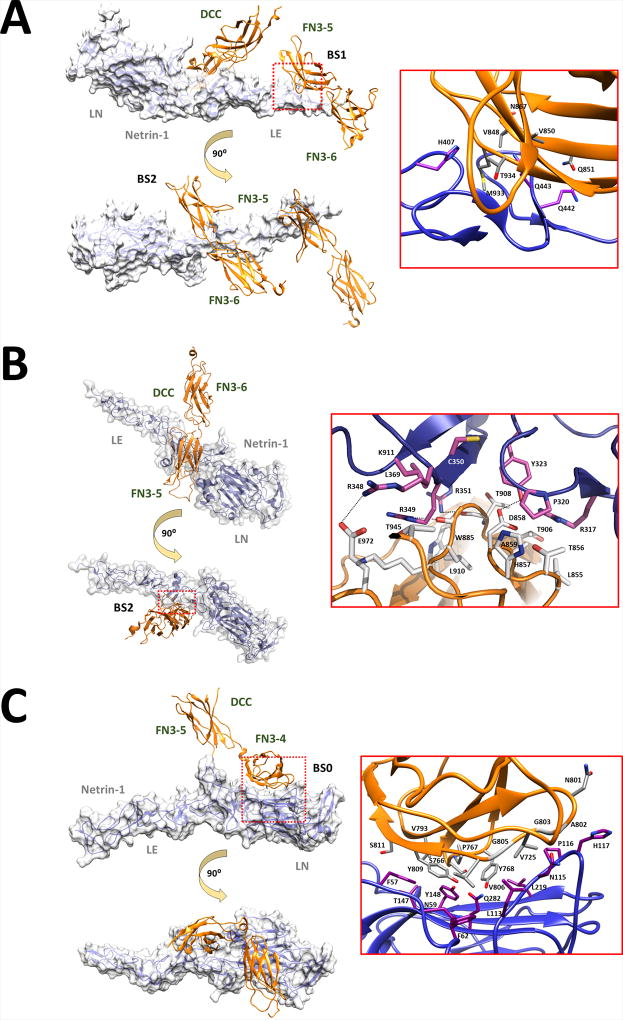
(A) Binding site 1 (BS1) and BS2 of the NTN1/DCC complex (PDB ID: 4URT). (B) BS2 of the NTN1/DCC complex (PDB ID: 4URT). (C) BS0 of the NTN1/DCC complex (PDB ID: 4PLO). Structure of NTN1 (transparent molecular surface) bound to DCC FN3 domains (orange ribbons). The expansion of the red dotted box region shows the NTN1 (magenta sticks) and DCC (gray or white sticks) involved in binding at BS1, BS2 or BS0. Hydrogen bonds are represented by dotted black lines. FN3, fibronectin type III –like domain; PDB ID, Protein Data Bank identification.
Figure 4
Figure 4
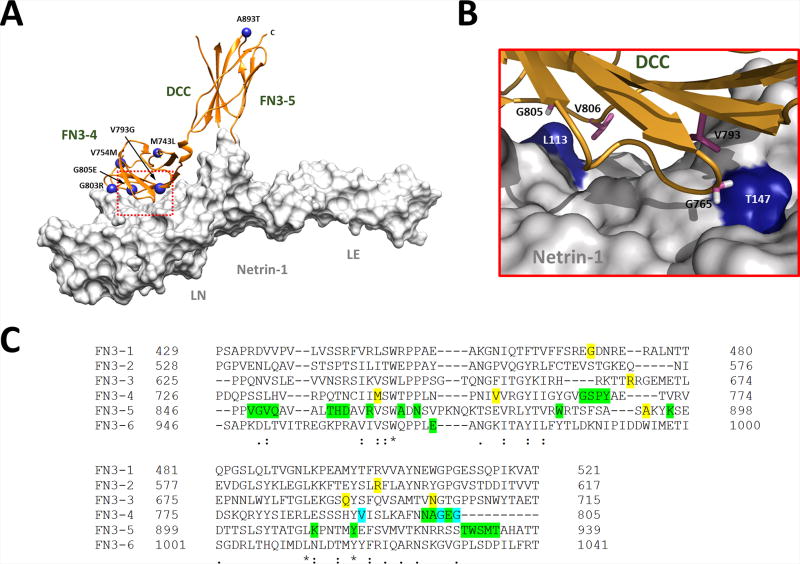
The fibronectin type III –like (FN3) domains are required for NTN1 binding and DCC function. (A) Enrichment of DCC missense mutations linked to MMs and/or iACC within the NTN1 binding region. Structure of NTN1/DCC complex. DCC is depicted as an orange ribbon and NTN1 as a white solvent accessible surface. DCC missense mutations located within the FN3–4 and FN3–5 domains are represented as blue spheres (PDB ID: 4PLO). (B) Expansion of the binding interface (red dotted box in A) with NTN1 residues colored blue and critical DCC residues represented as purple sticks. Mutation of V793 and G805 to Gly and Glu, respectively, is associated with both MMs and iACC. (C) Sequence alignment of the DCC FN3 domains. Residues highlighted in green are predicted to be directly involved in NTN1 binding by Finci et al. 2014 and/or Xu et al. 2014. Residues in yellow are missense mutations associated with MMs and/or iACC. Residues in blue are missense mutations associated with MMs and/or iACC that are also predicted to be directly involved in NTN1 binding. The NP_005206.2 reference sequence is used. PDB ID, Protein Data Bank identification. Image modified from Marsh et al. 2017.
Figure 5
Figure 5
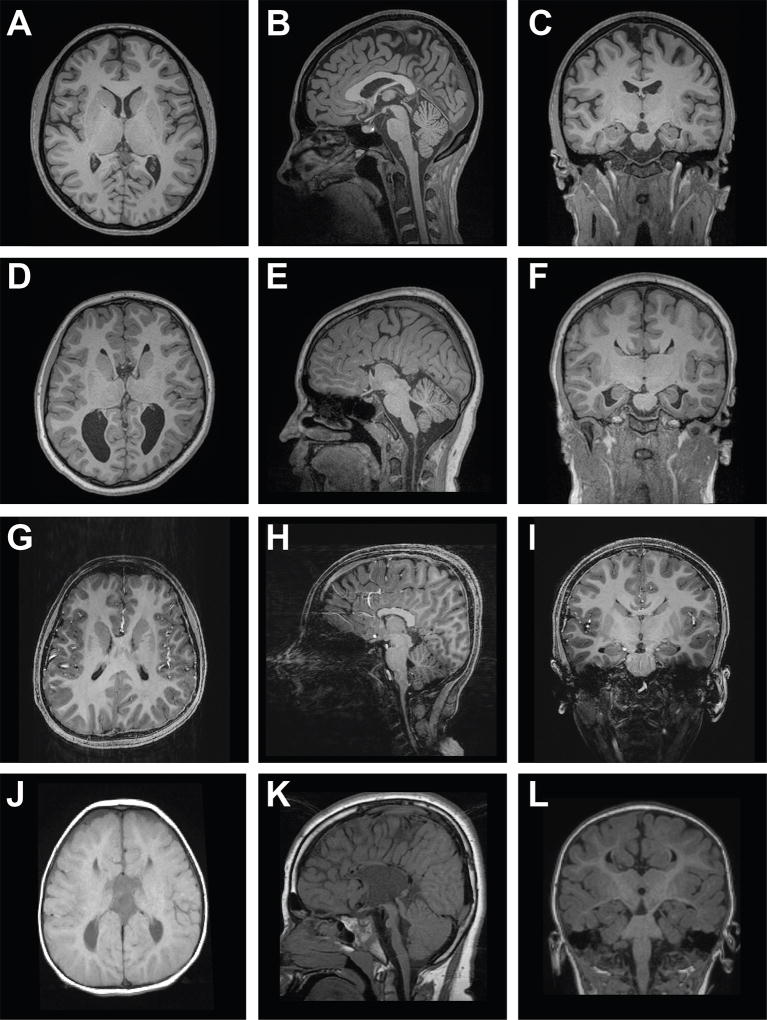
Axial MRI of control (A) and individuals with complete DCC-iACC (D), partial DCC-iACC (G) and DSBS (J). Midsagittal MRI of control (B) and individuals with complete DCC-iACC (E), partial DCC-iACC with absence of the rostrum and genu (H) and DSBS (K). Coronal MRI of control (C) and individuals with complete DCC-iACC (F), partial DCC-iACC (I) and DSBS (L). iACC, isolated agenesis of the corpus callosum; DSBS, developmental split brain syndrome. Images A-I adapted from Marsh et al. 2017. Images J-L adapted from Jamuar et al. 2017.

References

    1. Barr MS, Corballis MC. The role of the anterior commissure in callosal agenesis. Neuropsychology. 2002;16(4):459–71. - PubMed
    1. Bennett KL, Bradshaw J, Youngman T, Rodgers J, Greenfield B, Aruffo A, Linsley PS. Deleted in colorectal carcinoma (DCC) binds heparin via its fifth fibronectin type III domain. J Biol Chem. 1997;272(43):26940–6. - PubMed
    1. Bin JM, Han D, Lai Wing Sun K, Croteau LP, Dumontier E, Cloutier JF, Kania A, Kennedy TE. Complete Loss of Netrin-1 Results in Embryonic Lethality and Severe Axon Guidance Defects without Increased Neural Cell Death. Cell Rep. 2015;12(7):1099–106. - PubMed
    1. Blasiak A, Kilinc D, Lee GU. Neuronal Cell Bodies Remotely Regulate Axonal Growth Response to Localized Netrin-1 Treatment via Second Messenger and DCC Dynamics. Frontiers in Cellular Neuroscience. 2017;10(298) - PMC - PubMed
    1. Cesaretti C, Nanni M, Ghi T, Parazzini C, Conte G, Contro E, Grisolia G, Righini A. Variability of Forebrain Commissures in Callosal Agenesis: A Prenatal MR Imaging Study. AJNR Am J Neuroradiol. 2016;37(3):521–7. - PMC - PubMed

Publication types