. 2017 Oct 25;18(11):2238.
doi: 10.3390/ijms18112238.

Systemic Inflammation, Oxidative Damage to Nucleic Acids, and Metabolic Syndrome in the Pathogenesis of Psoriasis

Affiliations

Systemic Inflammation, Oxidative Damage to Nucleic Acids, and Metabolic Syndrome in the Pathogenesis of Psoriasis

Lenka Borska et al. Int J Mol Sci. .

Abstract

In the pathogenesis of psoriasis, systemic inflammation and oxidative stress play mutual roles interrelated with metabolic syndrome (MetS). This study aims to map the selected markers of inflammation (C-reactive protein (CRP)), oxidative damage to nucleic acids (DNA/RNA damage; 8-hydroxy-2'-deoxyguanosine, 8-hydroxyguanosine, and 8-hydroxyguanine), and the parameters of MetS (waist circumference, fasting glucose, triglycerides, high-density lipoprotein (HDL) cholesterol, diastolic and systolic blood pressure) in a group of 37 patients with psoriasis (62% of MetS) and in 43 healthy controls (42% of MetS). Levels of CRP, DNA/RNA damage, fasting glucose, and triglycerides were significantly elevated in patients. MetS in conjunction with psoriasis was associated with high levels of CRP, significantly higher than in control subjects without MetS. Patients with MetS exhibited further DNA/RNA damage, which was significantly higher in comparison with the control group. Our study supports the independent role of psoriasis and MetS in the increase of CRP and DNA/RNA damage. The psoriasis contributes to an increase in the levels of both effects more significantly than MetS. The psoriasis also diminished the relationship between CRP and oxidative damage to nucleic acids existent in controls.

Keywords: inflammation; metabolic syndrome; oxidative stress; psoriasis.


Conflict of interest statement

The authors declare no conflict of interest.

Figures
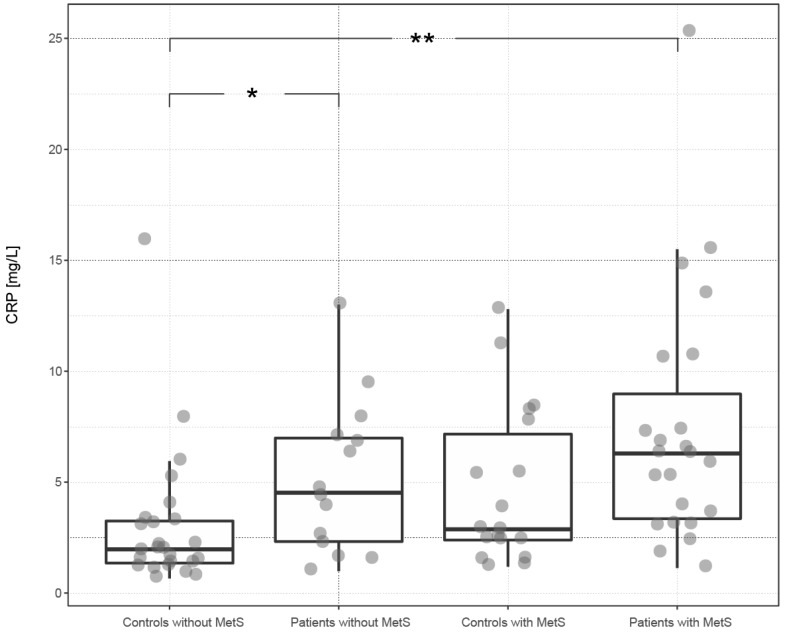
Figure 1
Figure 1
The distribution of CRP (C-reactive protein) among subgroups of subjects defined by the presence of psoriasis and metabolic syndrome. The box plot illustrates the distribution of CRP among subgroups of subjects defined by the presence of psoriasis and MetS (metabolic syndrome). Significant differences are depicted in the upper part of the plot, where * corresponds to p < 0.05 and ** to p < 0.01. For details, see Table 2. In the plot, the lower and upper hinges (first and third quartiles) surround the median of subgroup CRP distribution. The whiskers extend to the largest or smallest value no further than 1.5 times the distance between the first and third quartiles.
Figure 2
Figure 2
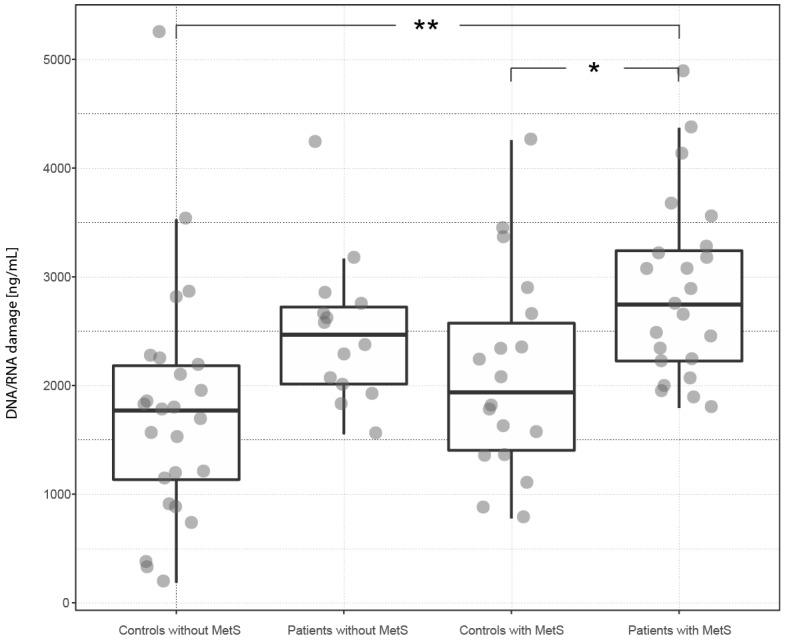
The distribution of DNA/RNA damage among subgroups of subjects defined by the presence of psoriasis and MetS. The box plot illustrates the distribution of DNA/RNA damage among subgroups of subjects defined by the presence of psoriasis and MetS. The plot arrangement corresponds to Figure 1.
Figure 3
Figure 3
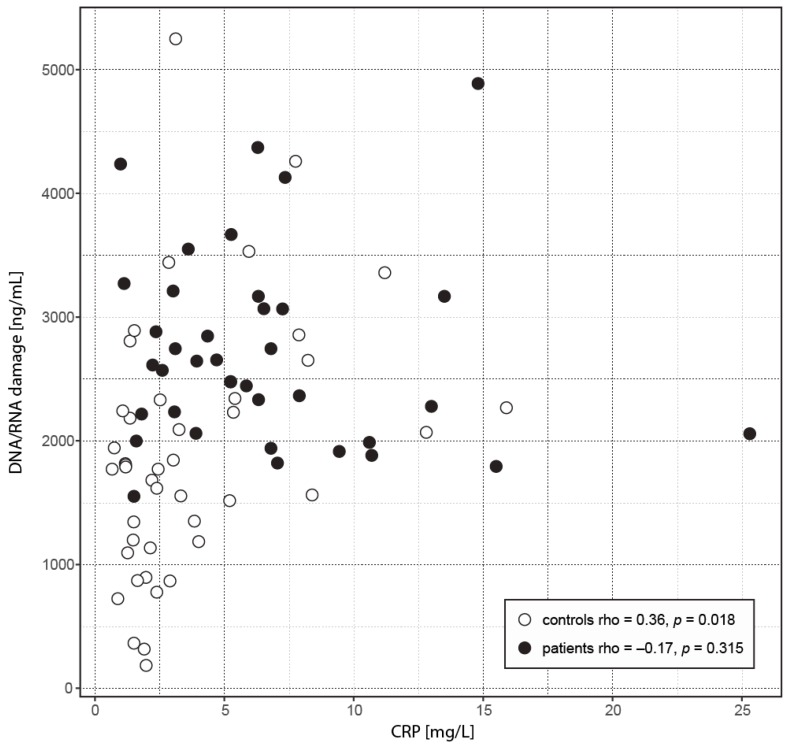
The relationship between CRP and DNA/RNA damage. The scatterplot depicts a relationship between CRP and DNA/RNA damage. Data of patients shows a significant shift toward higher values compared to controls (see Figure 1 and Figure 2) and also a different relationship (Fisher p = 0.0237). While in controls the correlation is positive, the relationship found in patients was not significantly different from zero.

References

    1. Milic M., Frustaci A., del Bufalo A., Sanchez-Alarcon J., Valencia-Quintana R., Russo P., Bonassi S. DNA damage in non-communicable diseases: A clinical and epidemiological perspective. Mutat. Res. 2015;776:118–127. doi: 10.1016/j.mrfmmm.2014.11.009. - DOI - PubMed
    1. Michalek I.M., Loring B., John S.M. A systematic review of worldwide epidemiology of psoriasis. J. Eur. Acad. Dermatol. Venereol. 2017;31:205–212. doi: 10.1111/jdv.13854. - DOI - PubMed
    1. Love T.J., Qureshi A.A., Karlson E.W., Gelfand J.M., Choi H.K. Prevalence of the metabolic syndrome in psoriasis: Results from the National Health and Nutrition Examination Survey, 2003–2006. Arch. Dermatol. 2011;147:419–424. doi: 10.1001/archdermatol.2010.370. - DOI - PMC - PubMed
    1. Vachatova S., Andrys C., Krejsek J., Salavec M., Ettler K., Rehacek V., Cermakova E., Malkova A., Fiala Z., Borska L. Metabolic Syndrome and Selective Inflammatory Markers in Psoriatic Patients. J. Immunol. Res. 2016;2016:8. doi: 10.1155/2016/5380792. - DOI - PMC - PubMed
    1. Takahashi H., Iinuma S., Honma M., Iizuka H. Increased serum C-reactive protein level in Japanese patients of psoriasis with cardio- and cerebrovascular disease. J. Dermatol. 2014;41:981–985. doi: 10.1111/1346-8138.12632. - DOI - PubMed