. 2017 Dec 4;14(12):4741-4750.
doi: 10.1021/acs.molpharmaceut.7b00532. Epub 2017 Nov 9.

In Vivo Pulmonary Delivery and Magnetic-Targeting of Dry Powder Nano-in-Microparticles

Affiliations

In Vivo Pulmonary Delivery and Magnetic-Targeting of Dry Powder Nano-in-Microparticles

Dominique N Price et al. Mol Pharm. .

Abstract

This brief communication evaluates the cytotoxicity and targeting capability of a dry powder chemotherapeutic. Nano-in-microparticles (NIMs) are a dry powder drug delivery vehicle containing superparamagnetic iron oxide nanoparticles (SPIONs) and either doxorubicin (w/w solids) or fluorescent nanospheres (w/v during formulation; as a drug surrogate) in a lactose matrix. In vitro cytotoxicity was evaluated in A549 adenocarcinoma cells using MTS and LDH assays to assess viability and toxicity after 48 h of NIMs exposure. In vivo magnetic-field-dependent targeting of inhaled NIMs was evaluated in a healthy mouse model. Mice were endotracheally administered fluorescently labeled NIMs either as a dry powder or a liquid aerosol in the presence of an external magnet placed over the left lung. Quantification of fluorescence and iron showed a significant increase in both fluorescence intensity and iron content to the left magnetized lung. In comparison, we observed decreased targeting of fluorescent nanospheres to the left lung from an aerosolized liquid suspension, due to the dissociation of SPIONs and nanoparticles during pulmonary administration. We conclude that dry powder NIMs maintain the therapeutic cytotoxicity of doxorubicin and can be better targeted to specific regions of the lung in the presence of a magnetic field, compared to a liquid suspension.

Keywords: aerosolized drug delivery; nano-in-microparticles (NIMs); non-small cell lung cancer; pulmonary chemotherapeutic; superparamagnetic iron oxide nanoparticles (SPIONs); targeted pulmonary delivery.


Conflict of interest statement

The authors declare no competing financial interest.

Figures
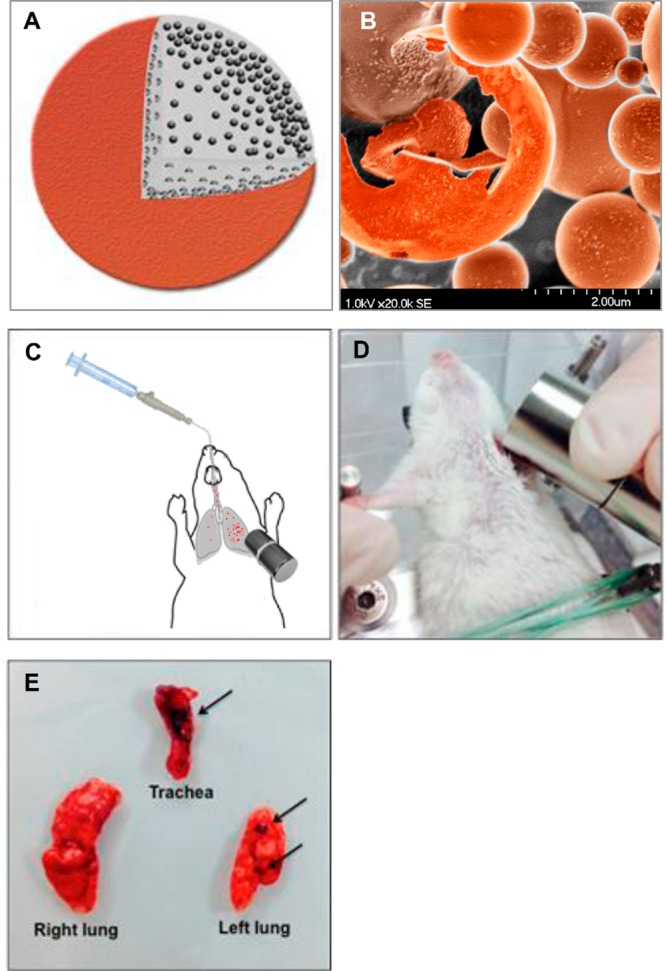
Figure 1
Figure 1
Magnetic field-dependent lung targeting. (A) Pictorial representation of NIMs dry powder showing lactose (gray), doxorubicin (red), and SPIONs (black). (B) Scanning electron microscope image of NIMs dry powder. (C) Schematic of endotracheal delivery of magnetically-targeted NIMs. (D) Orientation of the permanent magnet in thoracotomized mice prior to pulmonary delivery of NIMs. (E) Orientation of the trachea, right lung, and left lung prior to imaging. SPIONs are visible in the trachea and left lung (shown by arrows) demonstrating magnetic targeting.
Figure 2
Figure 2
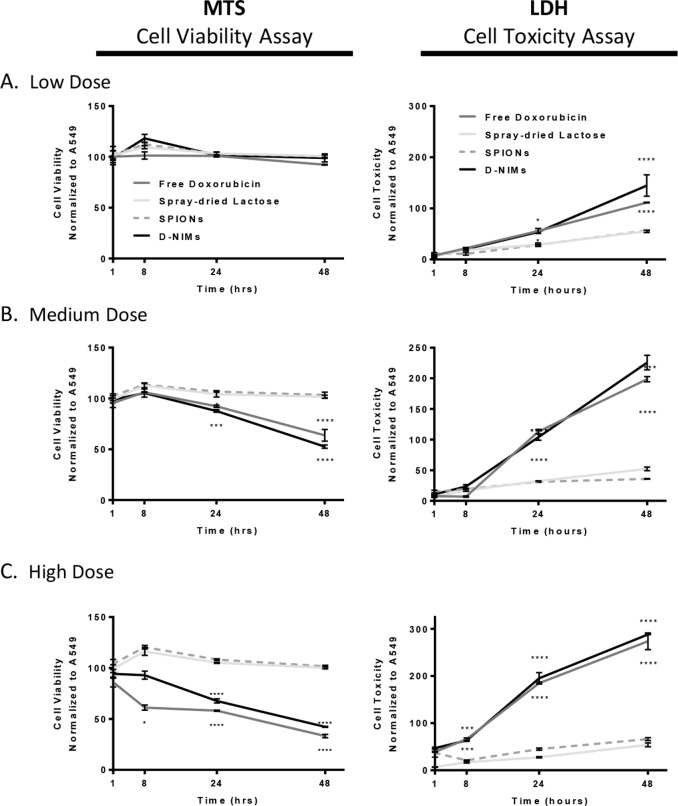
MTS viability and LDH cytotoxicity assay of A549 cells exposed to doxorubicin-loaded NIMs. MTS (left panel) and LDH (right panel) assay measuring viability and cytotoxicity, respectively, of A549 lung adenocarcinoma cells after 48 h of exposure to (A) low dose of D-NIMs compared to free doxorubicin (1 μg NIMs containing 0.016 μg doxorubicin compared to 0.03 μg free doxorubicin), (B) medium dose of D-NIMs compared to free doxorubicin (10 μg NIMs containing 0.16 μg doxorubicin compared to 0.3 μg free doxorubicin), and (C) high dose of D-NIMs compared to free doxorubicin (100 μg NIMs containing 1.6 μg doxorubicin compared to 3.0 μg free doxorubicin). Free doxorubicin control (dark gray), spray-dried lactose control (light gray), SPIONs control (dashed gray), D-NIMs (black); for both MTS and LDH panels. Lactose and SPIONs controls were used at the ratios from the spray-dried feed solution and were held constant relative to doxorubicin. A two-way ANOVA with Sidak’s multiple comparison test was used to determine statistical significance. *p <.05; **p <.01, ***p <.001, ****p <.0001; data shown with standard error of the mean (SEM) and n = 3.
Figure 3
Figure 3
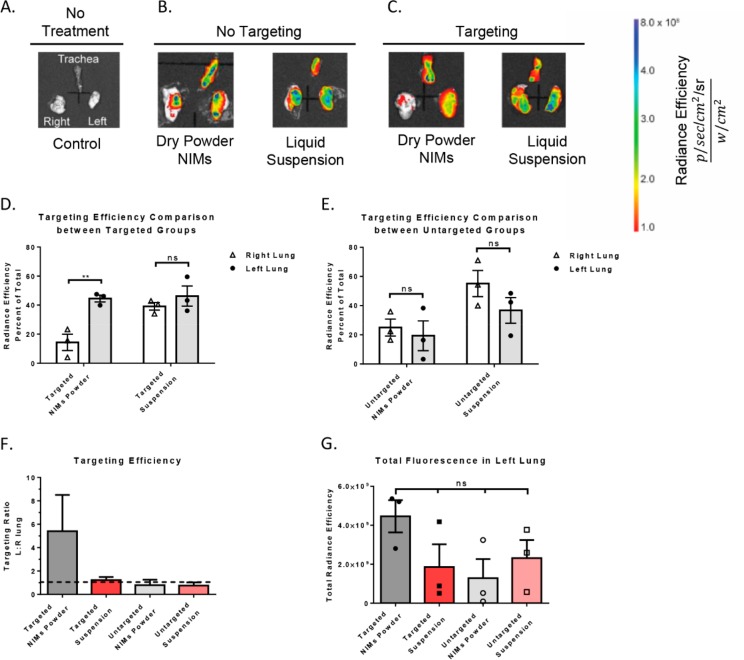
Fluorescence quantification in murine lungs after magnetic-field-dependent targeting. (A) Untreated control, no fluorescence is observed in lungs or trachea (n = 1). The trachea (upper half of image), the right lung (left side of image), and the left lung (right side of image) are shown. (B) No targeting controls: NIMs dry powder and liquid suspension in the absence of magnetic targeting (n = 3; representative images shown). (C) Targeted treatment groups: NIMs dry powder and liquid suspension in the presence of magnetic targeting (n = 3; representative images shown). (D,E) Comparison of targeting efficiency (measured as radiance efficiency, graphed as percent of total) of NIMs dry powder and liquid suspension in left (targeted) and right lungs (untargeted) in the (D) presence and (E) absence of magnetic targeting. (F) Targeting efficiency ratio between the left (targeted) and the right (untargeted) lung in the presence and absence of magnetic-field-dependent targeting. The dashed line represents equal fluorescence in the left and right lung. Any fluorescence above the dashed line shows targeting to magnetized left lung. (G) Fluorescence (in total radiance efficiency) quantified in the left targeted lung after delivery of NIMs dry powder and liquid suspension (in the presence and absence of magnetic targeting). A two-way ANOVA with Sidak’s multiple comparison test (for D and E) or a one-way ANOVA with Tukey’s multiple comparison post-test (for G) was used to determine statistical significance. *p <.05; **p <.01; ns = not significant; data shown with standard error of the mean (SEM) and n = 3.
Figure 4
Figure 4
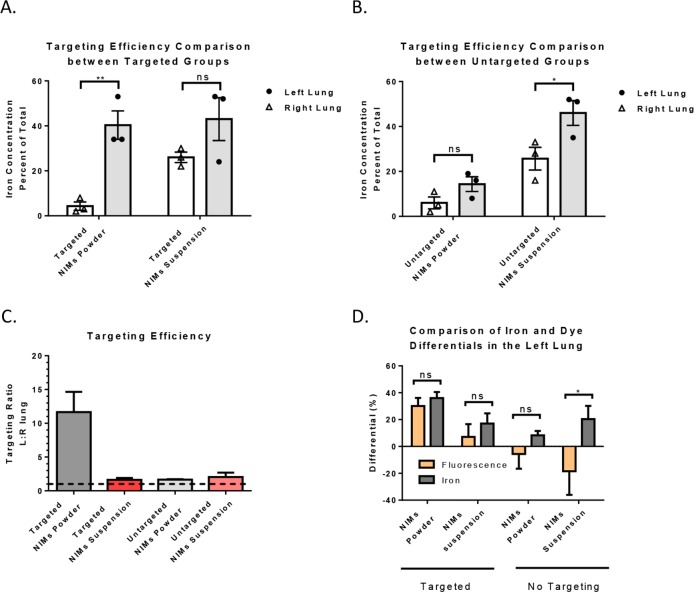
Iron quantification of magnetic targeting and corroboration of iron and dye components from NIMs. Comparison of targeting efficiency (measured as iron concentration, graphed as percent of total) of NIMs dry powder and liquid suspension in left (targeted) and right lungs (untargeted): (A) in the presence and (B) in the absence of magnetic targeting. (C) Comparison of iron targeting efficacy between vehicles in the presence and absence of targeting. Dashed line describes equal iron in left and right lung. Iron above shows targeting to left lung and below shows anti-targeting to right lung. (D) Comparison of fluorescence and iron differentials to the left lung (see eq 3) in the presence and absence of magnetic targeting of NIMs powder and liquid suspension. A two-way ANOVA with Sidak’s multiple comparison test (for A, B, and D) was used to determine statistical significance. *p <.05; **p <.01; ns = not significant; data shown with standard error of the mean (SEM) and n = 3.

References

    1. American Cancer Society Cancer Facts & Figures 2016. Cancer Facts Fig.; 2016; Vol. 2016, pp 1–9.
    1. Siegel R.; Ma J.; Zou Z.; Jemal A. Cancer Statistics. Ca-Cancer J. Clin. 2014, 64 (1), 9–29. 10.3322/caac.21208. - DOI - PubMed
    1. IARC World Cancer Report; Stewart B. W., Wild C. P., Eds.; 2014
    1. Patton J. S.; Byron P. R. Inhaling Medicines: Delivering Drugs to the Body through the Lungs. Nat. Rev. Drug Discovery 2007, 6 (1), 67–74. 10.1038/nrd2153. - DOI - PubMed
    1. Hickey A. J. Back to the Future: Inhaled Drug Products. J. Pharm. Sci. 2013, 102 (4), 1165–1172. 10.1002/jps.23465. - DOI - PubMed

Publication types

LinkOut - more resources