


Predictors of Posthospital Transitions of Care in Patients With Advanced Cancer
- PMID: 29068784
- PMCID: PMC5756321
- DOI: 10.1200/JCO.2017.74.0340
Predictors of Posthospital Transitions of Care in Patients With Advanced Cancer
Abstract
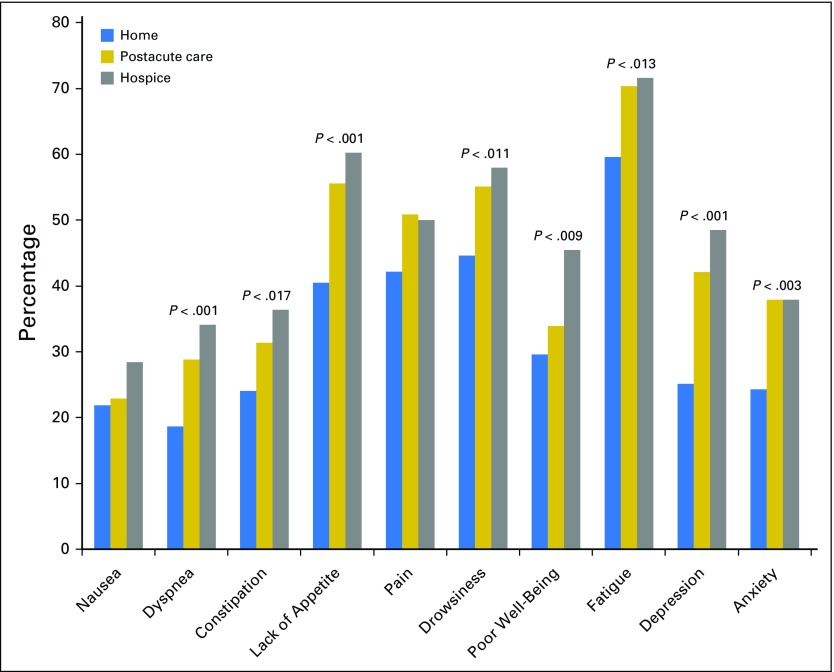
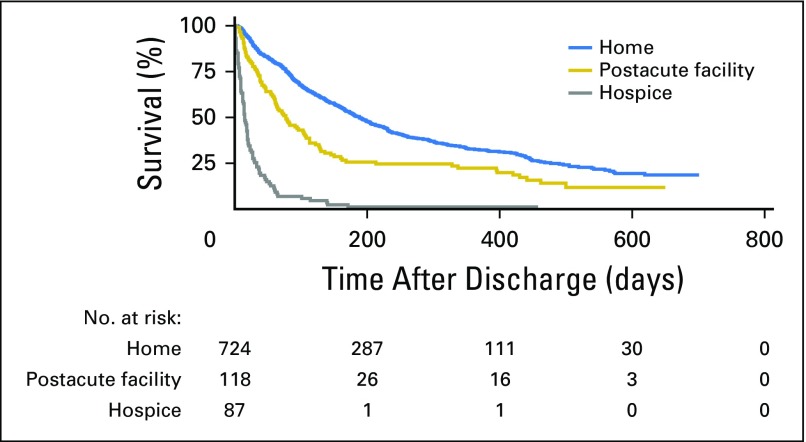
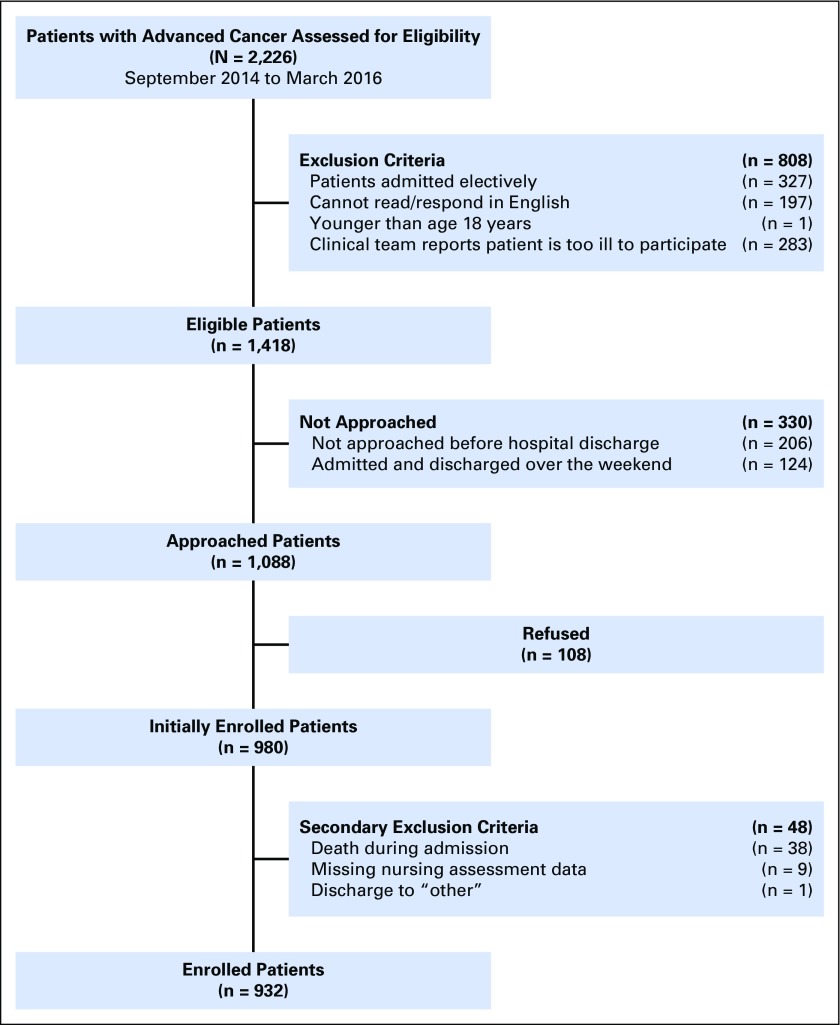
Purpose Patients with advanced cancer experience potentially burdensome transitions of care after hospitalizations. We examined predictors of discharge location and assessed the relationship between discharge location and survival in this population. Methods We conducted a prospective study of 932 patients with advanced cancer who experienced an unplanned hospitalization between September 2014 and March 2016. Upon admission, we assessed patients' physical symptoms (Edmonton Symptom Assessment System) and psychological distress (Patient Health Questionnaire-4). The primary outcome was discharge location (home without hospice, postacute care [PAC], or hospice [any setting]). The secondary outcome was survival. Results Of 932 patients, 726 (77.9%) were discharged home without hospice, 118 (12.7%) were discharged to PAC, and 88 (9.4%) to hospice. Those discharged to PAC and hospice reported high rates of severe symptoms, including dyspnea, constipation, low appetite, fatigue, depression, and anxiety. Using logistic regression, patients discharged to PAC or hospice versus home without hospice were more likely to be older (odds ratio [OR], 1.03; 95% CI, 1.02 to 1.05; P < .001), live alone (OR, 1.95; 95% CI, 1.25 to 3.02; P < .003), have impaired mobility (OR, 5.08; 95% CI, 3.46 to 7.45; P < .001), longer hospital stays (OR, 1.15; 95% CI, 1.11 to 1.20; P < .001), higher Edmonton Symptom Assessment System physical symptoms (OR, 1.02; 95% CI, 1.003 to 1.032; P < .017), and higher Patient Health Questionnaire-4 depression symptoms (OR, 1.13; 95% CI, 1.01 to 1.25; P < .027). Patients discharged to hospice rather than PAC were more likely to receive palliative care consultation (OR, 4.44; 95% CI, 2.12 to 9.29; P < .001) and have shorter hospital stays (OR, 0.84; 95% CI, 0.77 to 0.91; P < .001). Patients discharged to PAC versus home had lower survival (hazard ratio, 1.53; 95% CI, 1.22 to 1.93; P < .001). Conclusion Patients with advanced cancer who were discharged to PAC facilities and hospice had substantial physical and psychological symptom burden, impaired physical function, and inferior survival compared with those discharged to home. These patients may benefit from interventions to enhance their quality of life and care.
Figures
References
-
- Institute of Medicine: Dying in America. Washington, DC, The National Academies Press, 2015.
Publication types
MeSH terms
Grants and funding
LinkOut - more resources
Full Text Sources
Other Literature Sources
Medical
