. 2017 Oct 25;12(10):e0185178.
doi: 10.1371/journal.pone.0185178. eCollection 2017.

The responses of an anaerobic microorganism, Yersinia intermedia MASE-LG-1 to individual and combined simulated Martian stresses

Affiliations

The responses of an anaerobic microorganism, Yersinia intermedia MASE-LG-1 to individual and combined simulated Martian stresses

Kristina Beblo-Vranesevic et al. PLoS One. .

Abstract

The limits of life of aerobic microorganisms are well understood, but the responses of anaerobic microorganisms to individual and combined extreme stressors are less well known. Motivated by an interest in understanding the survivability of anaerobic microorganisms under Martian conditions, we investigated the responses of a new isolate, Yersinia intermedia MASE-LG-1 to individual and combined stresses associated with the Martian surface. This organism belongs to an adaptable and persistent genus of anaerobic microorganisms found in many environments worldwide. The effects of desiccation, low pressure, ionizing radiation, varying temperature, osmotic pressure, and oxidizing chemical compounds were investigated. The strain showed a high tolerance to desiccation, with a decline of survivability by four orders of magnitude during a storage time of 85 days. Exposure to X-rays resulted in dose-dependent inactivation for exposure up to 600 Gy while applied doses above 750 Gy led to complete inactivation. The effects of the combination of desiccation and irradiation were additive and the survivability was influenced by the order in which they were imposed. Ionizing irradiation and subsequent desiccation was more deleterious than vice versa. By contrast, the presence of perchlorates was not found to significantly affect the survival of the Yersinia strain after ionizing radiation. These data show that the organism has the capacity to survive and grow in physical and chemical stresses, imposed individually or in combination that are associated with Martian environment. Eventually it lost its viability showing that many of the most adaptable anaerobic organisms on Earth would be killed on Mars today.


Conflict of interest statement

Competing Interests: I have read the journal's policy and the authors of this manuscript have the following competing interests: Christine Moissl-Eichinger is a member of the editorial board of PLOS One. This does not alter our adherence to PLOS ONE policies on sharing data and materials.

Figures

Fig 1
Fig 1. The Trex-Box.
The desiccated cells on quartz glass discs can be positioned (arrow 1) inside the open Trex-Box. The box can be connected to various pumping systems (arrow 2) (A). Closed Trex-Box is ready for exposure to combined stresses e.g. radiation and vacuum (B).
Fig 2
Fig 2. Microscopic images of Y. intermedia MASE-LG-1.
SEM (A) and TEM (B) images of Y. intermedia MASE-LG-1 and growth curve (C) of Y. intermedia MASE-LG-1 cultivated under optimal anoxic conditions (30°C, pH 7). Growth was determined by direct cell counting using a Thoma counting chamber (n = 3). Bars: 1.0 μm.
Fig 3
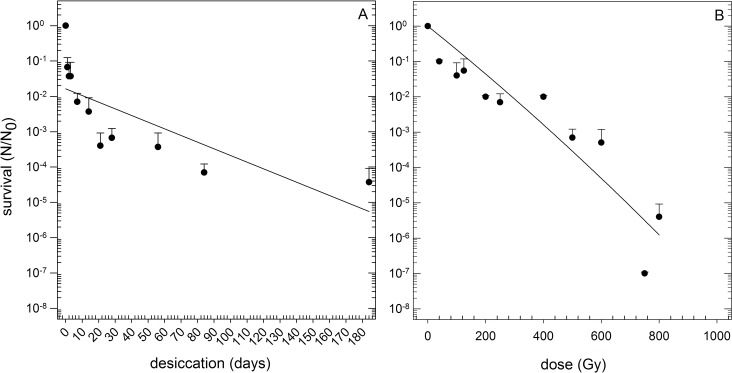
Fig 3. Survival after desiccation and radiation.
Survival of Y. intermedia MASE-LG-1 after anoxic desiccation (A) and after exposure to ionizing radiation (B). N0: Viable cells without desiccation / irradiation, N: Viable cells after desiccation / irradiation (n = 3). (A) Cells were applied on glass slides and dried under anoxic conditions up to 190 days. (B) Cells were exposed to ionizing radiation up to 1000 Gy in liquid culture medium under anoxic conditions.
Fig 4
Fig 4. Survival of Y. intermedia MASE-LG-1 after exposure to desiccation, vacuum and Martian atmosphere.
N0: viable cells without desiccation / exposure to vacuum, N: viable cells after desiccation / exposure to vacuum (n = 3). Black: Cells were desiccated on glass slides under anoxic conditions. Light grey: Cells were desiccated on quartz discs under anoxic conditions and exposed to vacuum (10−5 Pa) within the Trex-Box. Dark grey: Cells were desiccated on quartz discs under anoxic conditions and exposed to Martian atmosphere (Mars gas at a pressure of 10−3 Pa) within the Trex-Box.
Fig 5
Fig 5. Survival after combined stresses (desiccation and radiation).
Survival of Y. intermedia MASE-LG-1 after desiccation and irradiation in combination (A) and desiccation and irradiation in the presence of oxygen (B). N0: Viable cells without desiccation / irradiation. N: Viable cells after desiccation / irradiation (n = 3). (A) White squares: Cells were exposed to ionizing radiation under anoxic conditions in liquid culture medium. Black circles: Cells were desiccated (24 h) under anoxic conditions and subsequently exposed to ionizing radiation under anoxic conditions. Grey circles: Cells were exposed to ionizing radiation under anoxic conditions and subsequently desiccated (24 h) under anoxic conditions. (B) Black circles: Cells were desiccated (24 h) under anoxic conditions and subsequently exposed to ionizing radiation under anoxic conditions. White triangles: Cells were desiccated (24 h) under anoxic conditions and subsequently exposed to ionizing radiation under oxic conditions. White square: Survival of Y. intermedia MASE-LG-1 without desiccation and irradiation treatment.
Fig 6
Fig 6. Influence of nutrient limitation.
Influence of nutrient limitation on tolerance to desiccation (A) and ionizing radiation (B). N0: Viable cells without desiccation / irradiation, N: Viable cells after desiccation / irradiation. Recovery was performed under standard cultivation conditions (n = 3). (A) Black columns: growth in diluted medium after standard cultivation time (24 h). MASE I medium including all supplements was diluted 1:10 / 1:50 before inoculation. Grey columns: survival of Y. intermedia MASE-LG-1 in diluted medium (1:10 / 1:50) after desiccation (24 h) under anoxic conditions. Asterisks denote significant difference (p < 0.05) to the control (desiccation in full medium). (B) Cells grown under a limited set of nutrients were exposed to ionizing radiation up to 800 Gy under anoxic conditions. White squares: MASE I cultivation medium including all supplements without dilution. Black circles: MASE I cultivation medium, including all supplements was diluted 1:10 before inoculation. Grey circles: MASE I cultivation medium, including all supplements was diluted 1:50 before inoculation.
Fig 7
Fig 7. Influence of perchlorates.
Influence of perchlorates on tolerance to desiccation (A) and ionizing radiation (B). N0: Viable cells without desiccation / irradiation, N: Viable cells after desiccation / irradiation. Recovery was performed under standard cultivation conditions without perchlorate (n = 3). Asterisks denote significant difference (p < 0.05) to the control (survival after desiccation without perchlorates). (A) Black columns: Cells were exposed (15 min) to 0.5% perchlorate (0.5% NaClO4 = 35.6 mM; 0.5% Ca(Cl4)2 = 20.9 mM; 0.5% Mg(ClO4)2 = 22.4 mM) before desiccation treatment (24 h, anoxic conditions). Grey columns: Cells were exposed (15 min) to 1.0% perchlorate (1.0% NaClO4 = 71.2 mM; 1.0% Ca(Cl4)2 = 41.9 mM; 1.0% Mg(ClO4)2 = 44.8 mM) before desiccation treatment (24 h, anoxic conditions). (B) Cells were exposed (15 min) to the indicated perchlorates before treatment with ionizing radiation up to 800 Gy. Black circles: 0.5% Mg(ClO4)2; White circle: 1% Mg(ClO4)2; Black triangle: 0.5% Na(ClO4); White triangle: 1% Na(ClO4); Black square 0.5% Ca(ClO4)2; White square: 1% Ca(ClO4)2.

References

    1. Pollack JB, Kasting JF, Richardson SM, Poliakoff K. The case for a wet, warm climate on early Mars. Icarus. 1987;71: 203–224. - PubMed
    1. Baker VR. Water and the Martian landscape. Nature. 2001;412: 228–236. doi: 10.1038/35084172 - DOI - PubMed
    1. Jakosky BM, Phillips RJ. Mars' volatile and climate history. Nature. 2001;412: 237–244. doi: 10.1038/35084184 - DOI - PubMed
    1. Horneck G. The microbial world and the case for Mars. Planet Space Sci. 2000;48: 1053–1063.
    1. Cockell CS, Bush T, Bryce C, Direito S, Fox-Powell M, Harrison JP et al. Habitability: a review. Astrobiology. 2016;16: 89–117. doi: 10.1089/ast.2015.1295 - DOI - PubMed