Review
. 2018 Jan 1;42(1):fux050.
doi: 10.1093/femsre/fux050.

Metals in fungal virulence

Affiliations
Review

Metals in fungal virulence

Franziska Gerwien et al. FEMS Microbiol Rev. .

Abstract

Metals are essential for life, and they play a central role in the struggle between infecting microbes and their hosts. In fact, an important aspect of microbial pathogenesis is the 'nutritional immunity', in which metals are actively restricted (or, in an extended definition of the term, locally enriched) by the host to hinder microbial growth and virulence. Consequently, fungi have evolved often complex regulatory networks, uptake and detoxification systems for essential metals such as iron, zinc, copper, nickel and manganese. These systems often differ fundamentally from their bacterial counterparts, but even within the fungal pathogens we can find common and unique solutions to maintain metal homeostasis. Thus, we here compare the common and species-specific mechanisms used for different metals among different fungal species-focusing on important human pathogens such as Candida albicans, Aspergillus fumigatus or Cryptococcus neoformans, but also looking at model fungi such as Saccharomyces cerevisiae or A. nidulans as well-studied examples for the underlying principles. These direct comparisons of our current knowledge reveal that we have a good understanding how model fungal pathogens take up iron or zinc, but that much is still to learn about other metals and specific adaptations of individual species-not the least to exploit this knowledge for new antifungal strategies.

Keywords: host–pathogen interactions; metal homeostasis; nutritional immunity; pathogenic fungi; regulatory networks; transition metals.


Figures

Figure 1.
Figure 1.
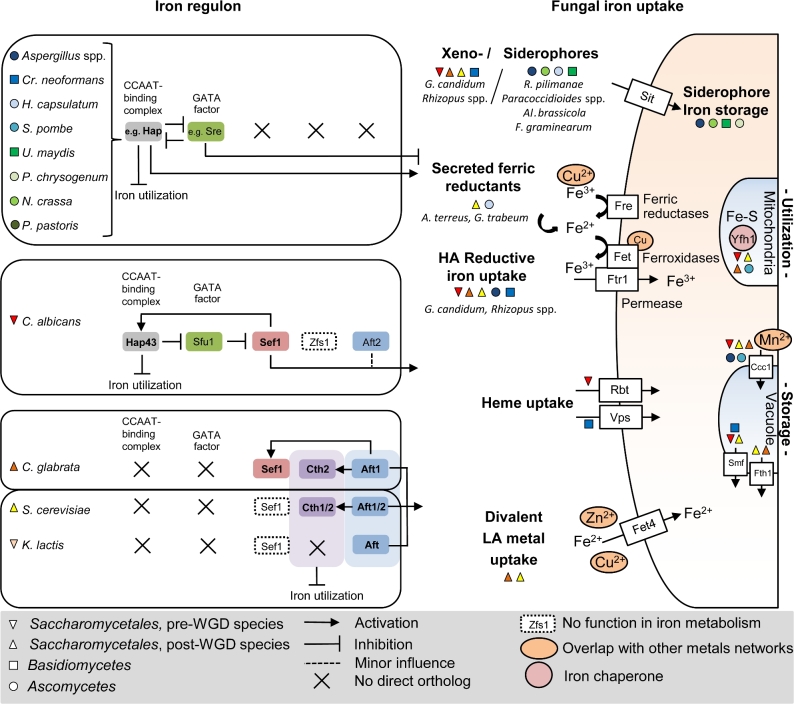
Fungal iron homeostasis. Regulation of iron homeostasis (left panel side) is shown for different fungal species (species is color coded, shape defines phylogenetic ancestry according to Gabaldon et al. 2013). Major transcription factors upregulated during iron starvation to initiate fungal iron uptake (right panel side) are written in bold. Functional orthologs are color shaded and aligned vertically, X indicates lack of ortholog and a white box with dashed borders indicates that an ortholog is present but not involved in iron homeostasis. HA, high affinity; LA, low affinity.
Figure 2.
Figure 2.
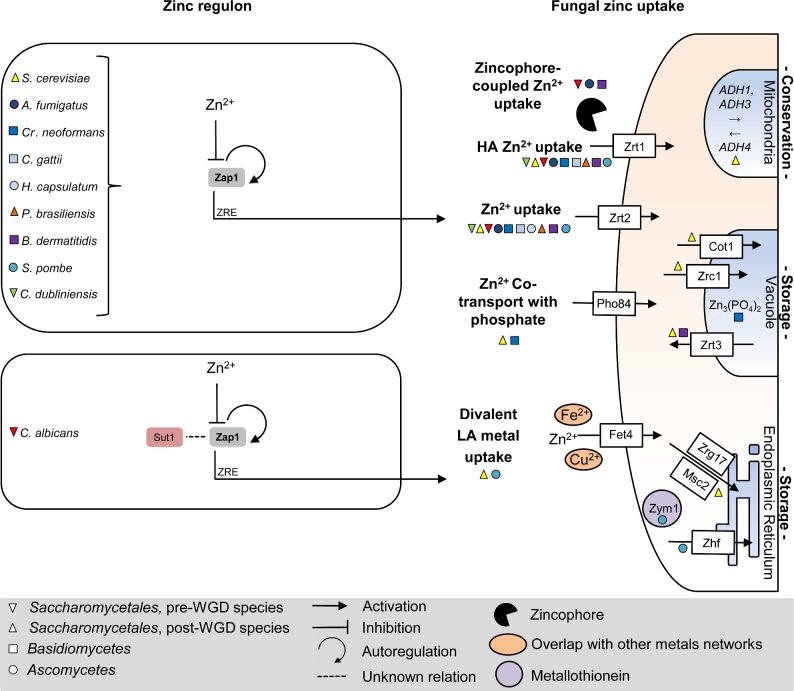
Fungal zinc homeostasis. Regulation of zinc homeostasis (left panel side) is shown for different fungal species (species is color coded, shape defines phylogenetic ancestry according to Gabaldon et al. 2013). Major transcription factors upregulated during zinc starvation to initiate fungal zinc uptake (right panel side) are written in bold. Orthologs are color shaded and aligned vertically. ZRE, recognition of target genes via zinc responsive elements. HA, high affinity; LA, low affinity.
Figure 3.
Figure 3.
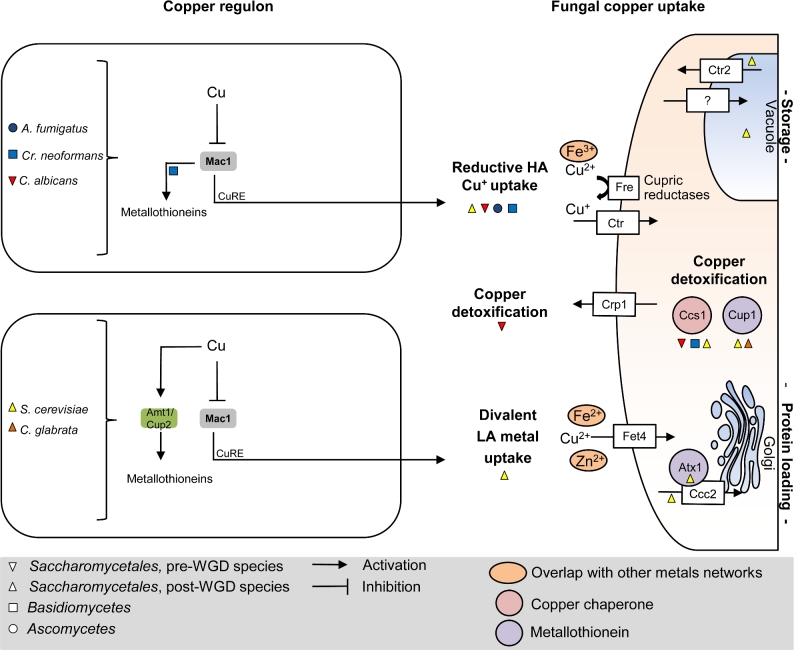
Fungal copper homeostasis. Regulation of copper homeostasis (left panel side) is shown for different fungal species (species is color coded, shape defines phylogenetic ancestry according to Gabaldon et al. 2013). Major transcription factors upregulated during copper starvation to initiate fungal copper uptake (right panel side) are written in bold. Orthologs are color shaded and aligned vertically. CuRE, recognition of target genes via copper responsive elements. HA, high affinity; LA, low affinity.

References

    1. Agranoff D, Collins L, Kehres D et al. The Nramp orthologue of Cryptococcus neoformans is a pH-dependent transporter of manganese, iron, cobalt and nickel. Biochem J 2005;385:225–32. - PMC - PubMed
    1. Almeida RS, Brunke S, Albrecht A et al. The hyphal-associated adhesin and invasin Als3 of Candida albicans mediates iron acquisition from host ferritin. PLoS Pathog 2008;4:e1000217. - PMC - PubMed
    1. Amich J, Leal F, Calera JA. Repression of the acid ZrfA/ZrfB zinc-uptake system of Aspergillus fumigatus mediated by PacC under neutral, zinc-limiting conditions. Int Microbiol 2010;12:39–47. - PubMed
    1. Amich J, Vicentefranqueira R, Leal F et al. Aspergillus fumigatus survival in alkaline and extreme zinc-limiting environments relies on the induction of a zinc homeostasis system encoded by the zrfC and aspf2 genes. Eukaryot Cell 2010;9:424–37. - PMC - PubMed
    1. Amich J, Vicentefranqueira R, Mellado E et al. The ZrfC alkaline zinc transporter is required for Aspergillus fumigatus virulence and its growth in the presence of the Zn/Mn‐chelating protein calprotectin. Cell Microbiol 2014;16:548–64. - PubMed

Publication types