


Negative Symptom Interventions in Youth at Risk of Psychosis: A Systematic Review and Network Meta-analysis
- PMID: 29069511
- PMCID: PMC6007754
- DOI: 10.1093/schbul/sbx139
Negative Symptom Interventions in Youth at Risk of Psychosis: A Systematic Review and Network Meta-analysis
Erratum in
-
Erratum to: Devoe DJ, Peterson A, Addington J. Negative Symptom Interventions in Youth at Risk of Psychosis: A Systematic Review and Network Meta-Analysis.Schizophr Bull. 2018 Feb 15;44(2):463. doi: 10.1093/schbul/sbx193. Schizophr Bull. 2018. PMID: 29462457 Free PMC article. No abstract available.
Abstract
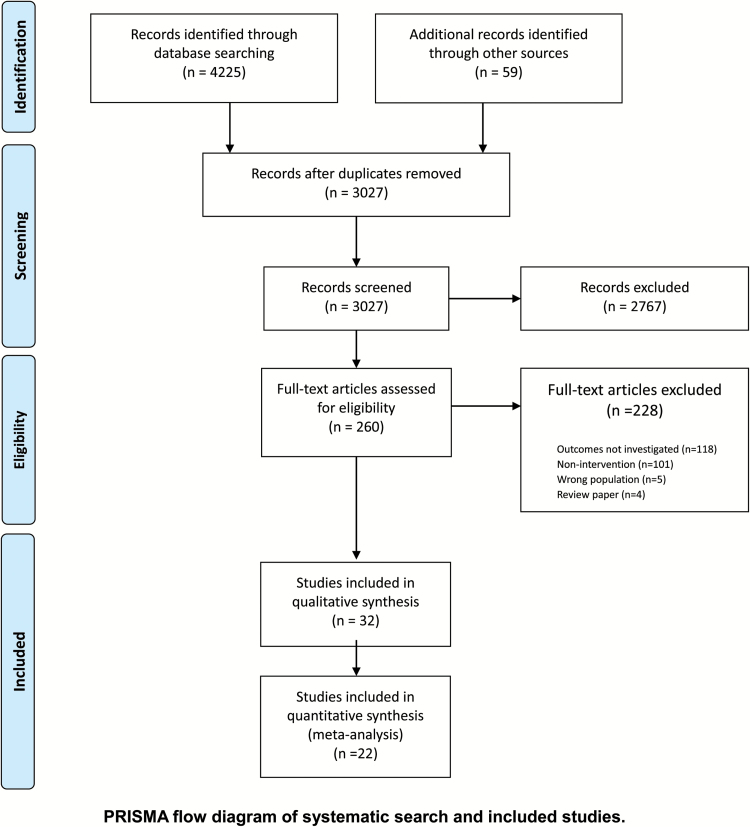
Objective: Youth at clinical high risk (CHR) for psychosis often demonstrate significant negative symptoms, which have been reported to be predictive of conversion to psychosis and a reduced quality of life but treatment options for negative symptoms remain inadequate. Therefore, we conducted a systematic review and network meta-analysis of all intervention studies examining negative symptom outcomes in youth at CHR for psychosis.
Method: The authors searched PsycINFO, Medline, Embase, CINAHL, and EBM from inception to December 2016. Studies were selected if they included any intervention that reported follow-up negative symptoms in youth at CHR for psychosis. Treatment comparisons were evaluated using both pairwise and network meta-analyses. Due to the differences in negative symptom scales the effect sizes were reported as the standardized mean difference (SMD).
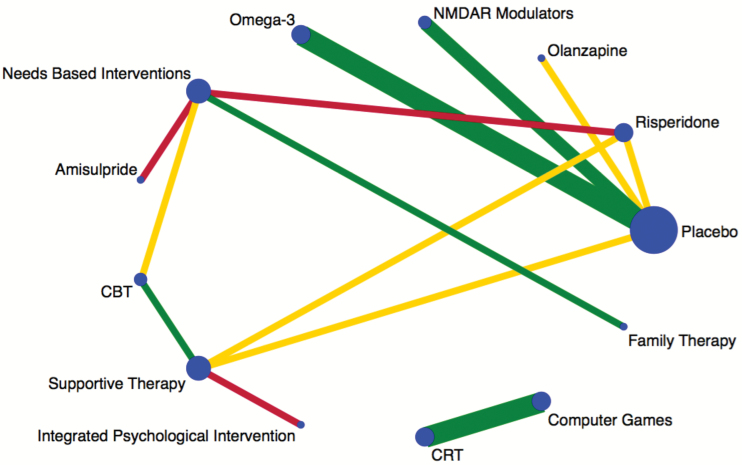
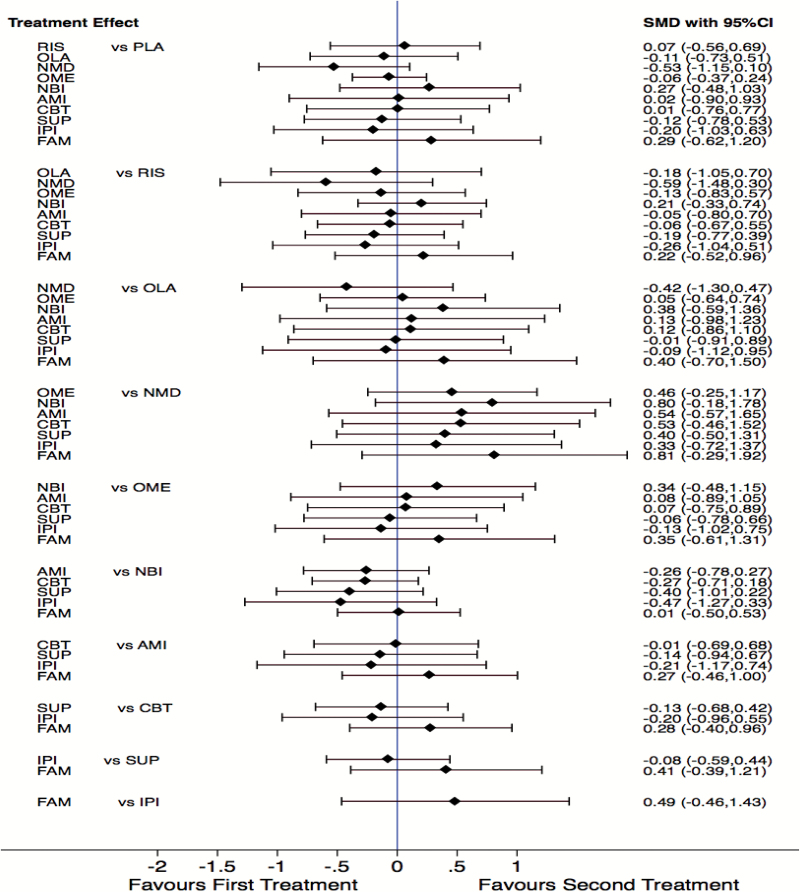
Results: Of 3027 citations, 32 studies met our inclusion criteria, including a total of 2463 CHR participants. The null hypothesis was not rejected for any of the 11 treatments. N-methyl-D-aspartate-receptor (NMDAR) modulators trended toward a significant reduction in negative symptoms compared to placebo (SMD = -0.54; 95% CI = -1.09 to 0.02; I2 = 0%, P = .06). In respective order of descending effectiveness as per the treatment hierarchy, NMDAR modulators were more effective than family therapy, need-based interventions, risperidone, amisulpride, cognitive behavioral therapy, omega-3, olanzapine, supportive therapy, and integrated psychological interventions.
Conclusions: Efficacy and effectiveness were not confirmed for any negative symptom treatment. Many studies had small samples and the majority were not designed to target negative symptoms.
Figures
References
-
- McGlashan T, Walsh B, Woods S.. The Psychosis-Risk Syndrome: Handbook for Diagnosis and Follow-up. New York, NY: Oxford University Press; 2010.
-
- Yung AR, Yuen HP, McGorry PD, et al. Mapping the onset of psychosis: the Comprehensive Assessment of At-Risk Mental States. Aust N Z J Psychiatry. 2005;39:964–971. - PubMed
-
- Fusar-Poli P, Van Os J. Lost in transition: setting the psychosis threshold in prodromal research. Acta Psychiatr Scand. 2013;127:248–252. - PubMed
Publication types
MeSH terms
Substances
Grants and funding
LinkOut - more resources
Full Text Sources
Other Literature Sources
Medical
Miscellaneous
