


Androgen receptor amplification is concordant between circulating tumor cells and biopsies from men undergoing treatment for metastatic castration resistant prostate cancer
- PMID: 29069718
- PMCID: PMC5641061
- DOI: 10.18632/oncotarget.16169
Androgen receptor amplification is concordant between circulating tumor cells and biopsies from men undergoing treatment for metastatic castration resistant prostate cancer
Abstract
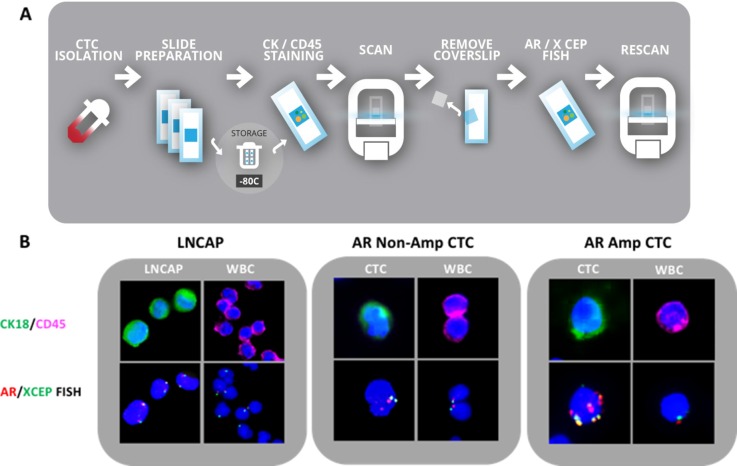
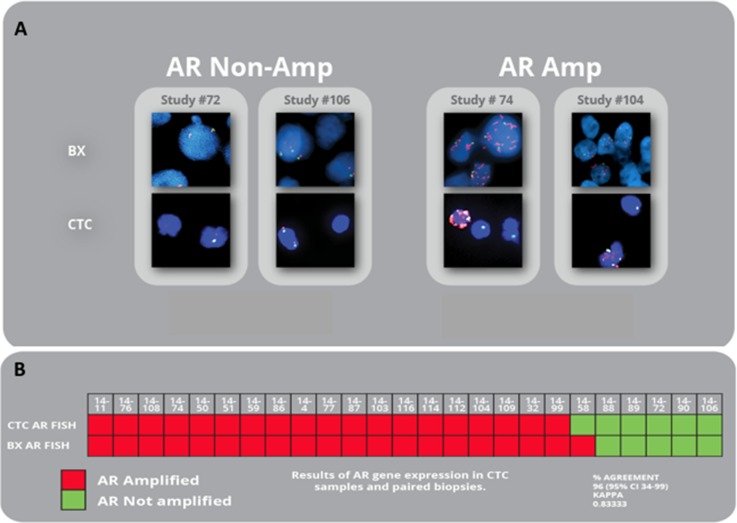
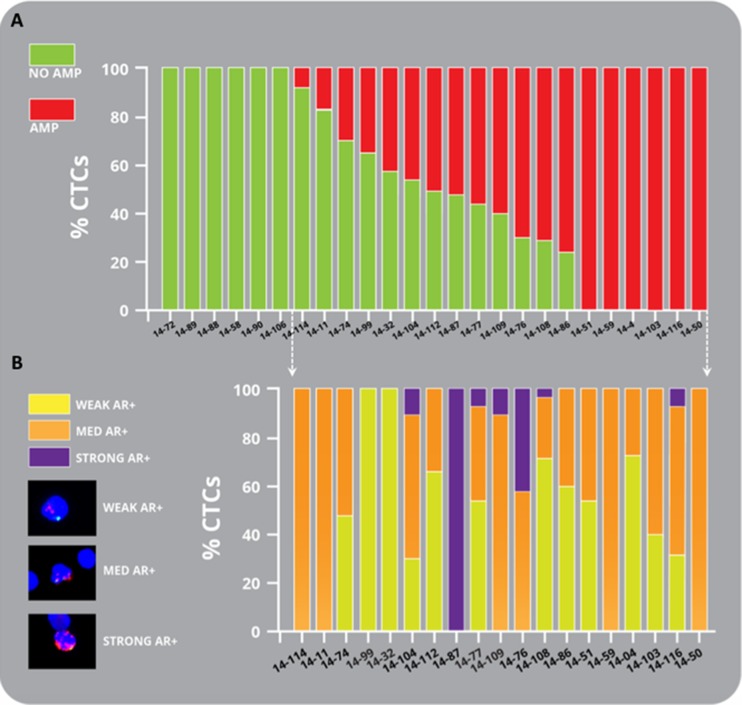
Increased AR activity has been shown to be preserved in spatially distinct metastatic tumors from the same patient suggesting the requirement for lineage-specific dependencies for metastatic castration resistant prostate cancer (mCRPC). Amplification of the AR gene is a common mechanism by which mCRPC increase AR activity. To determine whether AR amplification in circulating tumor cells (CTC) could complement metastatic tissue biopsies in men undergoing treatment for mCRPC, we developed a novel two-step assay to isolate CTCs and subsequently analyzed AR amplification status in CTCs and matched biopsy tissue from the same patient by fluorescence in situ hybridization (FISH). AR gene status in CTCs showed strong concordance with AR gene status in matched tissue samples in 24 of 25 patients (Correlation: 96%; Kappa: 0.83; Sensitivity: 100%, Specificity: 83%). Our work demonstrates that AR amplification is conserved between CTCs and biopsies and that CTCs can serve as non-invasive surrogate to document AR amplification in mCRPC.
Keywords: androgen receptor; circulating tumor cells; metastases; metastatic castration resistant prostate cancer; prostate cancer.
Conflict of interest statement
CONFLICTS OF INTEREST The authors declare that they have no competing interest
Figures
References
-
- Chen CD, Welsbie DS, Tran C, Baek SH, Chen R, Vessella R, Rosenfeld MG, Sawyers CL. Molecular determinants of resistance to antiandrogen therapy. Nat Med. 2004;10:33–39. - PubMed
-
- Scher HI, Sawyers CL. Biology of progressive, castration-resistant prostate cancer: directed therapies targeting the androgen-receptor signaling axis. J Clin Oncol. 2005;23:8253–8261. - PubMed
-
- Kumar A, Coleman I, Morrissey C, Zhang X, True LD, Gulati R, Etzioni R, Bolouri H, Montgomery B, White T, Lucas JM, Brown LG, Dumpit RF, et al. Substantial interindividual and limited intraindividual genomic diversity among tumors from men with metastatic prostate cancer. Nat Med. 2016;22:369–378. - PMC - PubMed
Grants and funding
LinkOut - more resources
Full Text Sources
Other Literature Sources
Research Materials
