. 2017 May 30;8(42):71833-71844.
doi: 10.18632/oncotarget.18284. eCollection 2017 Sep 22.

AG488 as a therapy against gliomas

Affiliations

AG488 as a therapy against gliomas

Jadith Ziegler et al. Oncotarget. .

Abstract

High-grade gliomas such as glioblastomas (GBM) present a deadly prognosis following diagnosis and very few effective treatment options. Here, we investigate if the small molecule AG488 can be an effective therapy against GBM with both anti-angiogenic as well as an anti-microtubule inhibiting modalities, using a human G55 glioma xenograft model in nude mice. From in vitro studies, we report that AG488 incubation reduced cell viability in G55 and HMEC-1 cells more so than TMZ treatment, and AG488 treatment also decreased cell viability in normal astrocytes, but not as much as for G55 cells (p<0.0001). In vivo investigations indicated that AG488 therapy helped reduce tumor volumes (p<0.0001), prolong survival (p<0.01), increase tumor perfusion (p<0.01), and decrease microvessel density (MVD) (p<0.05), compared to untreated mice or mice treated with non-specific IgG, in the G55 xenograft model. Additionally, AG488 did not induce apoptosis in normal mouse brain tissue. Animal survival and tumor volume changes for AG488 were comparable to TMZ or anti-VEGF therapies, however AG488 was found to be more effective in decreasing tumor-related vascularity (perfusion and MVD). AG488 is a potential novel therapy against high-grade gliomas.

Keywords: angiogenesis; anti-cancer therapy; gliomas; in vivo; magnetic resonance imaging (MRI).


Conflict of interest statement

CONFLICTS OF INTEREST There are no conflicts of interest

Figures
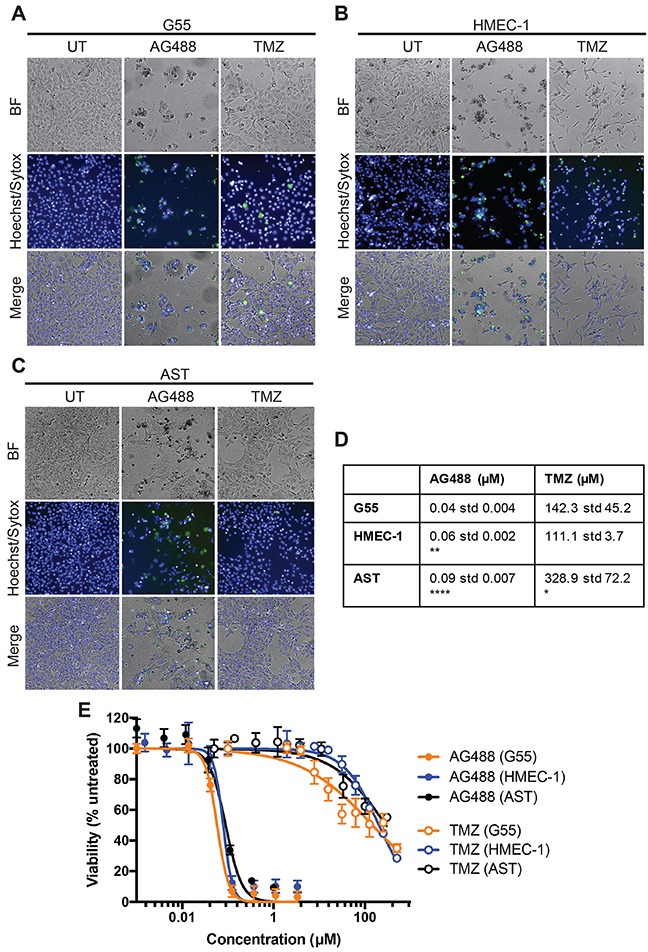
Figure 1
Figure 1. AG488 decreased G55 cell viability
G55 or HMEC-1 were seeded in 96-well plates at 3-5 × 10³ cells/well. Cells were then incubated with either AG488 (0.12 μM) or TMZ (300 μM). Viable cells were labeled Hoechst (blue) and dead cells were labeled with Sytox (green). Images of G55 cells were obtained (A) as well as HMEC-1 (B) and AST (primary astrocytes) (C). (D) Average EC50 values were calculated for each cell line and treatment. Data are listed as means ±S.D. There was a significant difference (*p<0.05, **p<0.01, or ****p<0.0001) when compared to G55 cells. (E) Representative dose response curves of G55, HMEC-1 or AST cells treated with either AG488 or TMZ were generated. Data are listed as means ±S.D.
Figure 2
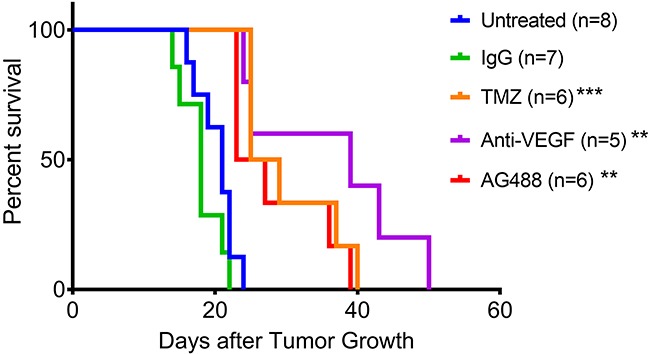
Figure 2. AG488 therapy increases percent survival in G55 gliomas
Animal survival curve for G55 glioma-bearing mice either untreated (n=8), IgG treated (n=7), TMZ treated (n=6), anti-VEGF treated (n=5) or AG488 treated (n=6). There was a significant increase in percent survival for all treatment groups (TMZ: p<0.001, anti-VEGF: p<0.01, and AG488: p<0.01) compared to untreated and IgG treated mice (non-specific antibody negative control).
Figure 3
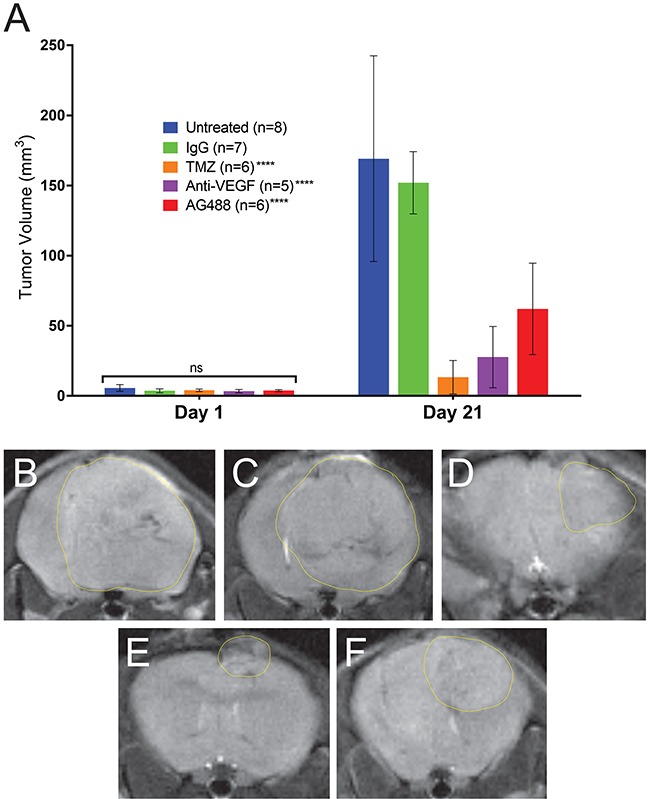
Figure 3. AG488 therapy decreases tumor volumes in G55 gliomas
Tumor volumes (mm3) were calculated from MR images. (A) All treatments had significantly reduced tumor volumes (p<0.0001 for TMZ, anti-VEGF, and AG488) compared to untreated and IgG treated mice. MRI morphological representations (with measured tumor volumes) for each treatment group are depicted in panels for (B) untreated (197.94 mm3), (C) IgG (170.25 mm3), (D) TMZ (17.31 mm3), (E) anti-VEGF (20.74 mm3), and (F) AG488 (31.92 mm3) G55 tumor-bearing mice.
Figure 4
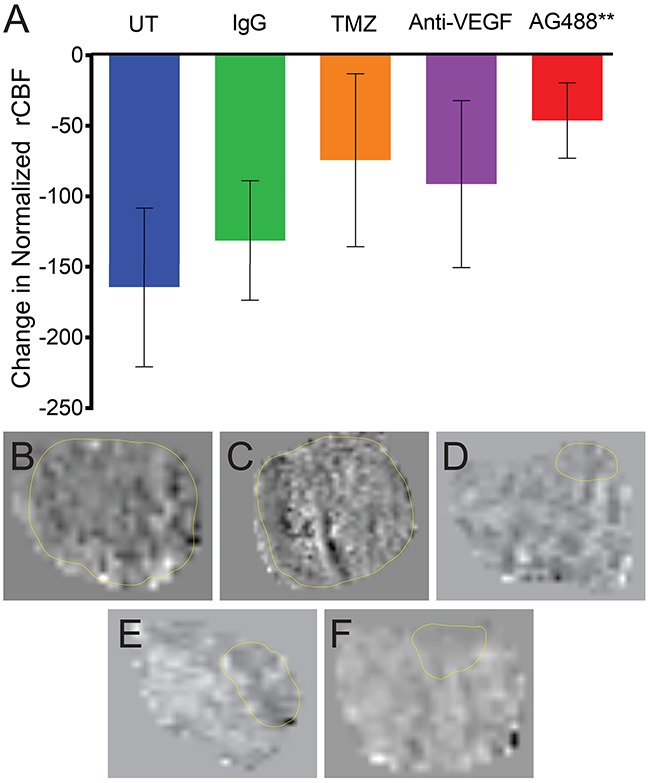
Figure 4. AG488 therapy increases tumor perfusion in G55 gliomas
Tumor perfusion was obtained via the MRI technique, arterial spin labeling (ASL), and calculated normalized relative cerebral blood flow (rCBF) values are depicted in a bar graph (A). Treatment with AG488 significantly increased rCBF compared to the untreated and IgG treatment groups (p<0.01). There was no significant change in the TMZ and anti-VEGF treatment groups, compared to the controls. Perfusion maps for each treatment group are depicted for (B) untreated, (C) IgG, (D) TMZ, (E) anti-VEGF, and (F) AG488 G55 tumor-bearing mice.
Figure 5
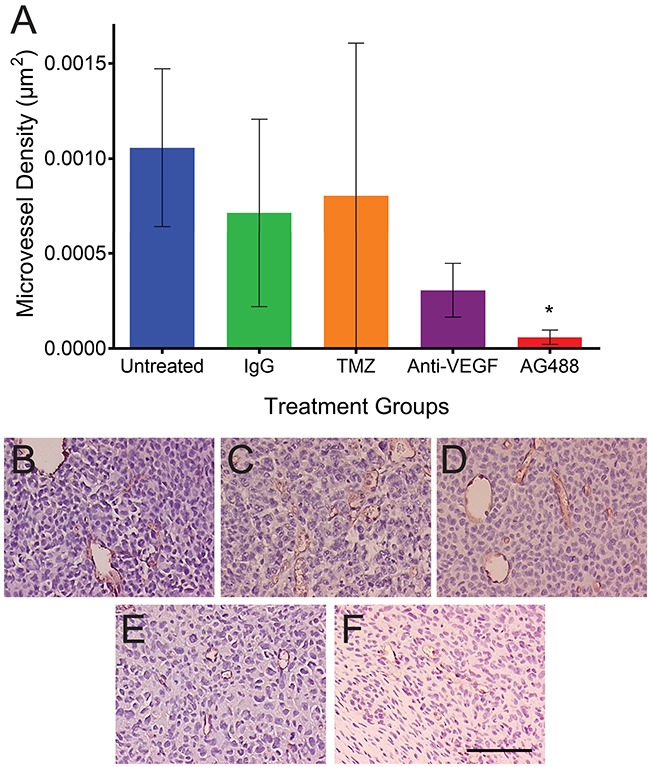
Figure 5. AG488 therapy decreases microvessel density in G55 gliomas
Immunohistochemistry was utilized, and tissues were stained for CD34. (A) A bar graph depicts AG488 treatment significantly decreased microvessel density in tumor tissue samples, compared to the untreated group (p<0.05). There was no change in the microvessel density for the TMZ and anti-VEGF treatment groups, compared to controls. Histological representative images for each treatment group are depicted for (B) untreated, (C) IgG, (D) TMZ, (E) anti-VEGF, and (F) AG488 G55 tumor-bearing mice. Scale bar=100 μm. Magnifications are all 20x.
Figure 6
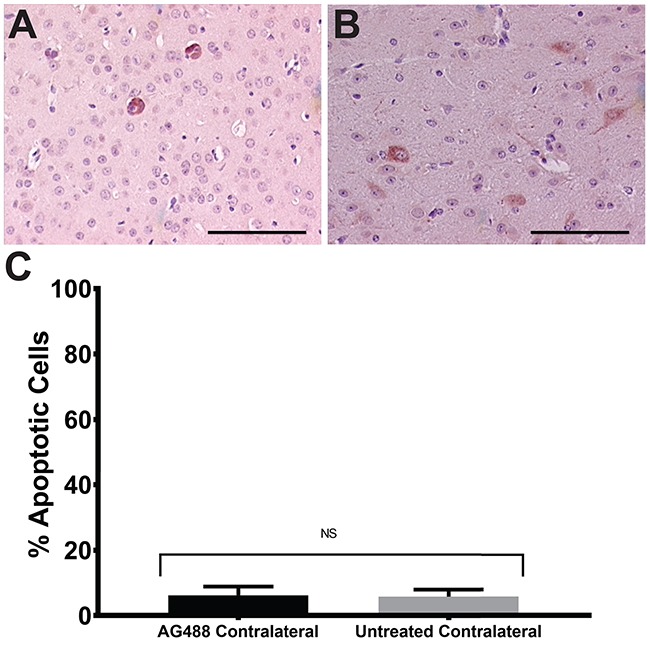
Figure 6. AG488 therapy does not affect normal brain cells
Untreated and AG488 treated contralateral tissue was stained with cleaved caspase-3 antibody and apoptosis was assessed. Histological representative images depicted for AG488 contralateral (A) and untreated (B) tissue. Bar graph in (C) depicts no significant difference in % apoptosis between treatment groups. Scale bar=100 μm. Magnifications are all 20x.

References

    1. Wen PY, Kesari S. Malignant gliomas in adults. N Engl J Med. 2008;359:492–507. - PubMed
    1. Ostrom QT, Gittleman H, de Blank PM, Finlay JL, Gurney JG, McKean-Cowdin R, Stearns DS, Wolff JE, Liu M, Wolinsky Y, Kruchko C, Barnholtz-Sloan JS. American Brain Tumor Association Adolescent and Young Adult Primary Brain and Central Nervous System Tumors Diagnosed in the United States in 2008-2012. Neuro-oncol. 2016;18:i1–50. - PMC - PubMed
    1. Rousseau A, Mokhtari K, Duyckaerts C. The 2007 WHO classification of tumors of the central nervous system - what has changed? Curr Opin Neurol. 2008;21:720–27. - PubMed
    1. Bastien JI, McNeill KA, Fine HA. Molecular characterizations of glioblastoma, targeted therapy, and clinical results to date. Cancer. 2015;121:502–16. - PubMed
    1. Alves TR, Lima FR, Kahn SA, Lobo D, Dubois LG, Soletti R, Borges H, Neto VM. Glioblastoma cells: a heterogeneous and fatal tumor interacting with the parenchyma. Life Sci. 2011;89:532–39. - PubMed

LinkOut - more resources