


The caudal pedunculopontine tegmental nucleus may be involved in the regulation of skeletal muscle activity by melanocortin-sympathetic pathway: a virally mediated trans-synaptic tracing study in spinally transected transgenic mice
- PMID: 29069752
- PMCID: PMC5641095
- DOI: 10.18632/oncotarget.17983
The caudal pedunculopontine tegmental nucleus may be involved in the regulation of skeletal muscle activity by melanocortin-sympathetic pathway: a virally mediated trans-synaptic tracing study in spinally transected transgenic mice
Abstract
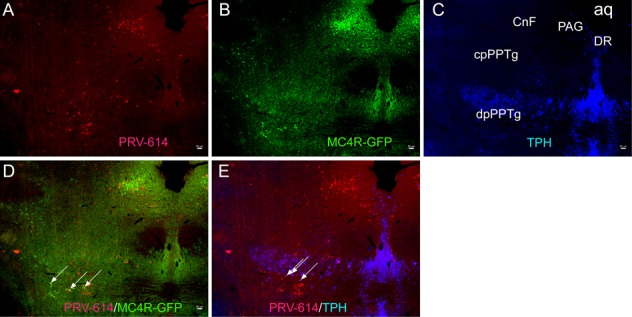
Understanding neuroanatomical sympathetic circuitry and neuronal connections from the caudal pedunculopontine tegmental nucleus to skeletal muscle is important to the study of possible mechanisms of pedunculopontine tegmental nucleus (PPTg) and cuneiform nucleus (CnF) that are involved in the regulation of skeletal muscle activity of the sympathetic pathway. The aim of this study was to use virus PRV-614 to trace the melanocortin-sympathetic neural pathways from PPTg and CnF to a hindlimb muscle (gastrocnemius) in spinally transected MC4R-GFP transgenic mice. PRV-614 was injected into the gastrocnemius muscle after receiving a complete spinal cord transection below the L2 level. PRV-614/MC4R-GFP and PRV-614/TPH dual-labeled neurons were found in the dissipated parts of PPTg (dpPPTg), but not between the compact parts of PPTg (cpPPTg) and CnF. It is proposed that a hierarchical pathway of neurons within the caudal pedunculopontine tegmental nucleus sends projections to the RVLM, which in turn projects onto the IML sympathetic preganglionic neurons that regulate muscle blood flow through melanocortin-sympathetic signals. Our results collectively indicate that MC4Rs expressed in caudal pedunculopontine tegmental nucleus may be involved in skeletal muscle activity of melanocortin-sympathetic pathways.
Keywords: melanocortin-4 receptor; mouse; pedunculopontine tegmental nucleus; pseudorabies virus; skeletal muscle.
Conflict of interest statement
CONFLICTS OF INTERESTS The authors have no conflicts of interest related to this paper.
Figures


References
-
- Zweig RM, Jankel WR, Hedreen JC, Mayeux R, Price DL. The pedunculopontine nucleus in Parkinson's disease. Annals of neurology. 1989;26:41–46. - PubMed
-
- Meissner WG, Frasier M, Gasser T, Goetz CG, Lozano A, Piccini P, Obeso JA, Rascol O, Schapira A, Voon V, Weiner DM, Tison F, Bezard E. Priorities in Parkinson's disease research. Nature reviews Drug discovery. 2011;10:377–393. - PubMed
-
- Rinne JO, Ma SY, Lee MS, Collan Y, Roytta M. Loss of cholinergic neurons in the pedunculopontine nucleus in Parkinson's disease is related to disability of the patients. Parkinsonism & related disorders. 2008;14:553–557. - PubMed
LinkOut - more resources
Full Text Sources
Other Literature Sources
