Review
. 2017 Oct 25;15(1):93.
doi: 10.1186/s12915-017-0443-x.

Plant hormone transporters: what we know and what we would like to know

Affiliations
Review

Plant hormone transporters: what we know and what we would like to know

Jiyoung Park et al. BMC Biol. .

Abstract

Hormone transporters are crucial for plant hormone action, which is underlined by severe developmental and physiological impacts caused by their loss-of-function mutations. Here, we summarize recent knowledge on the individual roles of plant hormone transporters in local and long-distance transport. Our inventory reveals that many hormones are transported by members of distinct transporter classes, with an apparent dominance of the ATP-binding cassette (ABC) family and of the Nitrate transport1/Peptide transporter family (NPF). The current need to explore further hormone transporter regulation, their functional interaction, transport directionalities, and substrate specificities is briefly reviewed.


Conflict of interest statement

Publisher’s Note

Springer Nature remains neutral with regard to jurisdictional claims in published maps and institutional affiliations.

Figures
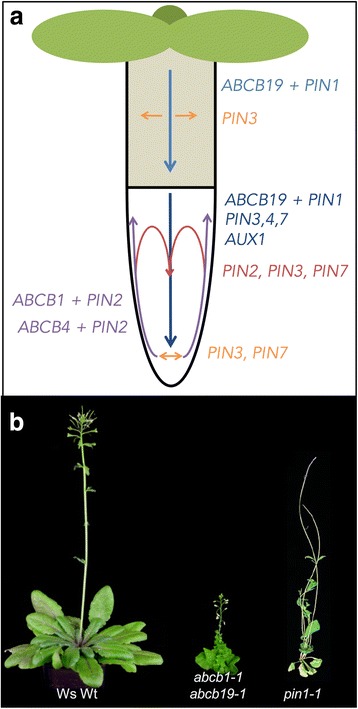
Fig. 1.
Fig. 1.
Main auxin transport routes and transporters in Arabidopsis seedlings and growth phenotypes of adult, mutant plants lacking auxin exporters. a Contribution of ABCB-, AUX1/LAX-, and PIN-type transporters in main auxin (IAA) transport routes (arrows) of seedling roots and hypocotyls, where auxin research has been focused. Concerted actions indicating a shared, overlapping function of two (or more) PIN- and ABCB-type auxin exporters (for details, see [12]) are designated by color-coded arrows. Figure modified from [12]. b Growth phenotypes of soil-grown plants defective in auxin export. From left to right: wild type (ecotype Wassilewskija, Ws), abcb1-1/abcb19-1 (taken from [36], and reprinted by permission of the publisher, Taylor & Francis Ltd, http://www.tandfonline.com) and pin1-1 (taken from [154] with permission). Note that, in contrast to the abcb1 abcb19 double mutant, abcb1 and abcb19 single mutants reveal only very subtle growth phenotypes, suggesting—despite opposite main transport routes—complementary action by ABCB19 and ABCB1 isoforms, respectively. Also note that other single PIN and higher order PIN mutants (without PIN1) [28] as well as single AUX1/LAX mutants and the quadruple aux1/lax mutant [23] reveal only very subtle growth phenotypes
Fig. 2.
Fig. 2.
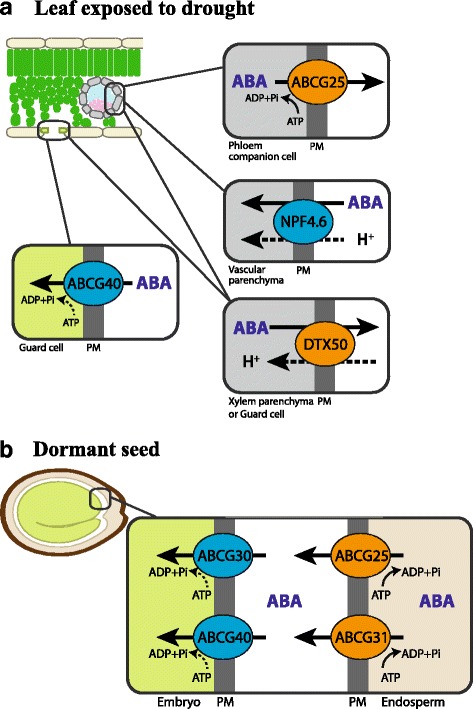
ABA transporters in the leaf exposed to drought and in the dormant seed. Transporters that mediate efflux of ABA are marked in orange, and transporters that mediate influx of ABA are marked in blue. a When exposed to drought, ABA synthesized in vascular parenchymal cells is exported out of the cells via ABCG25 and DTX50. NPF4.6/AIT1 is reported to regulate the level of ABA in the vascular parenchymal cells. In the guard cell, ABCG40 takes up ABA, which induces stomatal closing. b Concerted action of ABC transporters mediates ABA transfer from endosperm to embryo, thus maintaining seed dormancy. At the endosperm cells, ABCG25 and ABCG31 export ABA to the extracellular space. ABCG30 and ABCG40 take up ABA into embryo cells. Under normal conditions, most ABA inside the plant cell (pH around 7.5) is in anionic forms, while in the apoplast at a pH between 5 and 6 a larger part of ABA is present in uncharged forms. Under drought conditions when the pH of the xylem sap increases, more ABA in the apoplast becomes charged. Whether ABC transporters that mediate ABA import use ATP hydrolysis as an energy source is not clear (dashed arrows). A driving force for DTX50 and NPF4.6 was not examined, but it is most likely dependent on proton motive force, similarly to many MATE transporters and NPF family transporters (dashed arrows). PM plasma membrane
Fig. 3.
Fig. 3.
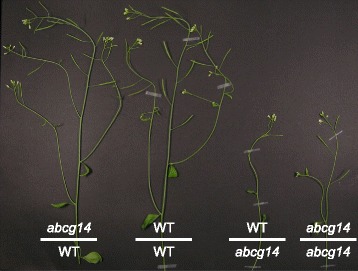
Retarded growth phenotype of cytokinin transporter mutant abcg14. Reciprocal grafting experiments support a role of ABCG14 in root-to-shoot transport of cytokinin, which is crucial for normal growth and development of the shoot. The graft between an abcg14 mutant scion and wild-type rootstock (abcg14/WT) complemented the stunted growth of abcg14 loss-of-function mutant plants (as shown by the graft between abcg14 scion and rootstock (abcg14/abcg14)), while the graft between a wild-type scion and abcg14 rootstock (WT/abcg14) maintained impaired growth. Image taken from [80]
Fig. 4.
Fig. 4.
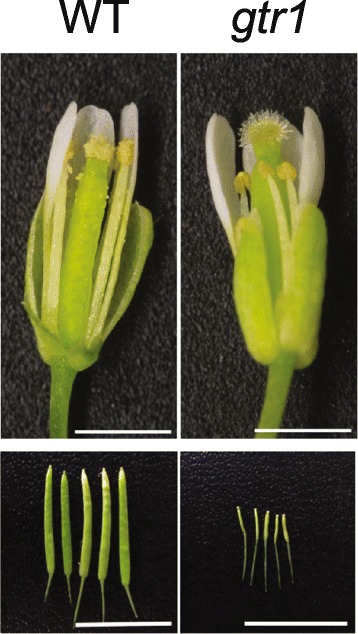
Reproductive organ phenotypes of GA/JA-Ile transporter mutant gtr1. Stamen growth is defective (top panel) and seed production is reduced (bottom panel) in the gtr1 mutant. Scale bar, 1 mm (top panel) and 10 mm (bottom panel). Images taken from [92]

References

    1. Darwin C, Darwin F. The power of movements in plants. London: Murray; 1880.
    1. Christie JM, Murphy AS. Shoot phototropism in higher plants: new light through old concepts. Am J Bot. 2013;100:35–46. - PubMed
    1. Bauer H, Ache P, Lautner S, Fromm J, Hartung W, Al-Rasheid KA, et al. The stomatal response to reduced relative humidity requires guard cell-autonomous ABA synthesis. Curr Biol. 2013;23:53–7. - PubMed
    1. Davies PJ. The plant hormones: their nature, occurrence, and functions. In: Davies PJ, editor. The plant hormones: biosynthesis, signal transduction, action! 3. Dordrecht: Springer Netherlands; 2010. pp. 1–15.
    1. Yang SF, Hoffmann NE. Ethylene biosynthesis and its regulation in higher plants. Annu Rev Plant Physiol. 1984;35:155–89.

Publication types

MeSH terms

LinkOut - more resources