


Prevalence of prenatal exposure to substances of abuse: questionnaire versus biomarkers
- PMID: 29070078
- PMCID: PMC5657059
- DOI: 10.1186/s12978-017-0385-3
Prevalence of prenatal exposure to substances of abuse: questionnaire versus biomarkers
Abstract
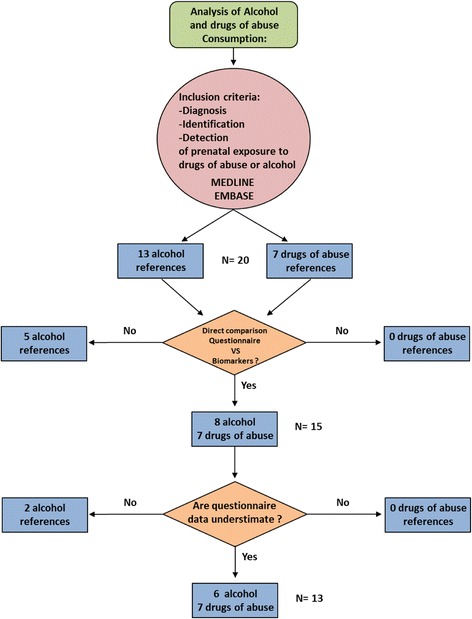
Alcohol and drugs of abuse consumption in young adults, including women of childbearing age, has experienced significant increase over the past two decades. The use of questionnaires as the only measure to investigate prenatal alcohol and drugs of abuse exposure underestimates the real prevalence of exposure and could mislead to wrong conclusions. Therefore, the aim of this article was to compare reported rates of prenatal alcohol and drugs of abuse consumption with biomarkers of exposure by a comprehensive review of the available literature. We searched MEDLINE and EMBASE databases for articles catalogued between 1992 and 2015. We identified relevant published studies that assessed the comparison between prenatal exposure to alcohol and drugs of abuse assessed by self-reported questionnaire of consumption versus biomarkers of exposure. Thirteen studies were included regarding alcohol consumption, and seven of them about drugs of abuse. Women who admitted consumption during pregnancy by questionnaire varied from 0 to 37% for alcohol, from 0 to 4.3% for cocaine, and 2.9% for tetrahydrocannabinol (THC). Positive biomarkers results ranged from 16 to 44% for alcohol, 15.4% for cocaine, and from 4 to 12.4% for THC. Biomarkers should always complement questionnaires, as it has been shown that self-report may underestimate prenatal exposure to substances of abuse.
El consumo de alcohol y drogas de abuso en adultos jóvenes, incluyendo mujeres en edad fértil, ha experimentado un aumento importante en las dos últimas décadas. El empleo de cuestionarios como única herramienta para detector la exposición prenatal a alcohol y drogas de abuso supone una infraestimación de la prevalencia real de la misma y podría llevar a conclusiones equivocadas. Por lo tanto, el objetivo de este estudio fue comparar las cifras declaradas de consumo prenatal de alcohol y drogas de abuso con biomarcadores de exposición mediante una revisión de la literatura. Se buscaron en MEDLINE y EMBASE artículos entre 1992 y 2015. Se identificaron los estudios publicados importantes que evaluaban la comparación entre cuestionarios de consumo autoadministrados y biomarcadores de exposición. Se incluyeron 13 estudios sobre el consumo de alcohol y 7 sobre drogas de abuso. Las mujeres que admitieron el consumo durante el embarazo por cuestionario fueron entre el 0% y el 37% para el alcohol, entre el 0% y el 4,3% para la cocaína y el 2,9% para el tetrahidrocannabinol (THC). Los valores de los biomarcadores positivos fueron entre el 16% y el 44% para el alcohol, el 15,4% para la cocaína y el 12,4% para el THC. Los biomarcadores deben acompañar siempre al cuestionario ya que se ha demostrado que la autodeclaración puede infraestimar la exposición prenatal a sustancias de abuso.
Keywords: Alcohol; Biological matrices; Biomarkers; Drugs of abuse; Pregnancy; Prenatal exposure; Questionnaire; Substances of abuse.
Conflict of interest statement
Ethics approval and consent to participate
Not applicable.
Consent for publication
Not applicable.
Competing interests
The authors declare that they have no competing interests.
Publisher’s Note
Springer Nature remains neutral with regard to jurisdictional claims in published maps and institutional affiliations.
Figures
References
-
- Consumo MdSyC. Observatorio Español de la Droga y Toxicomanía. 2011 [Accessed August 20, 2016]; Available from: http://www.pnsd.msssi.gob.es/profesionales/sistemasInformacion/informesE....
-
- Quality USDoHaHSSAaMHSACfBHSa. Results from the 2013 National Survey on Drug Use and Health: Summary of National Findings. 2013 [Accessed August 20, 2016]; Available from: http://www.samhsa.gov/data/sites/default/files/NSDUHresultsPDFWHTML2013/....
Publication types
MeSH terms
Substances
LinkOut - more resources
Full Text Sources
Other Literature Sources
Miscellaneous
