Review
. 2018 Mar 21;18(1):31-50.
doi: 10.3727/105221617X15088670121925. Epub 2017 Oct 25.

Molecular Mechanisms Driving Cholangiocarcinoma Invasiveness: An Overview

Affiliations
Review

Molecular Mechanisms Driving Cholangiocarcinoma Invasiveness: An Overview

Simone Brivio et al. Gene Expr. .

Abstract

The acquisition of invasive functions by tumor cells is a first and crucial step toward the development of metastasis, which nowadays represents the main cause of cancer-related death. Cholangiocarcinoma (CCA), a primary liver cancer originating from the biliary epithelium, typically develops intrahepatic or lymph node metastases at early stages, thus preventing the majority of patients from undergoing curative treatments, consistent with their very poor prognosis. As in most carcinomas, CCA cells gradually adopt a motile, mesenchymal-like phenotype, enabling them to cross the basement membrane, detach from the primary tumor, and invade the surrounding stroma. Unfortunately, little is known about the molecular mechanisms that synergistically orchestrate this proinvasive phenotypic switch. Autocrine and paracrine signals (cyto/chemokines, growth factors, and morphogens) permeating the tumor microenvironment undoubtedly play a prominent role in this context. Moreover, a number of recently identified signaling systems are currently drawing attention as putative mechanistic determinants of CCA cell invasion. They encompass transcription factors, protein kinases and phosphatases, ubiquitin ligases, adaptor proteins, and miRNAs, whose aberrant expression may result from either stochastic mutations or the abnormal activation of upstream pro-oncogenic pathways. Herein we sought to summarize the most relevant molecules in this field and to discuss their mechanism of action and potential prognostic relevance in CCA. Hopefully, a deeper knowledge of the molecular determinants of CCA invasiveness will help to identify clinically useful biomarkers and novel druggable targets, with the ultimate goal to develop innovative approaches to the management of this devastating malignancy.


Figures
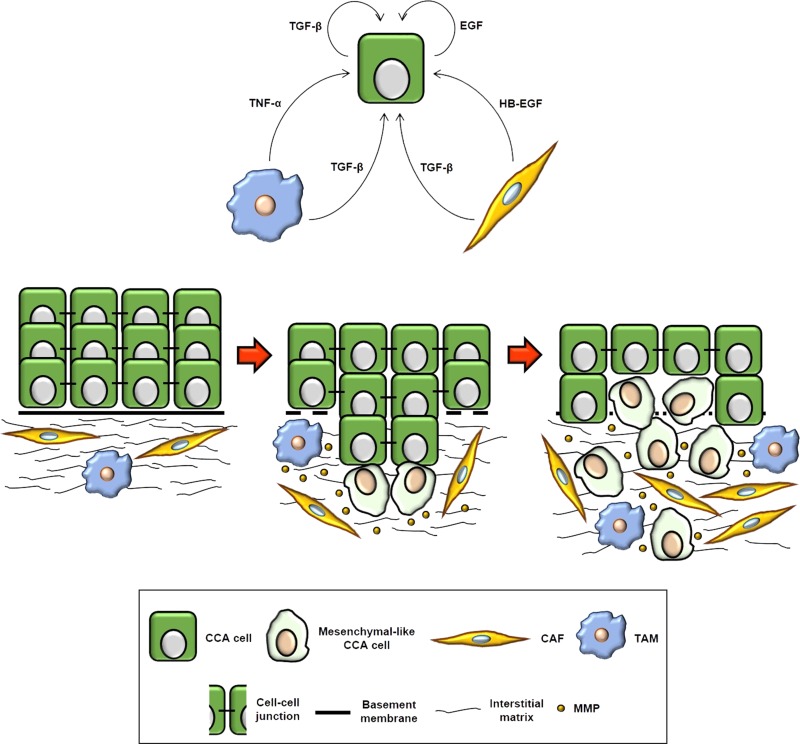
Figure 1
Figure 1
Cellular mechanisms underlying cholangiocarcinoma (CCA) invasion and main soluble mediators involved in the process. Primary cancer lesions are lined by an altered yet intact basement membrane, which keeps CCA cells physically separate from the neighboring stroma, predominantly consisting of cancer-associated fibroblasts (CAFs), tumor-associated macrophages (TAMs), and endothelial cells, embedded in an abnormally stiff interstitial matrix. However, in the course of cancer progression, the basement membrane is progressively dismantled, and CCA cells start migrating collectively in a coordinated manner to pervade the surrounding tissue, thus reinforcing their interplay with reactive stromal cells. At this stage, despite an enhanced motility and a broad secretion of matrix metalloproteinases (MMPs), most of the cells within the invading cohort overall retain epithelial features, including cell–cell adhesion. As cancer invasion proceeds, autocrine and paracrine [i.e., tumor reactive stroma (TRS)-derived] signals permeating the tumor microenvironment lead CCA cells, especially those located at the leading front, to finally adopt a mesenchymal-like phenotype, which allows them to move individually and more efficiently across the stroma toward the blood or lymphatic vessels. In addition to directly providing CCA cells with proinvasive stimuli, CAFs and TAMs also aplenty produce MMPs, thereby further supporting the process of local invasion. EGF, epidermal growth factor; HB-EGF, heparin-binding EGF; TGF-β, transforming growth factor-β; TNF-α, tumor necrosis factor-α.
Figure 2
Figure 2
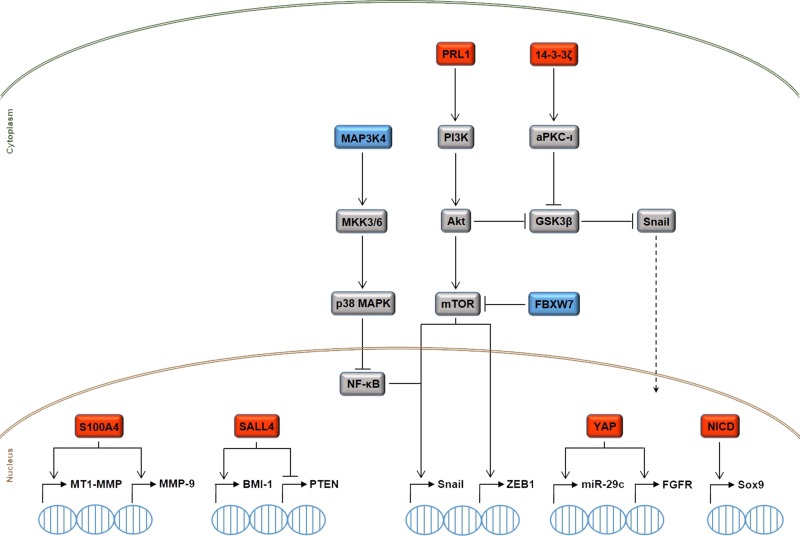
Simplified overview of the intracellular signaling mechanisms governing CCA cell motility and invasiveness. The upregulation (red boxes) or downregulation (blue boxes) of different transcription factors [S100A4, Sal-like protein 4 (SALL4), Yes-associated protein (YAP), Notch intracellular domain (NICD)], protein kinases [mitogen-activated protein kinase kinase kinase 4 (MAP3K4)] and phosphatases [phosphatases of regenerating liver 1 (PRL1)], ubiquitin ligases [F-box and WD repeat domain-containing 7 (FBXW7)], and adaptor proteins (14-3-3ζ) is responsible for the emergence of proinvasive features in CCA cells, due to the activation of deleterious transcriptional programs that are closely interwoven with the epithelial-to-mesenchymal transition (EMT) process. Protein tyrosine phosphatases protein tyrosine phosphatase nonreceptor 3 (PTPN3) and eyes absent homolog 4 (EYA4) are also endowed with protumorigenic and antitumorigenic functions in CCA, respectively, but the underlying molecular mechanisms have yet to be unveiled. Because of space limitations, we could not fully illustrate the extensive crosstalk among the depicted pathways. For instance, miR-29c, which is upregulated by YAP, can negatively regulate the expression of phosphatase and tensin homolog (PTEN), thereby allowing Akt to upregulate the expression of the oncoprotein gankyrin. Moreover, BMI-1 upregulation by SALL4 supports the activation of the prometastatic Wnt pathway. See text for further details. aPKC)-ι, atypical protein kinase C-ι; FGFR, fibroblast growth factor receptor; GSK-3β, lycogen synthase kinase-3β; mTOR, mammalian target of rapamycin; MMP-9, matrix metalloproteinase-9; MT1-MMP, membrane-type 1-MMP; NF-κB, nuclear factor-κB; Sox9, sex-determining region Y-box 9.

References

    1. Blechacz B. Cholangiocarcinoma: Current knowledge and new developments. Gut Liver 2017;11:13–26. - PMC - PubMed
    1. Ferlay J, Soerjomataram I, Ervik M, Dikshit R, Eser S, Mathers C, Rebelo M, Parkin DM, Forman D, Bray F. GLOBOCAN 2012 v1.0, cancer incidence and mortality worldwide: IARC CancerBase No. 11 [Internet]. Lyon, France: International Agency for Research on Cancer; 2013. Available from: http://globocan.iarc.fr/Default.aspx
    1. Brito AF, Abrantes AM, Encarnação JC, Tralhão JG, Botelho MF. Cholangiocarcinoma: From molecular biology to treatment. Med Oncol. 2015;32:245. - PubMed
    1. Banales JM, Cardinale V, Carpino G, Marzioni M, Andersen JB, Invernizzi P, Lind GE, Folseraas T, Forbes SJ, Fouassier L, Geier A, Calvisi DF, Mertens JC, Trauner M, Benedetti A, Maroni L, Vaquero J, Macias RI, Raggi C, Perugorria MJ, Gaudio E, Boberg KM, Marin JJ, Alvaro D. Expert consensus document: Cholangiocarcinoma: Current knowledge and future perspectives consensus statement from the European Network for the Study of Cholangiocarcinoma (ENS-CCA). Nat Rev Gastroenterol Hepatol. 2016;13:261–80. - PubMed
    1. Cadamuro M, Brivio S, Spirli C, Joplin RE, Strazzabosco M, Fabris L. Autocrine and paracrine mechanisms promoting chemoresistance in cholangiocarcinoma. Int J Mol Sci. 2017;18:149. - PMC - PubMed

Publication types