


Emergence and Adaptation of a Novel Highly Pathogenic H7N9 Influenza Virus in Birds and Humans from a 2013 Human-Infecting Low-Pathogenic Ancestor
- PMID: 29070694
- PMCID: PMC5752946
- DOI: 10.1128/JVI.00921-17
Emergence and Adaptation of a Novel Highly Pathogenic H7N9 Influenza Virus in Birds and Humans from a 2013 Human-Infecting Low-Pathogenic Ancestor
Abstract
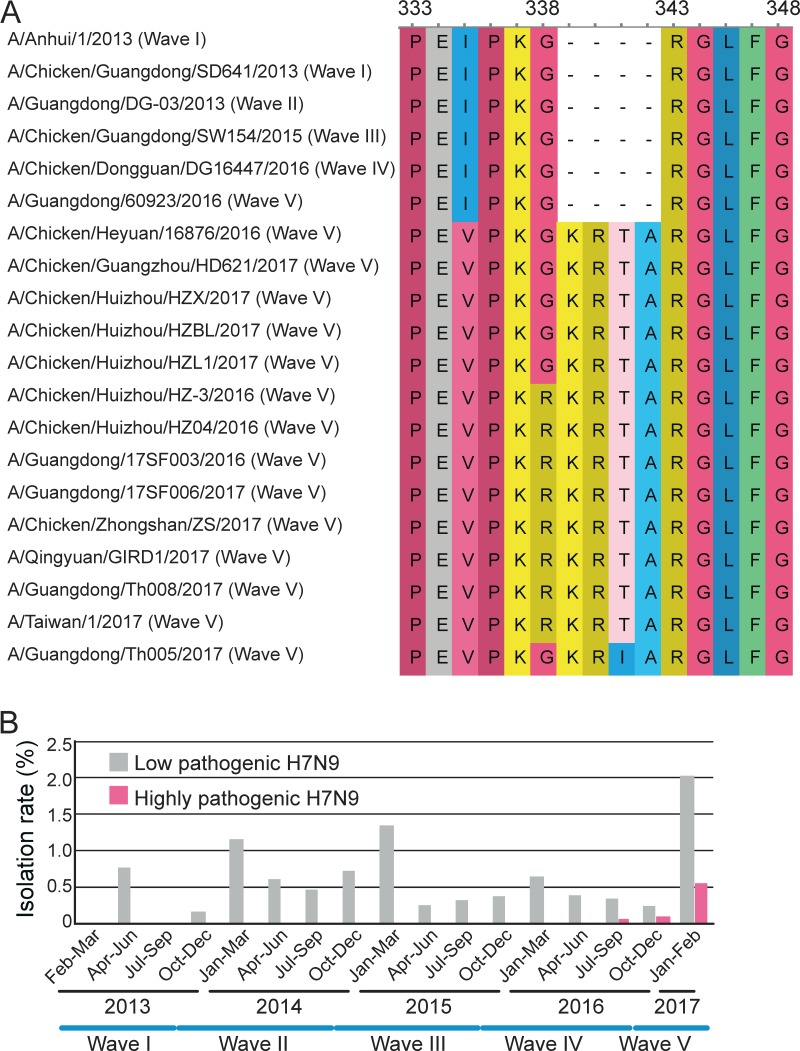
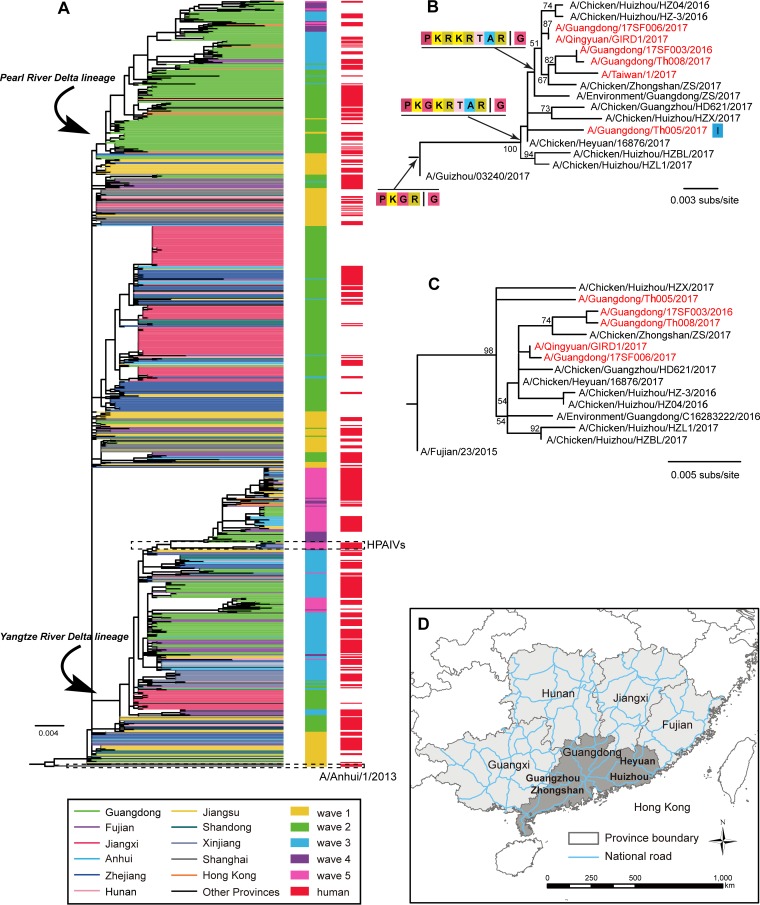
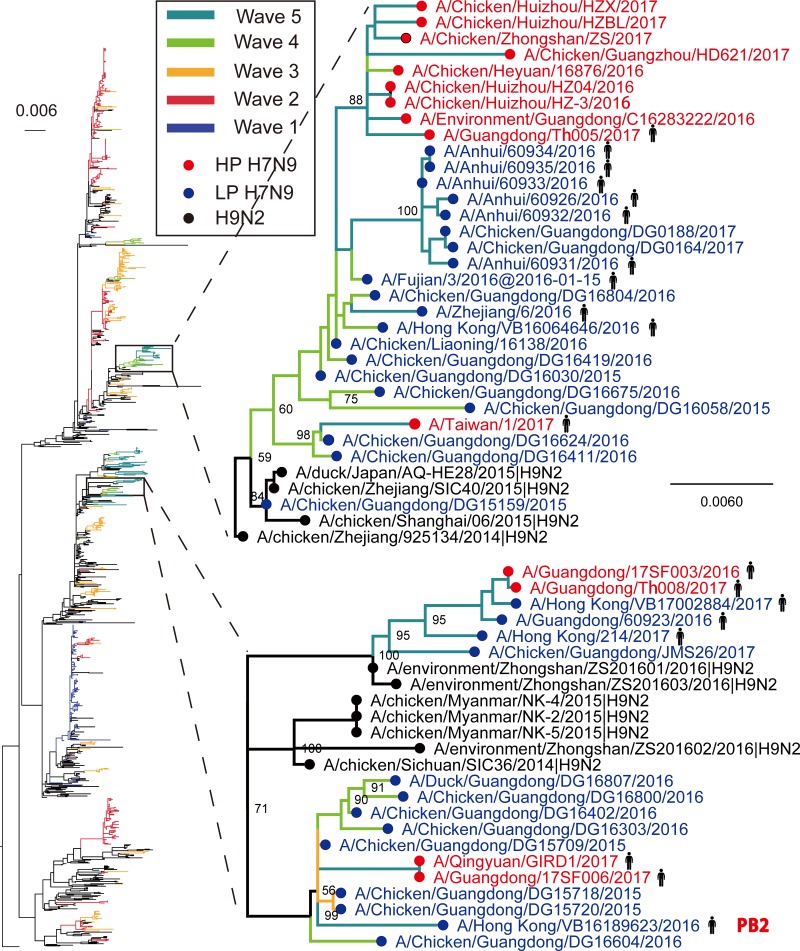
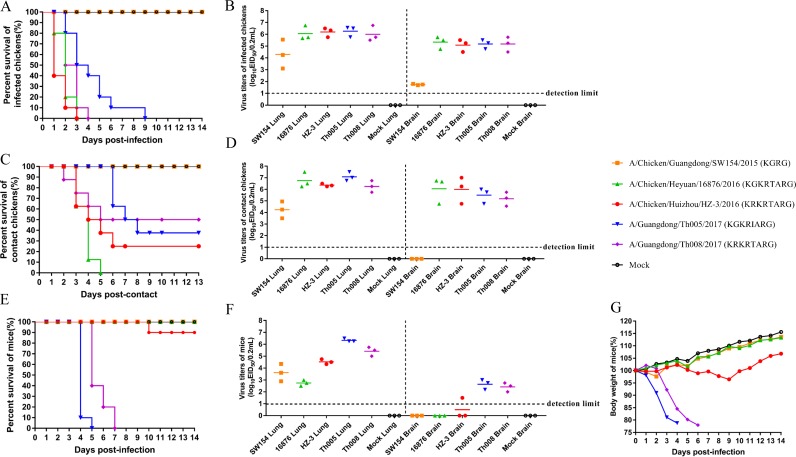
Since its emergence in 2013, the H7N9 low-pathogenic avian influenza virus (LPAIV) has been circulating in domestic poultry in China, causing five waves of human infections. A novel H7N9 highly pathogenic avian influenza virus (HPAIV) variant possessing multiple basic amino acids at the cleavage site of the hemagglutinin (HA) protein was first reported in two cases of human infection in January 2017. More seriously, those novel H7N9 HPAIV variants have been transmitted and caused outbreaks on poultry farms in eight provinces in China. Herein, we demonstrate the presence of three different amino acid motifs at the cleavage sites of these HPAIV variants which were isolated from chickens and humans and likely evolved from the preexisting LPAIVs. Animal experiments showed that these novel H7N9 HPAIV variants are both highly pathogenic in chickens and lethal to mice. Notably, human-origin viruses were more pathogenic in mice than avian viruses, and the mutations in the PB2 gene associated with adaptation to mammals (E627K, A588V, and D701N) were identified by next-generation sequencing (NGS) and Sanger sequencing of the isolates from infected mice. No polymorphisms in the key amino acid substitutions of PB2 and HA in isolates from infected chicken lungs were detected by NGS. In sum, these results highlight the high degree of pathogenicity and the valid transmissibility of this new H7N9 variant in chickens and the quick adaptation of this new H7N9 variant to mammals, so the risk should be evaluated and more attention should be paid to this variant.IMPORTANCE Due to the recent increased numbers of zoonotic infections in poultry and persistent human infections in China, influenza A(H7N9) virus has remained a public health threat. Most of the influenza A(H7N9) viruses reported previously have been of low pathogenicity. Now, these novel H7N9 HPAIV variants have caused human infections in three provinces and outbreaks on poultry farms in eight provinces in China. We analyzed the molecular features and compared the relative characteristics of one H7N9 LPAIV and two H7N9 HPAIVs isolated from chickens and two human-origin H7N9 HPAIVs in chicken and mouse models. We found that all HPAIVs both are highly pathogenic and have valid transmissibility in chickens. Strikingly, the human-origin viruses were more highly pathogenic than the avian-origin viruses in mice, and dynamic mutations were confirmed by NGS and Sanger sequencing. Our findings offer important insight into the origin, adaptation, pathogenicity, and transmissibility of these viruses to both poultry and mammals.
Keywords: adaptation; emergence; highly pathogenic H7N9 influenza virus; multiple basic amino acids.
Copyright © 2018 American Society for Microbiology.
Figures
References
-
- Liu D, Shi W, Shi Y, Wang D, Xiao H, Li W, Bi Y, Wu Y, Li X, Yan J, Liu W, Zhao G, Yang W, Wang Y, Ma J, Shu Y, Lei F, Gao GF. 2013. Origin and diversity of novel avian influenza A H7N9 viruses causing human infection: phylogenetic, structural, and coalescent analyses. Lancet 381:1926–1932. doi: 10.1016/S0140-6736(13)60938-1. - DOI - PubMed
-
- Lam TT, Wang J, Shen Y, Zhou B, Duan L, Cheung CL, Ma C, Lycett SJ, Leung CY, Chen X, Li L, Hong W, Chai Y, Zhou L, Liang H, Ou Z, Liu Y, Farooqui A, Kelvin DJ, Poon LL, Smith DK, Pybus OG, Leung GM, Shu Y, Webster RG, Webby RJ, Peiris JS, Rambaut A, Zhu H, Guan Y. 2013. The genesis and source of the H7N9 influenza viruses causing human infections in China. Nature 502:241–244. doi: 10.1038/nature12515. - DOI - PMC - PubMed
-
- Lam TT, Zhou B, Wang J, Chai Y, Shen Y, Chen X, Ma C, Hong W, Chen Y, Zhang Y, Duan L, Chen P, Jiang J, Zhang Y, Li L, Poon LL, Webby RJ, Smith DK, Leung GM, Peiris JS, Holmes EC, Guan Y, Zhu H. 2015. Dissemination, divergence and establishment of H7N9 influenza viruses in China. Nature 522:102–105. doi: 10.1038/nature14348. - DOI - PubMed
-
- Wang D, Yang L, Zhu W, Zhang Y, Zou S, Bo H, Gao R, Dong J, Huang W, Guo J, Li Z, Zhao X, Li X, Xin L, Zhou J, Chen T, Dong L, Wei H, Li X, Liu L, Tang J, Lan Y, Yang J, Shu Y. 2016. Two outbreak sources of influenza A H7N9 viruses have been established in China. J Virol 90:5561–5573. doi: 10.1128/JVI.03173-15. - DOI - PMC - PubMed
-
- Zhou L, Ren R, Yang L, Bao C, Wu J, Wang D, Li C, Xiang N, Wang Y, Li D, Sui H, Shu Y, Feng Z, Li Q, Ni D. 2017. Sudden increase in human infection with avian influenza A H7N9 virus in China, September-December 2016. Western Pac Surveill Response J 8:1. doi: 10.5365/WPSAR.2017.8.1.001. - DOI - PMC - PubMed
Publication types
MeSH terms
Substances
LinkOut - more resources
Full Text Sources
Other Literature Sources
Medical
