


Older Adults Perceptions of Technology and Barriers to Interacting with Tablet Computers: A Focus Group Study
- PMID: 29071004
- PMCID: PMC5649151
- DOI: 10.3389/fpsyg.2017.01687
Older Adults Perceptions of Technology and Barriers to Interacting with Tablet Computers: A Focus Group Study
Abstract
Background: New technologies provide opportunities for the delivery of broad, flexible interventions with older adults. Focus groups were conducted to: (1) understand older adults' familiarity with, and barriers to, interacting with new technologies and tablets; and (2) utilize user-engagement in refining an intervention protocol.
Methods: Eighteen older adults (65-76 years old; 83.3% female) who were novice tablet users participated in discussions about their perceptions of and barriers to interacting with tablets. We conducted three separate focus groups and used a generic qualitative design applying thematic analysis to analyse the data. The focus groups explored attitudes toward tablets and technology in general. We also explored the perceived advantages and disadvantages of using tablets, familiarity with, and barriers to interacting with tablets. In two of the focus groups, participants had previous computing experience (e.g., desktop), while in the other, participants had no previous computing experience. None of the participants had any previous experience with tablet computers.
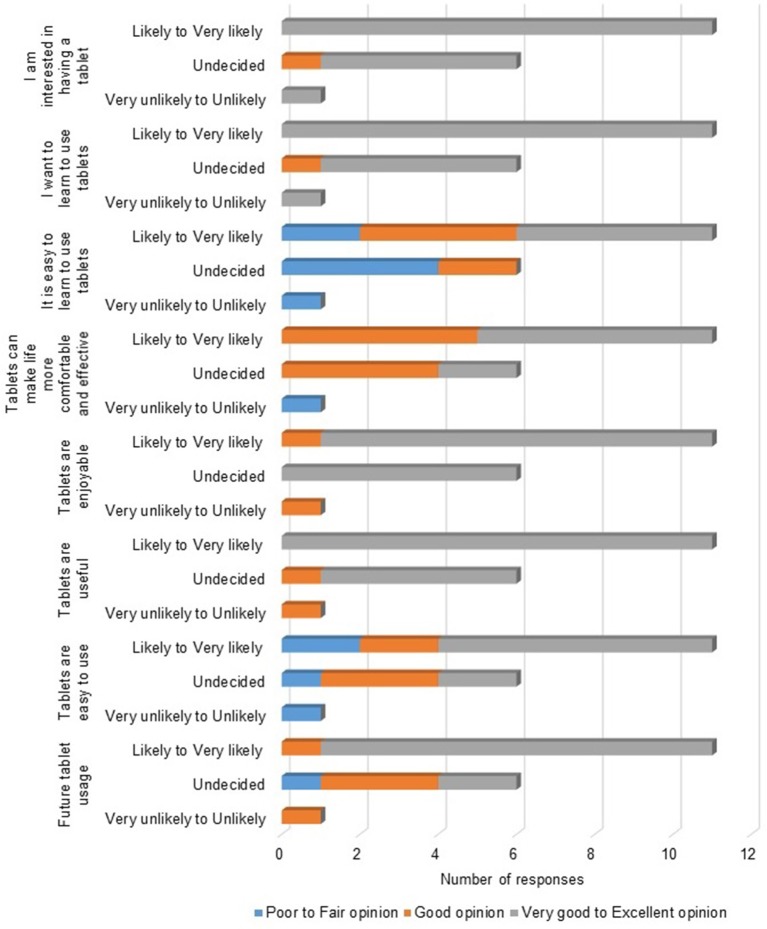
Results: The themes that emerged were related to barriers (i.e., lack of instructions and guidance, lack of knowledge and confidence, health-related barriers, cost); disadvantages and concerns (i.e., too much and too complex technology, feelings of inadequacy, and comparison with younger generations, lack of social interaction and communication, negative features of tablets); advantages (i.e., positive features of tablets, accessing information, willingness to adopt technology); and skepticism about using tablets and technology in general. After brief exposure to tablets, participants emphasized the likelihood of using a tablet in the future.
Conclusions: Our findings suggest that most of our participants were eager to adopt new technology and willing to learn using a tablet. However, they voiced apprehension about lack of, or lack of clarity in, instructions and support. Understanding older adults' perceptions of technology is important to assist with introducing it to this population and maximize the potential of technology to facilitate independent living.
Keywords: aging; focus groups; older adults; qualitative; tablet computers; technology.
Conflict of interest statement
Conflict of Interest Statement: The authors declare that the research was conducted in the absence of any commercial or financial relationships that could be construed as a potential conflict of interest. The reviewer, SL, declared a shared affiliation, with no collaboration, with one of the authors, AG, to the handling Editor.
Figures
References
-
- Anderson N. B., Bulatao R. A., Cohen B. (2004). Critical Perspectives on Racial and Ethnic Differences in Health in Late Life. Washington, DC: National Academies Press. - PubMed
-
- Bailey A., Ngwenyama O. (2010). Bridging the generation gap in ICT use: interrogating identity, technology and interactions in community telecenters. Inf. Technol. Dev. 16, 62–82. 10.1080/02681100903566156 - DOI
-
- Balagtas-Fernandez F., Forrai J., Hussmann H. (2009). Evaluation of user interface design and input methods for applications on mobile touch screen devices, in Human-Computer Interaction – INTERACT 2009: 12th IFIP TC 13 International Conference (Uppsala), Proceedings, Part I (Berlin, Heidelberg: Springer Berlin Heidelberg; ), 243–246.
Grants and funding
LinkOut - more resources
Full Text Sources
Other Literature Sources
