


Diagnosis and treatment of urethral prolapse in children: 16 years' experience with 89 Chinese girls
- PMID: 29071160
- PMCID: PMC5651941
- DOI: 10.1016/j.aju.2017.03.004
Diagnosis and treatment of urethral prolapse in children: 16 years' experience with 89 Chinese girls
Abstract
Objective: To review our experience and results in the diagnosis and treatment of urethral prolapse (UP) in Chinese girls.
Patients and methods: We conducted a retrospective chart review of 89 consecutive girls (aged <16 years) with UP and without other complications, who received treatment for UP from January 1999 to January 2015 (a study period of 16 years) at the Children's Hospital of Chongqing Medical University, China. Data analysed included: age, symptoms, clinical findings, predisposing factors, management, and outcomes.
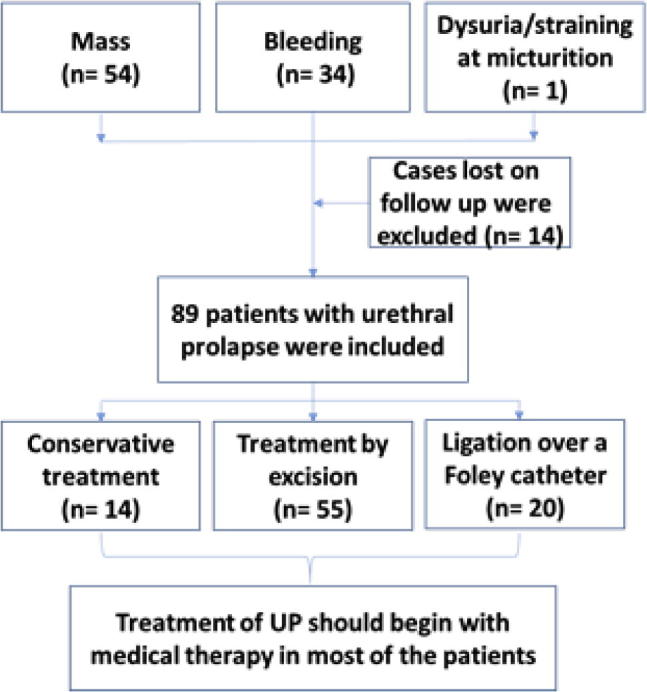
Results: The presenting symptoms in the 89 girls were: mass (54 girls), bleeding (34), and dysuria/straining at micturition (one). In all, 14 patients received conservative treatment as their symptoms were mild, and 75 were successfully treated by excision of the prolapsed urethral mucosa or ligation over a Foley catheter, as their symptoms were severe and recurred too frequently to be managed conservatively. The mean postoperative length of stay for ligation was 7.76 days and for excision was 4.57 days. Ligation over a Foley catheter had a longer hospital stay.
Conclusions: UP is a rare condition occurring in prepubertal girls, evidenced by a urethral mass and bleeding. Increased physician awareness and early recognition of UP avoids unnecessary examinations and patient anxiety.
Keywords: BMI, body mass index; China; FLACC, Face, Legs, Activity, Cry, Consolability (pain scale); Girls; Management; UP, urethral prolapse; Urethral prolapse.
Figures


References
-
- Valerie E., Gilchrist B.F., Frischer J., Scriven R., Klotz D.H., Ramenofsky M.L. Diagnosis and treatment of urethral prolapse in children. Urology. 1999;54:1082–1084. - PubMed
-
- Hillyer S., Mooppan U., Kim H., Gulmi F. Diagnosis and treatment of urethral prolapse in children: experience with 34 cases. Urology. 2009;73:1008–1011. - PubMed
-
- Holbrook C., Misra D. Surgical management of urethral prolapse in girls: 13 years’ experience. BJU Int. 2012;110:132–134. - PubMed
-
- Rudin J.E., Geldt V.G., Alecseev E.B. Prolapse of urethral mucosa in white female children: experience with 58 cases. J Pediatr Surg. 1997;32:423–425. - PubMed
-
- Ballouhey Q., Abbo O., Sanson S., Cochet T., Galinier P., Pienkowski C. Urogenital bleeding revealing urethral prolapse in a prepubertal girl. Gynecol Obstet Fertil. 2013;41:404–406. - PubMed
LinkOut - more resources
Full Text Sources
Other Literature Sources
