


IgE autoantibodies and their association with the disease activity and phenotype in bullous pemphigoid: a systematic review
- PMID: 29071428
- PMCID: PMC5754504
- DOI: 10.1007/s00403-017-1789-1
IgE autoantibodies and their association with the disease activity and phenotype in bullous pemphigoid: a systematic review
Abstract
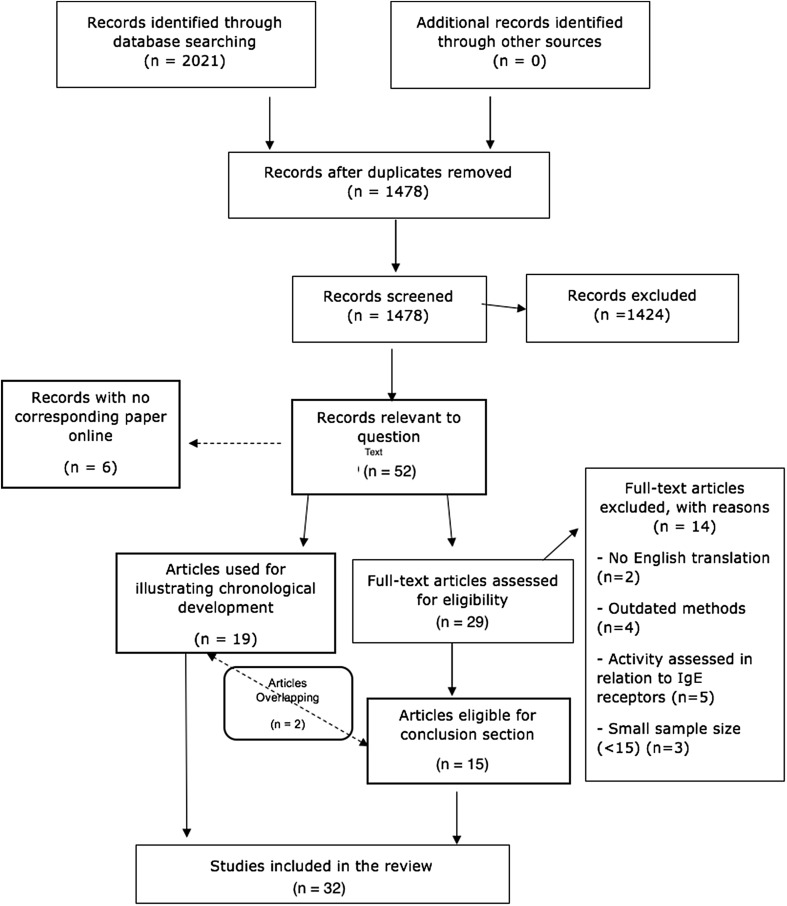
Bullous pemphigoid (BP) is the most common autoimmune skin disease of blistering character. The underlying pathophysiological mechanism involves an immune attack, usually by IgG class autoantibodies, on the autoantigen BP 180/BPAg2, which is a type XVII collagen (COL17) protein acting as the adhesion molecule between the epidermis and the basement membrane of the dermis. About 40 years ago, following consistent findings of elevated total serum IgE levels in BP patients, it was hypothesized that IgE may be involved in the pathophysiology of BP. Our objective was to determine whether there is strong evidence for an association between IgE class autoantibodies and the clinical severity or phenotype of BP. Three databases were searched for relevant studies and appropriate exclusion and inclusion criteria were applied. Data was extracted and assessed in relation to the study questions concerning the clinical significance of IgE autoantibodies in BP. Nine studies found that anti-BP180 autoantibodies of IgE class are associated with increased severity of BP, whereas two studies did not find such an association. The number of studies which found an association between higher IgE autoantibody levels and the erythematous urticarial phenotype of BP (5) was equal in number to the studies which found no such association (5). In conclusion, higher serum IgE autoantibody levels are associated with more severe clinical manifestations of BP. There is insufficient evidence to support higher IgE autoantibody levels being associated with specific clinical phenotypes of BP.
Keywords: Autoantibodies; BP; Bullous pemphigoid; Clinical manifestations; Clinical phenotype; Disease activity; Disease course; Disease severity; IgE; Immunoglobulin E.
Conflict of interest statement
The authors declare that they have no conflicts of interest.
Figures
References
-
- Asbrink E, Hovmark A. Serum IgE levels in patients with bullous pemphigoid and its correlation to the activity of the disease and anti-basement membrane zone antibodies. Acta Derm Venereol. 1984;64:243–246. - PubMed
-
- Baba T, Sonozaki H, Seki K, Uchiyama M, Ikesawa Y, Toriisu M. An eosinophil chemotactic factor present in blister fluids of bullous pemphigoid patients. J Immunol. 1976;116:112–116. - PubMed
Related articles recently published in Archives of Dermatological Research (selected by the journal’s editorial staff)
-
- Kalinska-Bienias A, Lukowska-Smorawska K, Jagielski P, Kowalewski C, Wozniak K. Mortality in bullous pemphigoid and prognostic factors in 1st and 3rd year of follow-up in specialized centre in Poland. Arch Dermatol Res. 2017 - PubMed
Publication types
MeSH terms
Substances
LinkOut - more resources
Full Text Sources
Other Literature Sources
Medical
