


Novel genetic variants in the P38MAPK pathway gene ZAK and susceptibility to lung cancer
- PMID: 29071797
- PMCID: PMC6128286
- DOI: 10.1002/mc.22748
Novel genetic variants in the P38MAPK pathway gene ZAK and susceptibility to lung cancer
Abstract
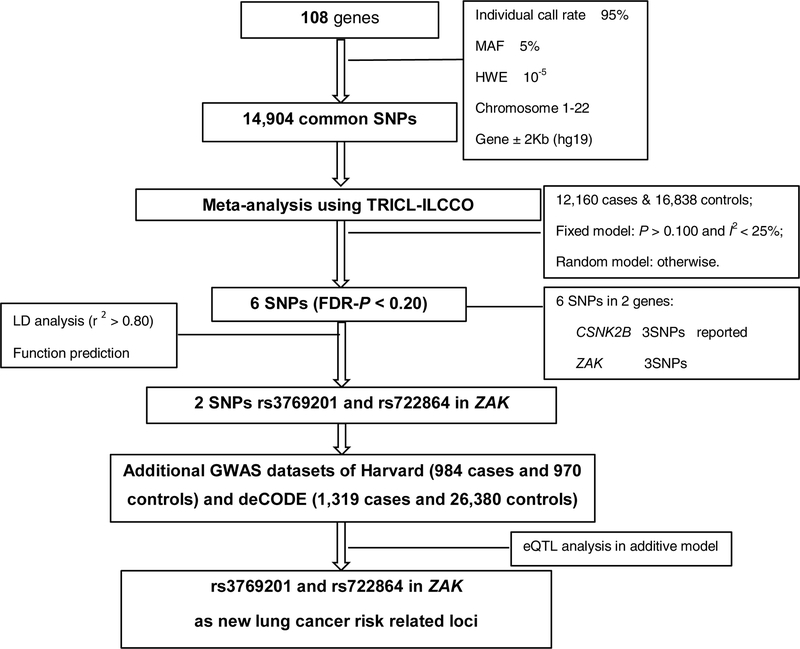
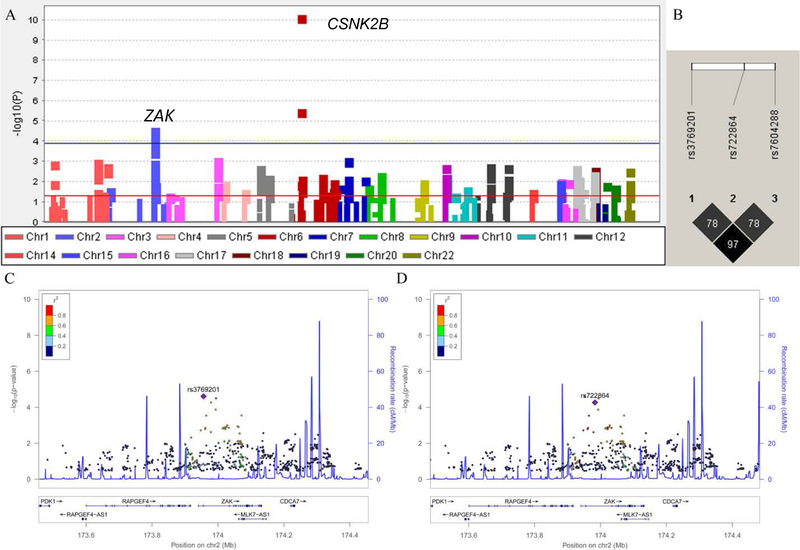
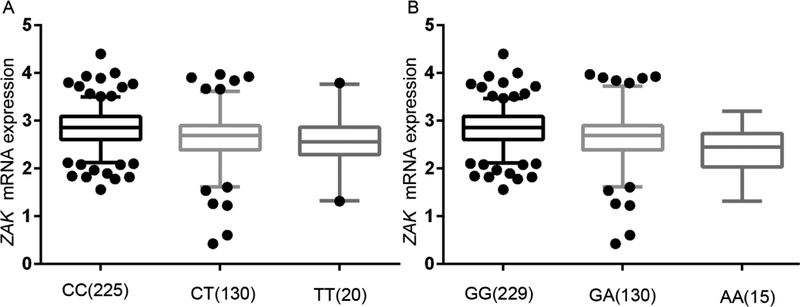
The P38MAPK pathway participates in regulating cell cycle, inflammation, development, cell death, cell differentiation, and tumorigenesis. Genetic variants of some genes in the P38MAPK pathway are reportedly associated with lung cancer risk. To substantiate this finding, we used six genome-wide association studies (GWASs) to comprehensively investigate the associations of 14 904 single nucleotide polymorphisms (SNPs) in 108 genes of this pathway with lung cancer risk. We identified six significant lung cancer risk-associated SNPs in two genes (CSNK2B and ZAK) after correction for multiple comparisons by a false discovery rate (FDR) <0.20. After removal of three CSNK2B SNPs that are located in the same locus previously reported by GWAS, we performed the LD analysis and found that rs3769201 and rs7604288 were in high LD. We then chose two independent representative SNPs of rs3769201 and rs722864 in ZAK for further analysis. We also expanded the analysis by including these two SNPs from additional GWAS datasets of Harvard University (984 cases and 970 controls) and deCODE (1319 cases and 26 380 controls). The overall effects of these two SNPs were assessed using all eight GWAS datasets (OR = 0.92, 95%CI = 0.89-0.95, and P = 1.03 × 10⁻⁵ for rs3769201; OR = 0.91, 95%CI = 0.88-0.95, and P = 2.03 × 10⁻⁶ for rs722864). Finally, we performed an expression quantitative trait loci (eQTL) analysis and found that these two SNPs were significantly associated with ZAK mRNA expression levels in lymphoblastoid cell lines. In conclusion, the ZAK rs3769201 and rs722864 may be functional susceptibility loci for lung cancer risk.
Keywords: SNP; ZAK; lung cancer risk; pathway analysis.
© 2017 Wiley Periodicals, Inc.
Figures
References
Publication types
MeSH terms
Substances
Grants and funding
- R01 CA127219/CA/NCI NIH HHS/United States
- R01 CA133996/CA/NCI NIH HHS/United States
- R01 DA017932/DA/NIDA NIH HHS/United States
- U19 CA203654/CA/NCI NIH HHS/United States
- R01 CA121197/CA/NCI NIH HHS/United States
- C1298/A8780/CRUK_/Cancer Research UK/United Kingdom
- K07 CA160753/CA/NCI NIH HHS/United States
- R01 CA092039/CA/NCI NIH HHS/United States
- S10 OD018164/OD/NIH HHS/United States
- C1298/A8362/CRUK_/Cancer Research UK/United Kingdom
- U01 HG004438/HG/NHGRI NIH HHS/United States
- U01 HG004446/HG/NHGRI NIH HHS/United States
- R01 CA111703/CA/NCI NIH HHS/United States
- HHSN268200782096C/HG/NHGRI NIH HHS/United States
- P30 CA014236/CA/NCI NIH HHS/United States
- N01RC37004/RC/CCR NIH HHS/United States
- U19 CA148127/CA/NCI NIH HHS/United States
- 001/WHO_/World Health Organization/International
- R01 CA055769/CA/NCI NIH HHS/United States
LinkOut - more resources
Full Text Sources
Other Literature Sources
Medical
Research Materials
