. 2017 Oct 26;8(10):e3142.
doi: 10.1038/cddis.2017.555.

Requirement for CCNB1 in mouse spermatogenesis

Affiliations

Requirement for CCNB1 in mouse spermatogenesis

Ji-Xin Tang et al. Cell Death Dis. .

Abstract

Spermatogenesis, which involves mitosis and meiosis of male germ cells, is a highly complicated and coordinately ordered process. Cyclin B1 (CCNB1), an important regulator in cell cycle machinery, is proved essential for mouse embryonic development. However, the role of CCNB1 in mammalian spermatogenesis remains unclear. Here we tested the requirement for CCNB1 using conditional knockout mice lacking CCNB1 in male germ cells. We found that ablation of CCNB1 in gonocytes and spermatogonia led to mouse sterile caused by the male germ cells' depletion. Gonocyte and spermatogonia without CCNB1 is unable to proliferate normally and apoptosis increased. Moreover, CCNB1 ablation in spermatogonia may promote their differentiation by downregulating Lin28a and upregulating let-7 miRNA. However, ablation of CCNB1 in premeiotic male germ cells did not have an effect on meiosis of spermatocytes and male fertility, suggesting that CCNB1 may be dispensable for meiosis of spermatocytes. Collectively, these results indicate that CCNB1 is critically required for the proliferation of gonocytes and spermatogonia but may be redundant in meiosis of spermatocytes in mouse spermatogenesis.


Conflict of interest statement

The authors declare no conflict of interest.

Figures
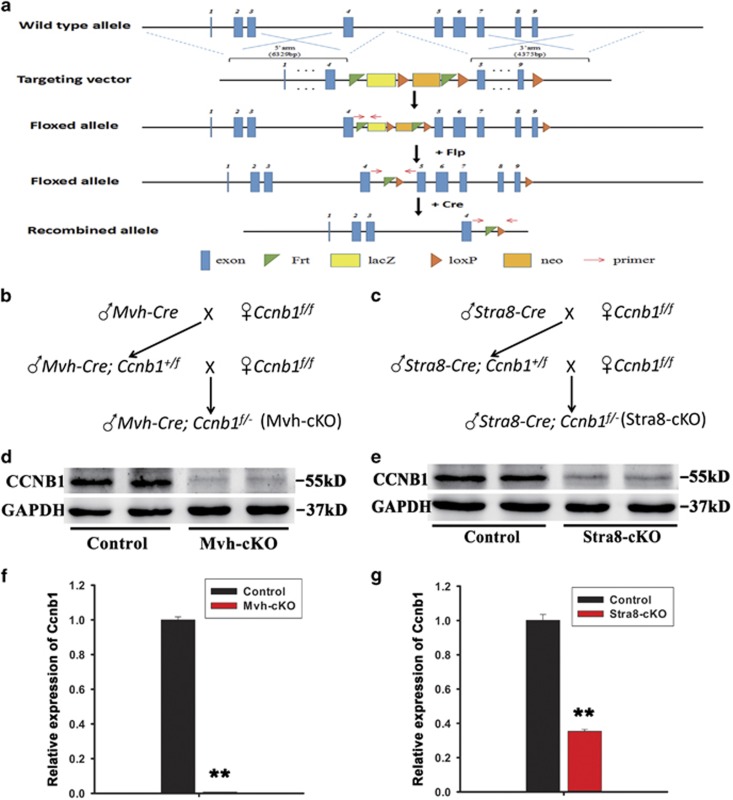
Figure 1
Figure 1
Generation of Ccnb1 conditional knockout mice. (a) The target strategy of Ccnb1. LoxP site were inserted behind exons 4 and 9 of Ccnb1 allele; when the floxed allele crossed with Cre, exons 5–9 were deleted. (b) Mating strategy to generate all germ cell conditional knockout Ccnb1 mice (Mvh-cKO). (c) Mating strategy to generate postnatal, premeiotic male germ cell conditional knockout Ccnb1 mice (Sta8-cKO). (d) Western blotting analysis of Ccnb1 in adult (8–12 weeks) Mvh-cKO and Control littermates’ testis. (e) Western blotting analysis of Ccnb1 in adult Stra8-cKO and Control littermates’ testis. (f) Real-time PCR analysis of Ccnb1 expression in adult Control and Mvh-cKO mice testis. (g) Real-time PCR analysis of Ccnb1 expression in adult Control and Stra8-cKO mice testis. In panels (f and g), ≥3 samples were used in each group in qPCR
Figure 2
Figure 2
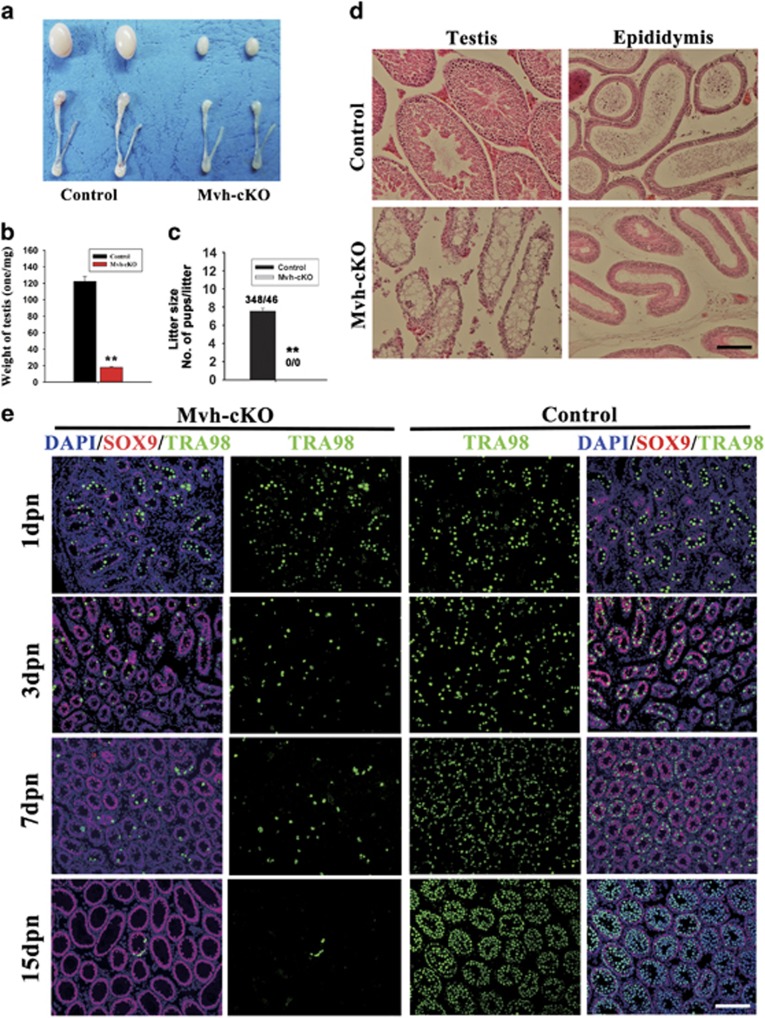
Deletion of Ccnb1 in early-stage male germ cells resulted in male mice sterile due to germ cells’ depletion. (a) Testis and epididymis of adult (2-month-old) control and Mvh-cKO mice. (b) Testis weight of 2-month-old Control and Mvh-cKO mice (n=12, Control; n=12, Mvh-cKO). (c) Litter size of female WT mice mated with Control and Mvh-cKO male mice, respectively. (d) Histological appearance of Mvh-cKO testis and epididymis. (e) Immunostaining of TRA98 and Sox9 in 1, 3, 7 and 15 dpn Mvh-cKO and Control littermate testis. TRA98, a marker of germ cell; Sox9, a marker of Sertoli cell. Bar=100 μm
Figure 3
Figure 3
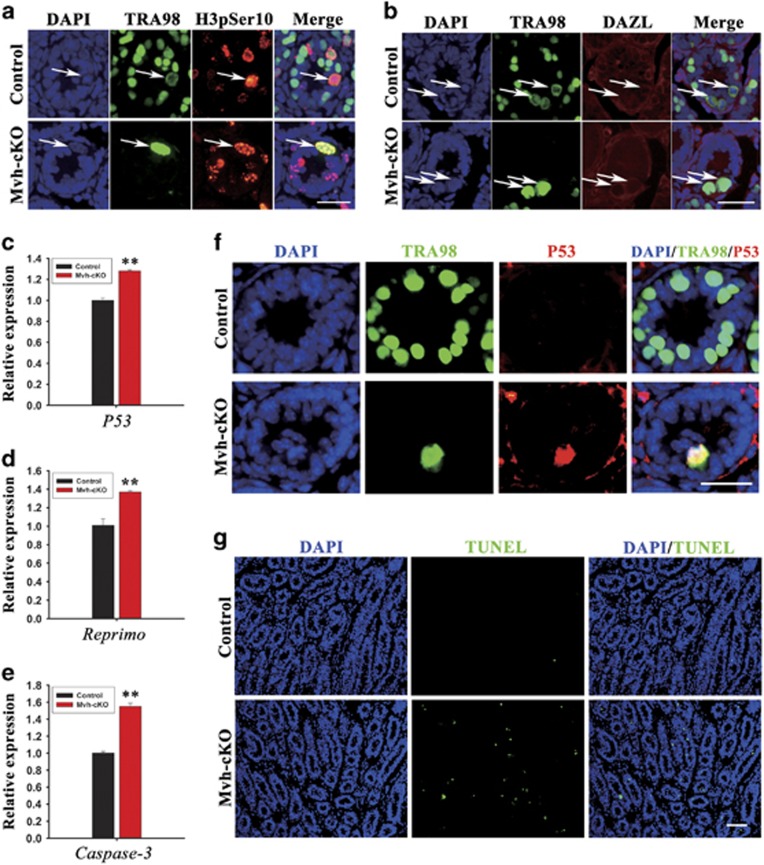
Germ cells’ depletion in Mvh-cKO mice is caused by germ cells’ apoptosis and inhibited proliferation. (a) Immunostaining of TRA98 and H3pSer10 in 7 dpn Control and Mvh-cKO mouse testes. (b) Immunostaining of TRA98 and Dazl in 7 dpn Control and Mvh-cKO mouse testes. TRA98 expressed in germ cells, primarily in nuclear in G1, S and G2 phase and in cytoplasm in M phase. Arrows indicate the germ cells in M phase. Dazl expressed in germ cells, primarily in cytoplasm in G1, S and G2 phase and in cytoplasm and nuclear region in M phase. In control mice, spermatogonia were able to complete nuclear envelop breakdown and chromosome condensation, but in Mvh-cKO mice, spermatogonia were unable to complete these processes. (ce) Real-time PCR analysis of p53, Reprimo and Caspase-3 in 7 dpn control and Mvh-cKO mouse testes. Three or more samples were used in each group in panels (ce). (f) Immunostaining of TRA98 and p53 in 7 dpn Control and Mvh-cKO mouse testes. (g) Apoptosis signal significantly increased in 3 dpn Mvh-cKO mouse testes compared with control littermates detected by TUNEL analysis. Bar=100 μm
Figure 4
Figure 4
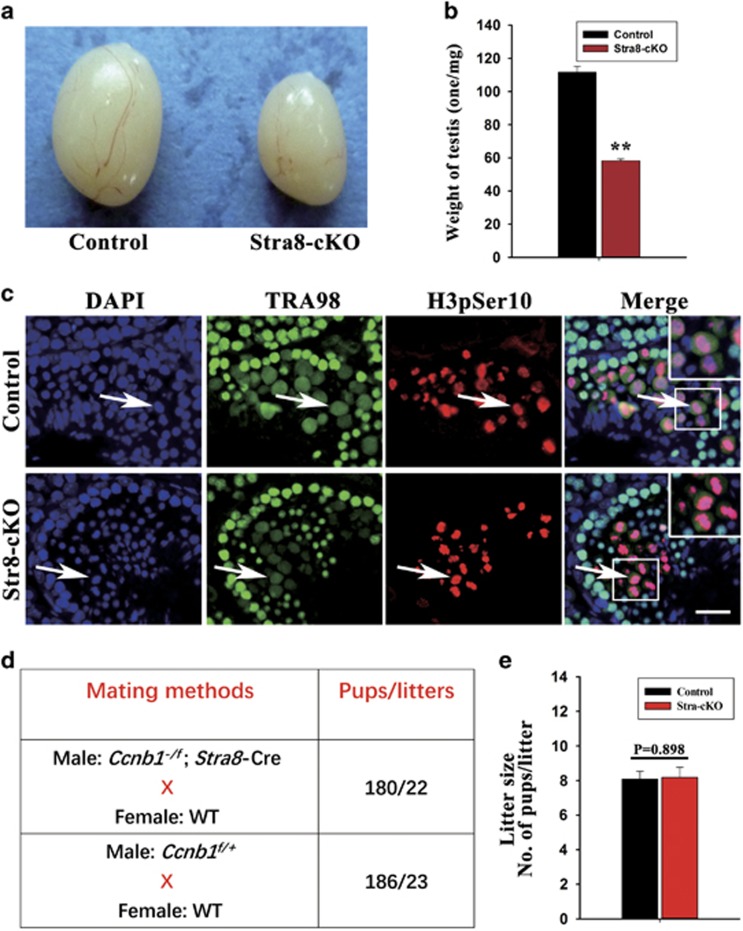
Deletion of Ccnb1 in postnatal, premeiotic germ cells has no effect on spermatocyte meiosis and male fertility. (a) Testis of 2-month-old Control and Mvh-cKO mice. (b) Testis weight of 2-month-old Control and Stra8-cKO mice (n=12, Control; n=12, Stra8-cKO). (c) Immunostaining of TRA98 and H3pSer10 in 3-month-old Control and Stra8-cKO mice testis. (d) Fertility analysis: mating methods and pubs/litters obtained. (e) Litter size of female WT mice mated with Control and Stra8-cKO male mice, respectively. Bar=100 μm
Figure 5
Figure 5
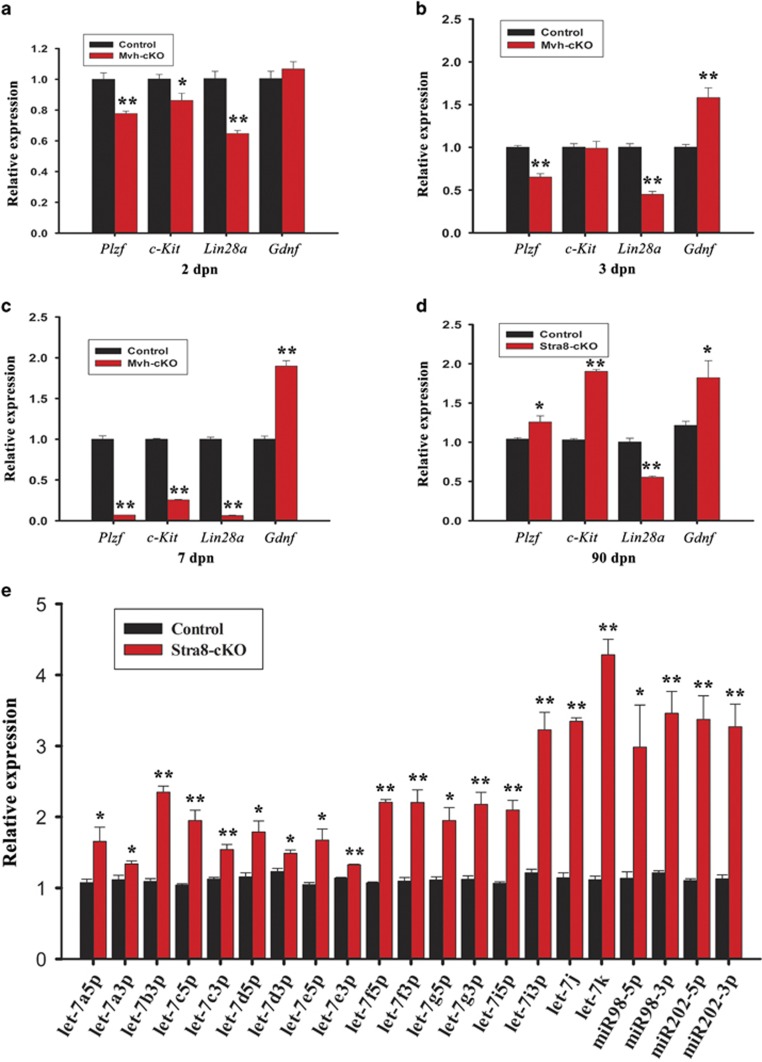
Deletion of Ccnb1 in germ cells promoted their differentiation and Lin28a/let-7 axis involved in this process. (a) Real-time PCR analysis of Plzf, c-Kit, Lin28a and Gdnf expression in 2 dpn control and Mvh-cKO mice testis. (b) Real-time PCR analysis of Plzf, c-Kit, Lin28a and Gdnf expression in 3 dpn control and Mvh-cKO mice testis. (c) Real-time PCR analysis of Plzf, c-Kit, Lin28a and Gdnf expression in 7 dpn control and Mvh-cKO mice testis. (d) Real-time PCR analysis of Plzf, c-Kit, Lin28a and Gdnf expression in 90 dpn control and Stra8-cKO mice testis. (e) Real-time PCR analysis of let-7 family miRNAs expression in 90 dpn Control and Stra8-cKO mice testis. In panels (ae), ≥3 samples were used in each group in qPCR

References

    1. Masui Y, Markert CL. Cytoplasmic control of nuclear behavior during meiotic maturation of frog oocytes. J Exp Zool 1971; 177: 129–145. - PubMed
    1. Smith LD, Ecker RE. The interaction of steroids with Rana pipiens oocytes in the induction of maturation. Dev Biol 1971; 25: 232–247. - PubMed
    1. Kishimoto T, Kanatani H. Cytoplasmic factor responsible for germinal vesicle breakdown and meiotic maturation in starfish oocytes. Nature 1976; 260: 321–322. - PubMed
    1. Wasserman WJ, Smith LD. The cycle behavior of a cytoplasmic factor controlling nuclear membrane breakdown. J Cell Biol 1978; 78: R15–R22. - PMC - PubMed
    1. Sunkara PS, Wright DA, Rao PN. Mitotic factors from mammalian cells induce germinal vesicle breakdown and chromosome condensation in amphibian oocytes. Proc Natl Acad Sci USA 1979; 76: 2799–2802. - PMC - PubMed

Publication types