. 2018 Feb 15;124(4):841-849.
doi: 10.1002/cncr.31089. Epub 2017 Oct 26.

PROMIS measures can be used to assess symptoms and function in long-term hematopoietic cell transplantation survivors

Affiliations

PROMIS measures can be used to assess symptoms and function in long-term hematopoietic cell transplantation survivors

Bronwen E Shaw et al. Cancer. .

Abstract

Background: Patient-reported outcomes for hematopoietic cell transplantation (HCT) survivors are well characterized with established measures; however, there is little experience with the new, freely available Patient-Reported Outcomes Measurement Information System (PROMIS) measures in this population. The aim of this study was to compare the performance of the PROMIS measures in the HCT setting with the performance of the commonly used 36-Item Short Form Health Survey (SF-36).

Methods: Adult HCT survivors from the Fred Hutchinson Cancer Research Center (n = 4446) were mailed a survey that included the following as part of an annual follow-up survey: the Patient-Reported Outcomes Measurement Information System-Global Health (PROMIS-GH; 10 questions), the 29-Item Patient-Reported Outcomes Measurement Information System Profile (PROMIS-29), and the SF-36.

Results: Both the SF-36 and PROMIS measures were available for 1634 HCT recipients (503 autologous recipients and 1131 allogeneic recipients). The overall response rate was 46%. The median time after transplantation for allogeneic and autologous recipients was 12.0 years (range, 0.4-44.1 years) and 6.1 years (range, 0.4-30.1 years), respectively. With the SF-36 or PROMIS-GH, overall physical functioning was somewhat lower in comparison with the general population, but mental functioning was similar. Component and domain scores with similar contents were strongly correlated by Pearson correlation coefficients: the Global Health-Physical and SF-36 Physical Component Summary scores for autologous (r = 0.82) and allogeneic recipients (r = 0.83) and the PROMIS-29 and SF-36 physical function, pain, and vitality/fatigue scores for allogeneic (0.87, -0.82, and -0.82, respectively) and autologous recipients (0.84, -0.82, and -0.81, respectively). The correlation between the Global Health-Mental and SF-36 Mental Component Summary scores was lower (0.70 for autologous recipients and 0.72 for allogeneic recipients).

Conclusions: Physical and mental symptoms and function in autologous and allogeneic HCT survivors can be adequately assessed with PROMIS-29 and PROMIS-GH. Cancer 2018;124:841-9. © 2017 American Cancer Society.

Keywords: 36-Item Short Form Health Survey (SF-36); Patient-Reported Outcomes Measurement Information System (PROMIS); convergent validity; hematopoietic cell transplantation; patient-reported outcomes; quality of life.


Conflict of interest statement

Disclosures: None of the authors have any relevant conflict of interest to report and all authors have approved the final version of the manuscript.

Figures

Figure 1
Figure 1
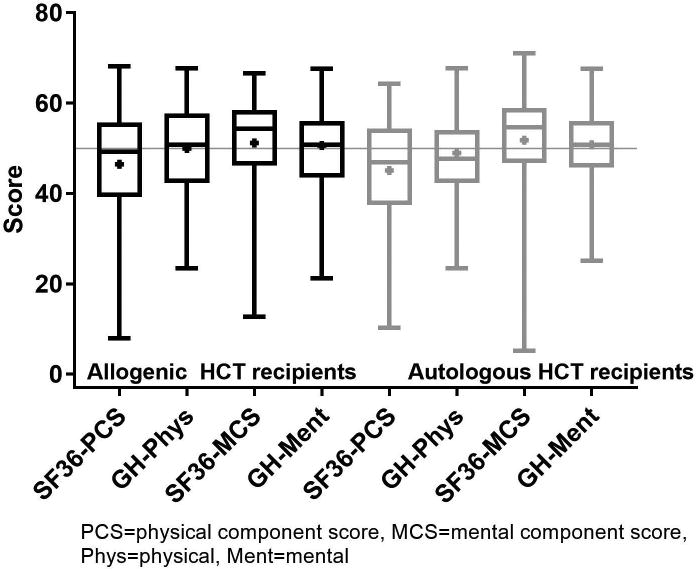
SF36 and PROMIS component score distribution. Data are displayed as mean (square), median (line inside the box), Interquartile range (IQR) (top & bottom edges), and extreme values (whiskers).
Figure 2a
Figure 2a
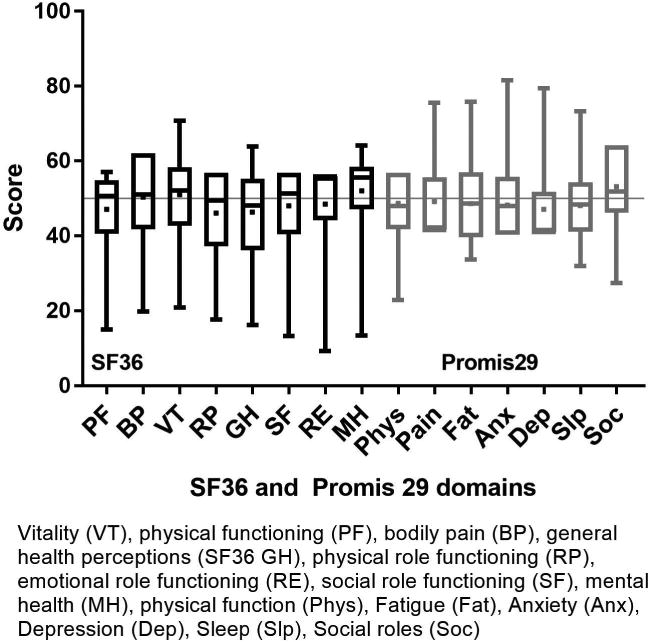
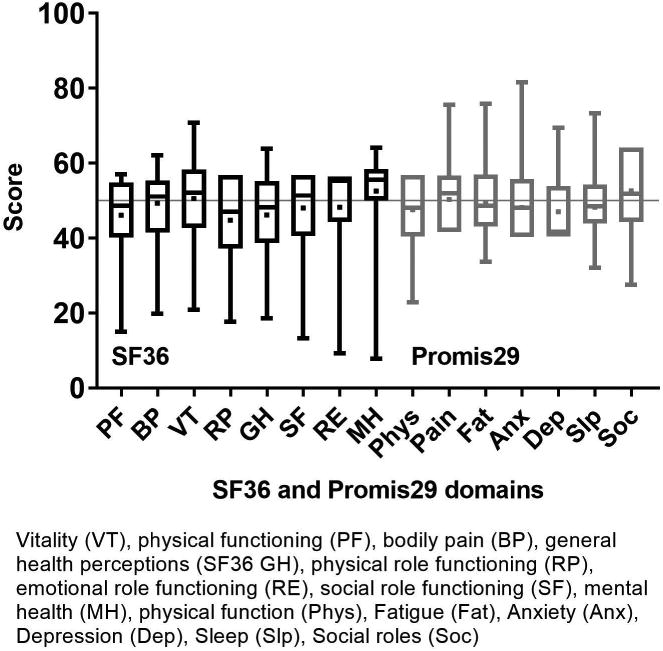
SF36 and PROMIS29 domain score distribution in allogeneic HCT recipients. Data are displayed as mean (square), median (line inside the box), Interquartile range (IQR) (top & bottom edges), and extreme values (whiskers). SF36: lower scores indicate worse symptoms and function. PROMIS: for negatively-worded concepts a higher T-score represents more of the concept being measured (depression, anxiety, pain interference, fatigue, sleep disturbance), for positively-worded concepts a higher T-score reflects more (better) of the concept being measured (physical function, social interaction). SF36 and PROMIS29 domain score distribution in autologous HCT recipients. Data are displayed as mean (square), median (line inside the box), IQR (top & bottom edges), and extreme values (whiskers). SF36: lower scores indicate worse symptoms and function. PROMIS: for negatively-worded concepts a higher T-score represents more of the concept being measured (depression, anxiety, pain interference, fatigue, sleep disturbance), for positively-worded concepts a higher T-score reflects more (better) of the concept being measured (physical function, social interaction).
Figure 2a
Figure 2a
SF36 and PROMIS29 domain score distribution in allogeneic HCT recipients. Data are displayed as mean (square), median (line inside the box), Interquartile range (IQR) (top & bottom edges), and extreme values (whiskers). SF36: lower scores indicate worse symptoms and function. PROMIS: for negatively-worded concepts a higher T-score represents more of the concept being measured (depression, anxiety, pain interference, fatigue, sleep disturbance), for positively-worded concepts a higher T-score reflects more (better) of the concept being measured (physical function, social interaction). SF36 and PROMIS29 domain score distribution in autologous HCT recipients. Data are displayed as mean (square), median (line inside the box), IQR (top & bottom edges), and extreme values (whiskers). SF36: lower scores indicate worse symptoms and function. PROMIS: for negatively-worded concepts a higher T-score represents more of the concept being measured (depression, anxiety, pain interference, fatigue, sleep disturbance), for positively-worded concepts a higher T-score reflects more (better) of the concept being measured (physical function, social interaction).

References

    1. Majhail NS, Tao L, Bredeson C, et al. Prevalence of hematopoietic cell transplant survivors in the United States. Biol Blood Marrow Transplant. 2013;19:1498–501. - PMC - PubMed
    1. Bevans M, Ross A, Cella D. Patient-Reported Outcomes Measurement Information System (PROMIS): efficient, standardized tools to measure self-reported health and quality of life. Nurs Outlook. 2014;62:339–45. - PMC - PubMed
    1. Pidala J, Kurland B, Chai X, et al. Patient-reported quality of life is associated with severity of chronic graft-versus-host disease as measured by NIH criteria: report on baseline data from the Chronic GVHD Consortium. Blood. 2011;117:4651–7. - PMC - PubMed
    1. Mosher CE, Redd WH, Rini CM, et al. Physical, psychological, and social sequelae following hematopoietic stem cell transplantation: a review of the literature. Psychooncology. 2009;18:113–27. - PMC - PubMed
    1. Pidala J, Anasetti C, Jim H. Quality of life after allogeneic hematopoietic cell transplantation. Blood. 2009;114:7–19. - PMC - PubMed

Publication types

LinkOut - more resources