


Identification and Optimization of 4-Anilinoquinolines as Inhibitors of Cyclin G Associated Kinase
- PMID: 29072804
- PMCID: PMC5914168
- DOI: 10.1002/cmdc.201700663
Identification and Optimization of 4-Anilinoquinolines as Inhibitors of Cyclin G Associated Kinase
Abstract
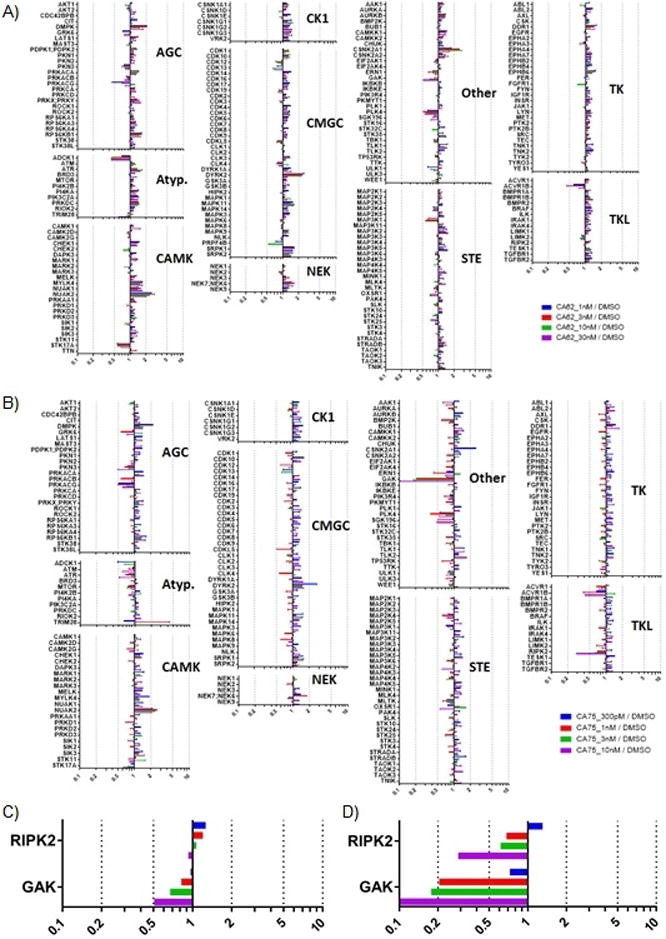
4-Anilinoquinolines were identified as potent and narrow-spectrum inhibitors of the cyclin G associated kinase (GAK), an important regulator of viral and bacterial entry into host cells. Optimization of the 4-anilino group and the 6,7-quinoline substituents produced GAK inhibitors with nanomolar activity, over 50 000-fold selectivity relative to other members of the numb-associated kinase (NAK) subfamily, and a compound (6,7-dimethoxy-N-(3,4,5-trimethoxyphenyl)quinolin-4-amine; 49) with a narrow-spectrum kinome profile. These compounds may be useful tools to explore the therapeutic potential of GAK in prevention of a broad range of infectious and systemic diseases.
Keywords: anilinoquinolines; antibacterial agents; chemical probes; cyclin G associated kinase (GAK).
© 2018 Wiley-VCH Verlag GmbH & Co. KGaA, Weinheim.
Figures
References
-
- Greener T, Zhao X, Nojima H, Eisenberg E, Greene LE. J Biol Chem. 2000;275(2):1365–1370. - PubMed
- Kanaoka Y, Kimura SH, Okazaki I, Ikeda M, Nojima H. FEBS Lett. 1997;402(1):73–80. - PubMed
- Kimura SH, Tsuruga H, Yabuta N, Endo Y, Nojima H. Genomics. 1997;44(2):179–187. - PubMed
- Korolchuk VI, Banting G. Traffic. 2002;3(6):428–439. - PubMed
-
- Shimizu H, Nagamori I, Yabuta N, Nojima H. J Cell Sci. 2009;122(Pt 17):3145–3152. - PubMed
-
- Manning G, Whyte DB, Martinez R, Hunter T, Sudarsanam S. Science. 2002;298(5600):1912–1934. - PubMed
-
- Barbieri E, Di Fiore PP, Sigismund S. Curr Opin Cell Biol. 2016;39:21–27. - PubMed
Publication types
MeSH terms
Substances
Grants and funding
LinkOut - more resources
Full Text Sources
Other Literature Sources
Miscellaneous
