


International Assessment of Event-Free Survival at 24 Months and Subsequent Survival in Peripheral T-Cell Lymphoma
- PMID: 29072976
- PMCID: PMC5736237
- DOI: 10.1200/JCO.2017.73.8195
International Assessment of Event-Free Survival at 24 Months and Subsequent Survival in Peripheral T-Cell Lymphoma
Abstract
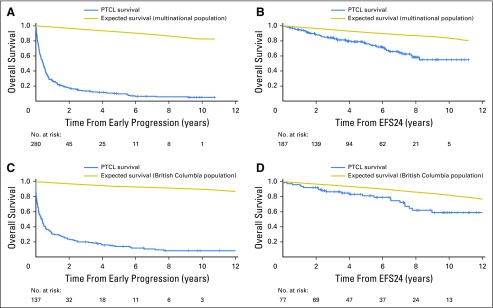
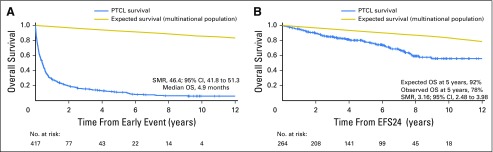
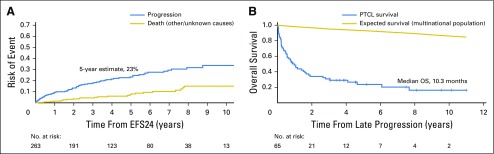
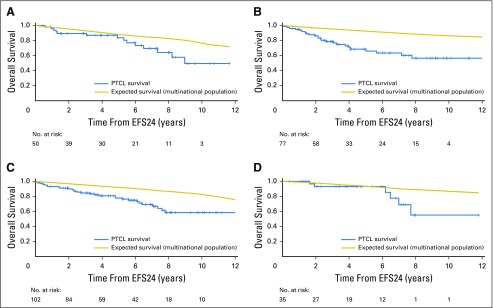
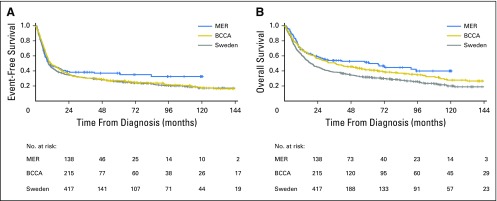
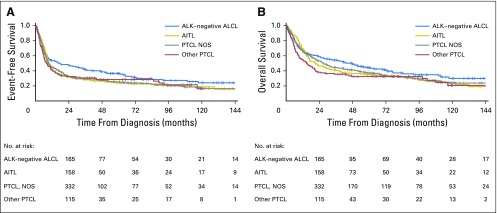
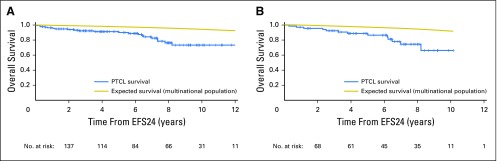
Purpose Peripheral T-cell lymphomas (PTCLs) have aggressive clinical behavior. We have previously shown that event-free survival (EFS) at 24 months (EFS24) is a clinically useful end point in diffuse large B-cell lymphoma. Here, we assess EFS24 and subsequent overall survival (OS) in large, multinational PTCL cohorts. Patients and Methods Patients with systemic PTCL newly diagnosed from 2000 to 2012 and treated with curative intent were included from the United States and Sweden (initial cohorts) and from Canada (replication cohort). EFS was defined as time from date of diagnosis to progression after primary treatment, retreatment, or death. Subsequent OS was measured after achieving EFS24 or from the time of progression if it occurred within 24 months. OS rates were compared with the age-, sex-, and country-matched general population. Results Seven hundred seventy-five patients were included in the study (the median age at diagnosis was 64 years; 63% were men). Results were similar in the initial and replication cohorts, and a combined analysis was undertaken. Sixty-four percent of patients progressed within the first 24 months and had a median OS of only 4.9 months (5-year OS, 11%). In contrast, median OS after achieving EFS24 was not reached (5-year OS, 78%), although relapses within 5 years of achieving EFS24 occurred in 23% of patients. Superior outcomes after achieving EFS24 were observed in younger patients (≤ 60 years of age: 5-year OS, 91%). Conclusion EFS24 stratifies subsequent outcome in PTCL. Patients with PTCL with primary refractory disease or early relapse have extremely poor survival. However, more than one third of patients with PTCL remain in remission 2 years after diagnosis with encouraging subsequent OS, especially in younger patients. These marked differences in outcome suggest that EFS24 has utility for patient counseling, study design, and risk stratification in PTCL.
Figures
References
-
- Armitage JO: The aggressive peripheral T-cell lymphomas: 2015. Am J Hematol 90:665-673, 2015 - PubMed
-
- Fisher RI, Gaynor ER, Dahlberg S, et al. : A phase III comparison of CHOP vs. m-BACOD vs. ProMACE-CytaBOM vs. MACOP-B in patients with intermediate- or high-grade non-Hodgkin’s lymphoma: Results of SWOG-8516 (Intergroup 0067), the National High-Priority Lymphoma Study. Ann Oncol 5:91-95, 1994. (suppl 2) - PubMed
-
- Vose J, Armitage J, Weisenburger D, et al. : International peripheral T-cell and natural killer/T-cell lymphoma study: Pathology findings and clinical outcomes. J Clin Oncol 26:4124-4130, 2008 - PubMed
-
- Savage KJ, Harris NL, Vose JM, et al. : ALK- anaplastic large-cell lymphoma is clinically and immunophenotypically different from both ALK+ ALCL and peripheral T-cell lymphoma, not otherwise specified: Report from the International Peripheral T-Cell Lymphoma Project. Blood 111:5496-5504, 2008 - PubMed
MeSH terms
Grants and funding
LinkOut - more resources
Full Text Sources
Other Literature Sources
Medical
