


Increased dietary long-chain polyunsaturated fatty acids alter serum fatty acid concentrations and lower risk of urine stone formation in cats
- PMID: 29073223
- PMCID: PMC5658157
- DOI: 10.1371/journal.pone.0187133
Increased dietary long-chain polyunsaturated fatty acids alter serum fatty acid concentrations and lower risk of urine stone formation in cats
Abstract
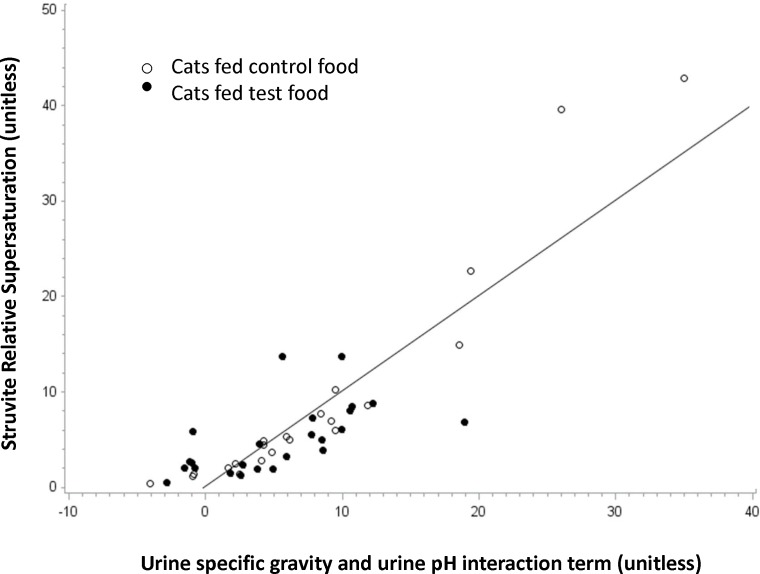
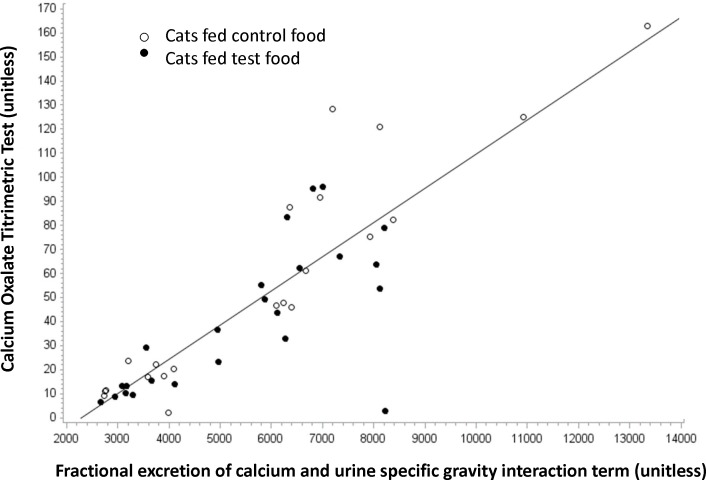
The lifespan of cats with non-obstructive kidney stones is shortened compared with healthy cats indicating a need to reduce stone formation and minimize chronic kidney disease. The purpose of this study was to investigate the effects of increasing dietary polyunsaturated fatty acids (PUFA) on urine characteristics. Domestic-short-hair cats (n = 12; mean age 5.6 years) were randomized into two groups and fed one of two dry-cat foods in a cross-over study design. For one week before study initiation, all cats consumed control food that contained 0.07% arachidonic acid (AA), but no eicosapentaenoic acid (EPA) or docosahexaenoic acid (DHA). Group 1 continued eating control food for 56 days. Group 2 was fed test food for 56 days, which was control food plus fish oil and high-AA oil. Test food contained 0.17% AA, 0.09% EPA and 0.18% DHA. After 56 days, cats were fed the opposite food for another 56 days. At baseline and after each feeding period, serum was analyzed for fatty acid concentrations, and urine for specific gravity, calcium concentration, relative-super-saturation for struvite crystals, and a calcium-oxalate-titrimetric test was performed. After consuming test food, cats had increased (all P<0.001) serum concentrations of EPA (173%), DHA (61%), and AA (35%); decreased urine specific gravity (P = 0.02); decreased urine calcium concentration (P = 0.06); decreased relative-super-saturation for struvite crystals (P = 0.03); and increased resistance to oxalate crystal formation (P = 0.06) compared with cats consuming control food. Oxalate crystal formation was correlated with serum calcium concentration (r = 0.41; P<0.01). These data show benefits for reducing urine stone formation in cats by increasing dietary PUFA.
Conflict of interest statement
Figures
References
-
- Hall JA, Yerramilli M, Obare E, Li J, Jewell DE. Serum concentrations of symmetric dimethylarginine and creatinine in cats with kidney stones. PLoS One. 2017;12(4):e0174854 Epub 2017/04/07. doi: 10.1371/journal.pone.0174854 ; PubMed Central PMCID: PMC5383095. - DOI - PMC - PubMed
-
- Osborne CA, Lulich JP, Kruger JM, Ulrich LK, Koehler LA. Analysis of 451,891 canine uroliths, feline uroliths, and feline urethral plugs from 1981 to 2007: Perspectives from the Minnesota Urolith Center. Vet Clin North Am Small Anim Pract. 2009;39(1):183–97. doi: 10.1016/j.cvsm.2008.09.011 PubMed PMID: ISI:000262171600015. - DOI - PubMed
-
- Cannon AB, Westropp JL, Ruby AL, Kass PH. Evaluation of trends in urolith composition in cats: 5,230 cases (1985–2004). J Am Vet Med Assoc. 2007;231(4):570–6. Epub 2007/08/19. doi: 10.2460/javma.231.4.570 . - DOI - PubMed
-
- Lekcharoensuk C, Osborne CA, Lulich JP, Pusoonthornthum R, Kirk CA, Ulrich LK, et al. Association between dietary factors and calcium oxalate and magnesium ammonium phosphate urolithiasis in cats. J Am Vet Med Assoc. 2001;219(9):1228–37. Epub 2001/11/08. . - PubMed
-
- Osborne CA, Lulich JP, Kruger JM, Polzin DJ, Johnston GR, Kroll RA. Medical dissolution of feline struvite urocystoliths. J Am Vet Med Assoc. 1990;196(7):1053–63. Epub 1990/04/01. . - PubMed
MeSH terms
Substances
LinkOut - more resources
Full Text Sources
Other Literature Sources
Medical
Research Materials
Miscellaneous
