Comparative risks of diabetes-related complications of basal insulins: a longitudinal population-based cohort of type 1 diabetes 1999-2013 in Taiwan
- PMID: 29073329
- PMCID: PMC5777427
- DOI: 10.1111/bcp.13461
Comparative risks of diabetes-related complications of basal insulins: a longitudinal population-based cohort of type 1 diabetes 1999-2013 in Taiwan
Abstract
Aim: We compared the effects of two types of basal insulin: long-acting insulin analogues vs. intermediate/long-acting human insulin, on diabetes-related complications in type 1 diabetes.
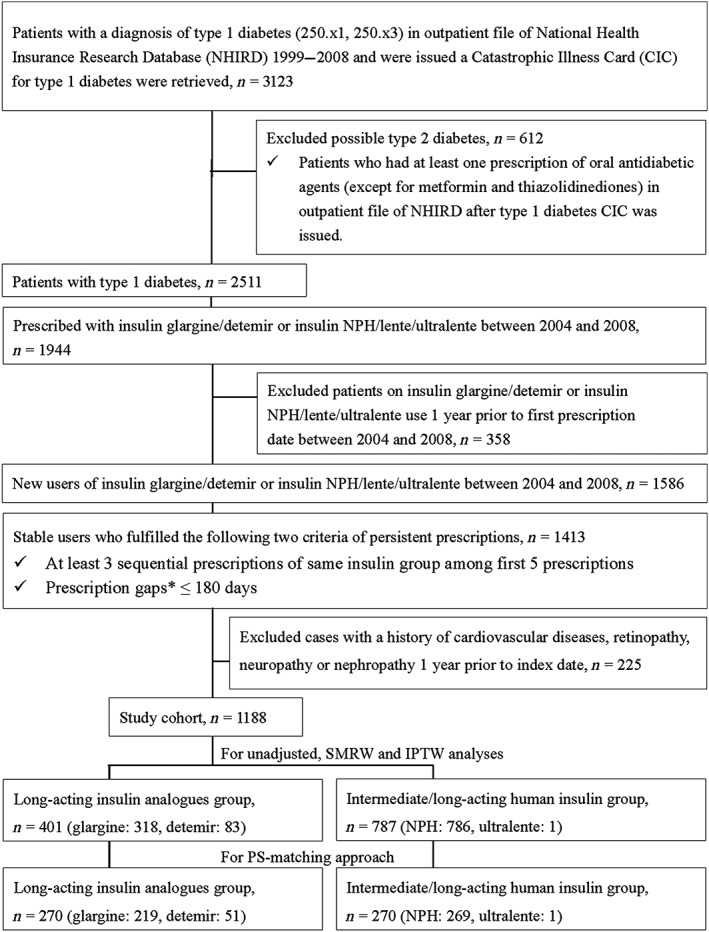
Methods: A total of 1188 patients with type 1 diabetes who had recently started on long-acting insulin analogues or intermediate/long-acting human insulin were identified in 2004-2008 and followed until death or the end of 2013. Clinical outcomes included acute (i.e. hyperglycaemia, hypoglycaemia) and chronic (i.e. nephropathy, retinopathy, neuropathy, cardiovascular diseases) complications. Diabetes-related complications were measured as a composite outcome which included acute and chronic complications. Cox proportional hazards models were used to assess the time to event hazard ratio. Three propensity score (PS) methods were applied to adjust for baseline imbalances between basal insulin groups, including the PS-matching approach (as the main analysis), standardized mortality ratio weighting (SMRW) and inverse probability of treatment weighting (IPTW).
Results: Long-acting insulin analogues vs. intermediate/long-acting human insulin had a lower risk for a composite of diabetes-related complications {adjusted hazards ratios [aHRs] [95% confidence interval (CI)] 0.782 [0.639, 0.956], 0.743 [0.598, 0.924] and 0.699 [0.577, 0.846] according to the PS-matching approach, SMRW and IPTW, respectively}. Compared with intermediate/long-acting human insulin, using long-acting insulin analogues had a lower hypoglycaemia risk: aHRs (95% CI) 0.681 (0.498, 0.930), 0.662 (0.466, 0.943) and 0.639 (0.471, 0.867) from the PS-matching approach, SMRW and IPTW, respectively. No statistical differences were found between two types of insulin on individual chronic complications.
Conclusion: A trend of lower diabetes-related complications associated with long-acting insulin analogues vs. intermediate/long-acting human insulin was observed. A reduced hypoglycaemia risk with long-acting insulin analogues was confirmed in this 'real-world' study.
Keywords: diabetes-related complications; hypoglycaemia; intermediate/long-acting human insulin; long-acting insulin analogues; type 1 diabetes.
© 2017 The British Pharmacological Society.
Figures
References
-
- Soltesz G, Patterson CC, Dahlquist G. Worldwide childhood type 1 diabetes incidence – what can we learn from epidemiology? Pediatr Diabetes 2007; 8 (Suppl. 6): 6–14. - PubMed
-
- Patterson CC, Dahlquist GG, Gyurus E, Green A, Soltesz G. Incidence trends for childhood type 1 diabetes in Europe during 1989–2003 and predicted new cases 2005–20: a multicentre prospective registration study. Lancet 2009; 373: 2027–2033. - PubMed
-
- Lu CL, Shen HN, Chen HF, Li CY. Epidemiology of childhood type 1 diabetes in Taiwan, 2003 to 2008. Diabet Med 2014; 31: 666–673. - PubMed
-
- Ou HT, Yang CY, Wang JD, Hwang JS, Wu JS. Life expectancy and lifetime health care expenditures for type 1 diabetes: a nationwide longitudinal cohort of incident cases followed for 14 years. Value Health 2016; 19: 976–984. - PubMed
-
- Nathan DM, Genuth S, Lachin J, Cleary P, Crofford O, Davis M, et al The effect of intensive treatment of diabetes on the development and progression of long‐term complications in insulin‐dependent diabetes mellitus. N Engl J Med 1993; 329: 977–986. - PubMed
Publication types
MeSH terms
Substances
LinkOut - more resources
Full Text Sources
Other Literature Sources
Medical