. 2018 Feb;70(2):242-254.
doi: 10.1002/art.40359. Epub 2018 Jan 3.

Gut Microbiota Perturbations in Reactive Arthritis and Postinfectious Spondyloarthritis

Affiliations

Gut Microbiota Perturbations in Reactive Arthritis and Postinfectious Spondyloarthritis

Julia Manasson et al. Arthritis Rheumatol. 2018 Feb.

Abstract

Objective: Reactive arthritis (ReA) is an inflammatory disorder occurring several weeks after gastrointestinal or genitourinary tract infections. HLA-B27 positivity is considered a risk factor, although it is not necessarily predictive of disease incidence. Among nongenetic factors, the intestinal microbiome may play a role in disease susceptibility. The objective of this study was to characterize the gut microbiota and host gene interactions in ReA and postinfectious spondyloarthritis.

Methods: Adult subjects with peripheral spondyloarthritis and control subjects with preceding infections who did not develop arthritis were prospectively recruited from a geographic region with a high prevalence of ReA. Clinical variables, HLA status, and 16S ribosomal RNA gene sequencing of intestinal microbiota were analyzed.

Results: Subjects with ReA showed no significant differences from controls in gut bacterial richness or diversity. However, there was a significantly higher abundance of Erwinia and Pseudomonas and an increased prevalence of typical enteropathogens associated with ReA. Subjects with ultrasound evidence of enthesitis were enriched in Campylobacter, while subjects with uveitis and radiographic sacroiliitis were enriched in Erwinia and unclassified Ruminococcaceae, respectively; both were enriched in Dialister. Host genetics, particularly HLA-A24, were associated with differences in gut microbiota diversity irrespective of disease status. We identified several co-occurring taxa that were also predictive of HLA-A24 status.

Conclusion: This is the first culture-independent study characterizing the gut microbial community in postinfectious arthritis. Although bacterial factors correlated with disease presence and clinical features of ReA, host genetics also appeared to be a major independent driver of intestinal community composition. Understanding of these gut microbiota-host genetic relationships may further clarify the pathogenesis of postinfectious spondyloarthritides.


Figures

Figure 1
Figure 1
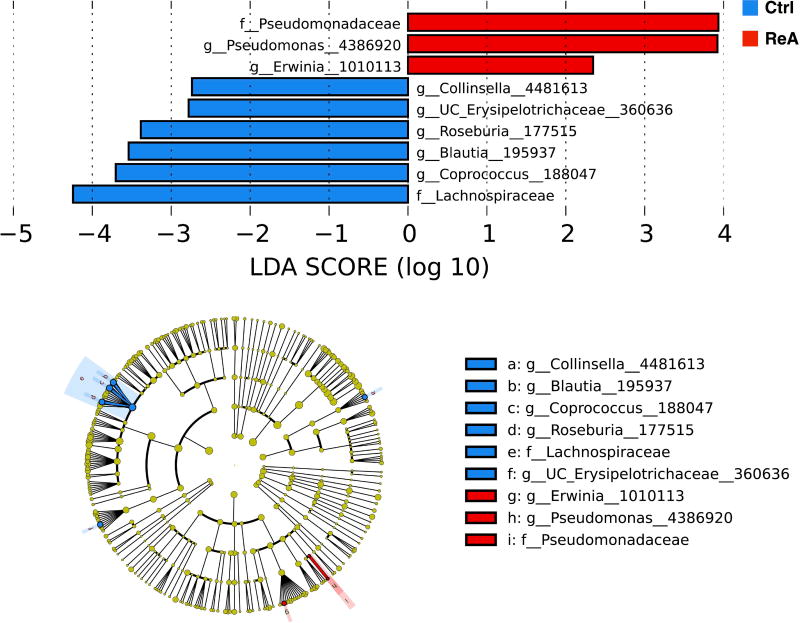
LEfSe analysis of reactive arthritis (ReA) and control (Ctrl) subjects. LDA demonstrates that enteropathogens were enriched in ReA subjects, while commensals were enriched in control subjects. Cladogram shows the relationships among differentiating taxa between subject groups. Log LDA >2 for all taxa. None passed FDR or Bonferroni correction thresholds.
Figure 2
Figure 2
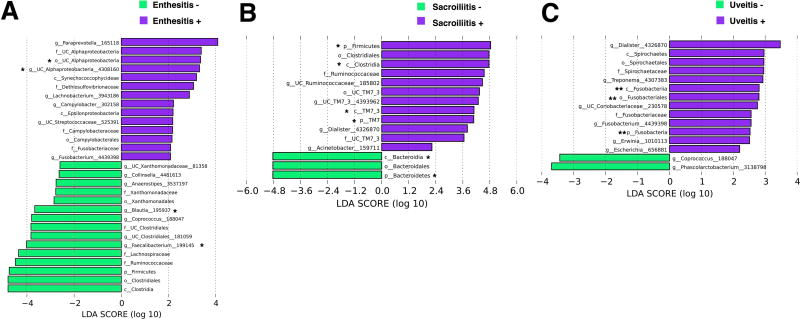
LEfSe analysis for clinical and radiographic data specific to reactive arthritis. Unclassified Alphaproteobacteria (genus and order) were enriched in subjects with ultrasound evidence of enthesitis (A), while Clostridia (class), TM7_3 (class), Firmicutes (phylum), and TM7 (phylum) were enriched in subjects with radiographic sacroiliitis (B), all passing FDR correction threshold. Fusobacteriales (order), Fusobacteria (class), and Fusobacteria (phylum) were enriched in subjects with uveitis, passing both FDR and Bonferroni correction thresholds (C). Although not achieving FDR or Bonferroni significance, Campylobacter was enriched in subjects with enthesitis (A), unclassified Ruminococcaceae was enriched in subjects with sacroiliitis (B), and Erwinia was enriched in subjects with uveitis (C). Dialister was independently enriched in subjects with sacroiliitis (B) and those with uveitis (C). Log LDA >2 for all taxa. * Passed FDR correction threshold. ** Passed FDR and Bonferroni correction thresholds.
Figure 3
Figure 3
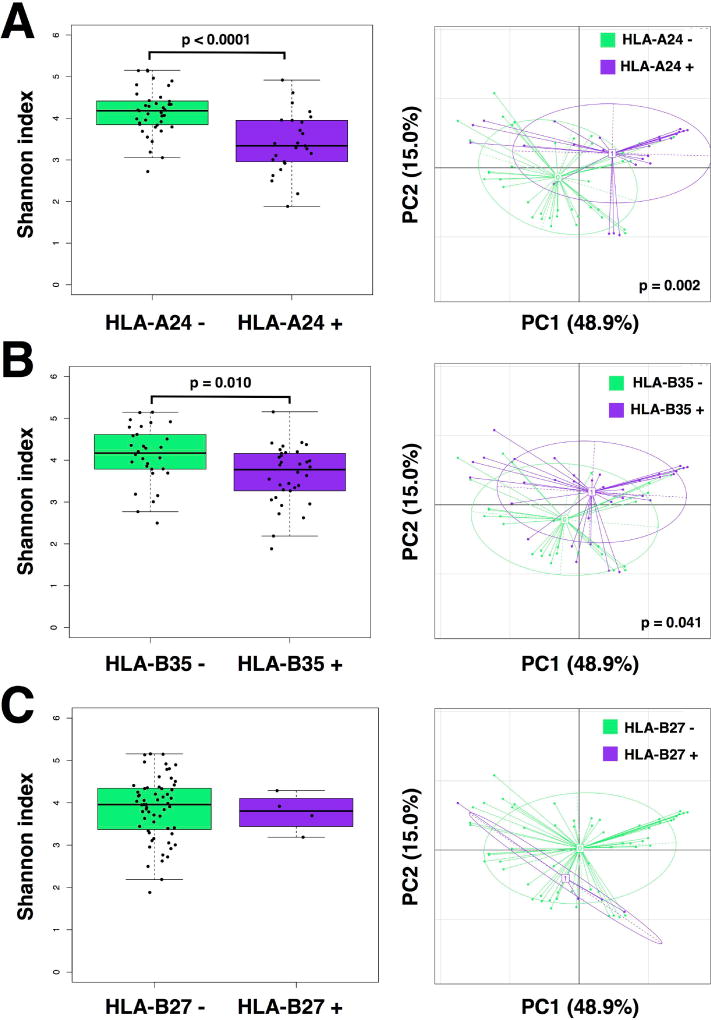
Alpha and beta diversity for subjects grouped by HLA alleles. Alpha diversity was significantly lower in subjects carrying the HLA-A24 allele (p<0.0001) (A) and the HLA-B35 allele (p=0.010) (B). Correspondingly, differences in beta diversity were also seen in cases of HLA-A24 (p=0.002) (A) and HLA-B35 (p=0.041) (B). There were too few HLA-B27 positive subjects to calculate a statistical difference (C). Alpha diversity was determined by the Shannon diversity index. Beta diversity was determined by weighted UniFrac distances. Statistical significance was calculated using the Mann-Whitney U test for alpha diversity and the Adonis (Permanova) test for beta diversity.
Figure 4
Figure 4
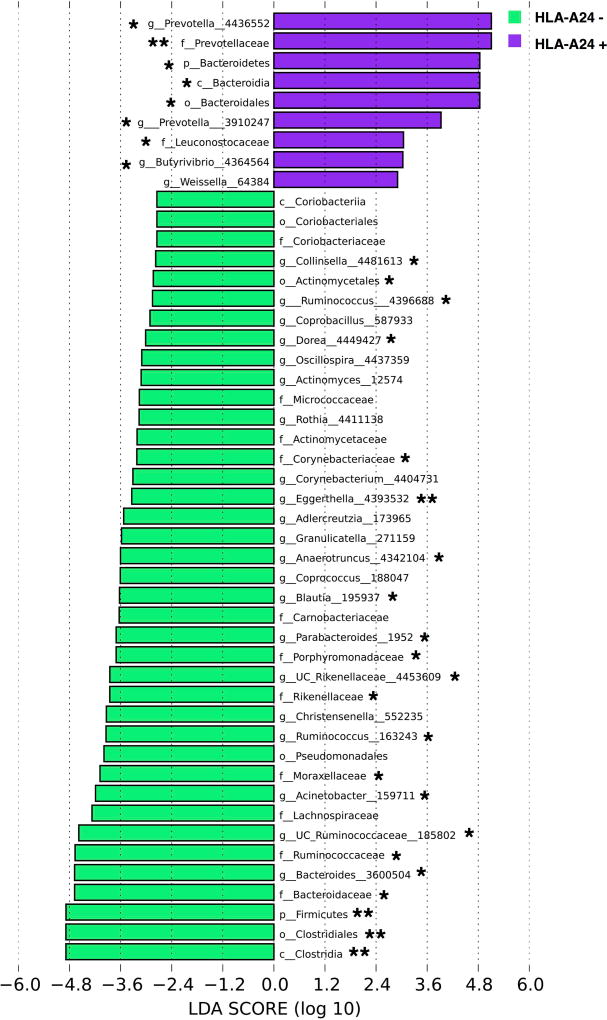
LEfSe analysis of HLA-A24 positive and negative subjects. LDA demonstrates that HLA-A24 negative subjects had overall more differentiating taxa compared to HLA-A24 positive subjects. A number of genera passed FDR correction threshold. Most notably, Prevotella was enriched in subjects who had the HLA-A24 allele. Log LDA >2 for all taxa. * Passed FDR correction threshold. ** Passed FDR and Bonferroni correction thresholds.
Figure 5
Figure 5
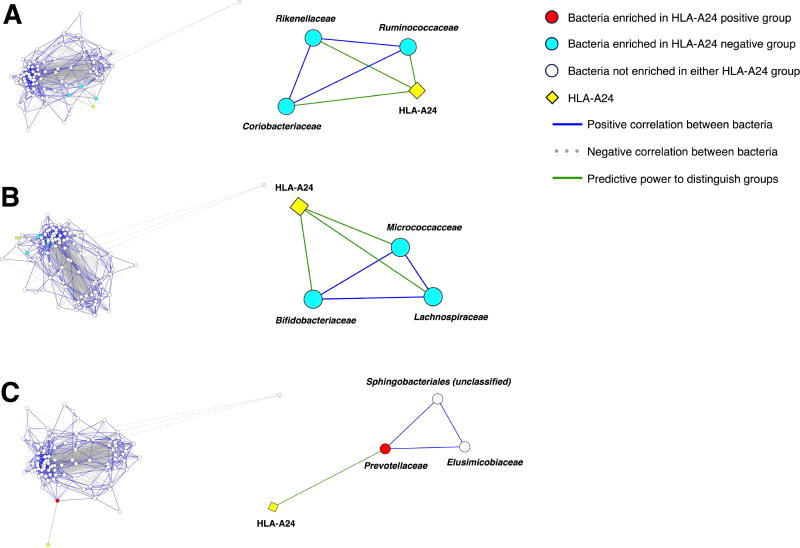
Co-occurrence network analysis at the family level. Left side of the figure demonstrates the entire network of relationships among taxa. Right side of the figure demonstrates specific cliques of taxa, which co-occur with one another and with at least one taxon in each clique having predictive power for HLA-A24 allele status. In the overall network and cliques, edge lengths are inversely proportional to the strength of the correlation or the strength of predictive power that distinguishes between HLA-A24 positive and negative groups. Taxa that were enriched in the HLA-A24 negative cohort; each individual taxon also had predictive power for HLA-A24 status (A and B). Only Prevotellaceae was enriched in the HLA-A24 positive cohort and had predictive power for HLA-A24 status (C).

References

    1. Hannu T. Reactive arthritis. Best Pract Res Clin Rheumatol. 2011;25(3):347–57. - PubMed
    1. Schiellerup P, Krogfelt KA, Locht H. A comparison of self-reported joint symptoms following infection with different enteric pathogens: effect of HLA-B27. J Rheumatol. 2008;35(3):480–7. - PubMed
    1. Putterman C, Rubinow A. Reactive arthritis associated with Clostridium difficile pseudomembranous colitis. Semin Arthritis Rheum. 1993;22(6):420–6. - PubMed
    1. Brewerton DA, Caffrey M, Nicholls A, Walters D, Oates JK, James DC. Reiter's disease and HL-A 27. Lancet. 1973;302(7836):996–8. - PubMed
    1. Khan MA. HLA-B27 and its subtypes in world populations. Curr Opin Rheumatol. 1995;7(4):263–9. - PubMed

Publication types