


Racial disparities in outcomes after intact abdominal aortic aneurysm repair
- PMID: 29074109
- PMCID: PMC5869065
- DOI: 10.1016/j.jvs.2017.07.138
Racial disparities in outcomes after intact abdominal aortic aneurysm repair
Abstract
Objective: We aimed to compare perioperative morbidity and mortality and late survival among black, white, and Asian patients undergoing intact abdominal aortic aneurysm (AAA) repair.
Methods: We identified all patients undergoing intact, infrarenal AAA repair in the Vascular Quality Initiative (VQI) from 2003 to 2017. We compared in-hospital outcomes by race using the Fisher exact and Kruskal-Wallis tests. Multivariable logistic and linear regression models of perioperative outcomes adjusted for differences in demographics, comorbidities, hospital volume, and procedure. We used Cox regression to evaluate late survival by race.
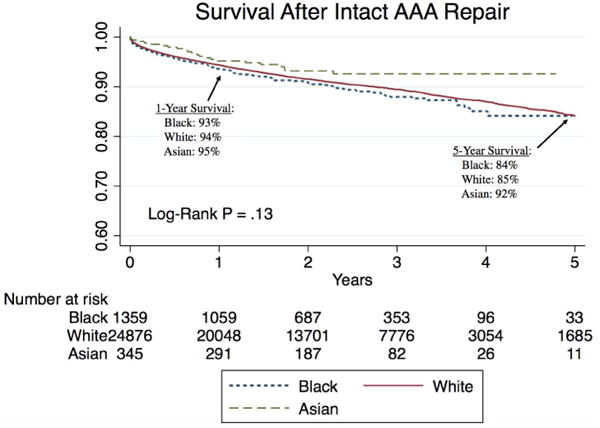
Results: In the cohort, 21,961 (94%) patients were white, 1215 (5.2%) were black, and 318 (1.4%) were Asian. Black patients were more likely to be symptomatic (black, 16%; white, 9.1%; Asian, 11%; P < .001) and to undergo endovascular aneurysm repair (EVAR; black, 87%; white, 83%; Asian, 84%; P < .001). There were no differences in 30-day mortality after EVAR (black, 1.1%; white, 1.1%; Asian, 0.8%; P = .80) or open repair (black; 4.3%; white, 2.6%; Asian, 1.9%; P = .33). However, black patients were more likely to receive new postoperative dialysis (black, 1.6%; white, 0.8%; Asian; 0.7%; P = .01) and to return to the operating room (black, 4.3%; white, 2.9%; Asian, 0.9%; P < .01). Mean hospital length of stay was longer in black patients after EVAR (black, 3.3 days; white, 2.6 days; Asian, 2.6 days; P < .001) and in Asian and black patients after open repair (black, 10.5 days; white, 8.5 days; Asian, 13.0 days; P < .001). After multivariable adjustment, black patients were more likely than white patients to have postoperative dialysis (odds ratio, 2.2; 95% confidence interval [CI], 1.3-3.6; P < .01) and return to the operating room (odds ratio, 1.6; 95% CI, 1.2-2.2; P < .01). Five-year survival was highest for Asian patients (black, 84%; white, 85%; Asian, 92%), even in the adjusted Cox model (Asian: hazard ratio, 0.6; 95% CI, 0.4-0.97; P = .04).
Conclusions: Although perioperative mortality is comparable across races after AAA repair, black patients are more likely than white or Asian patients to develop new postoperative renal failure and return to the operating room, even after adjusting for differences in comorbidities, operative variables, and hospital volume. In addition, whereas Asian patients have the highest rate of postoperative myocardial infarction, they also have the highest late survival. Further studies are warranted to elucidate the mechanism of these disparities.
Copyright © 2017 Society for Vascular Surgery. Published by Elsevier Inc. All rights reserved.
Figures
References
-
- Jha AK, Fisher ES, Li Z, Orav EJ, Epstein AM. Racial trends in the use of major procedures among the elderly. N Engl J Med. 2005;353(7):683–91. - PubMed
-
- Ravi P, Sood A, Schmid M, Abdollah F, Sammon JD, Sun M, et al. Racial/Ethnic Disparities in Perioperative Outcomes of Major Procedures: Results From the National Surgical Quality Improvement Program. Ann Surg. 2015;262(6):955–64. - PubMed
-
- Costa M, Robbs JV. Abdominal aneurysms in a black population: clinicopathological study. Br J Surg. 1986;73(7):554–8. - PubMed
-
- Lederle FA, Johnson GR, Wilson SE, Chute EP, Littooy FN, Bandyk D, et al. Prevalence and associations of abdominal aortic aneurysm detected through screening. Aneurysm Detection and Management (ADAM) Veterans Affairs Cooperative Study Group. Ann Intern Med. 1997;126(6):441–9. - PubMed
Publication types
MeSH terms
Grants and funding
LinkOut - more resources
Full Text Sources
Other Literature Sources
Medical
