. 2017 Jun:2017:299-310.
doi: 10.1007/978-3-319-59050-9_24. Epub 2017 May 23.

Exact Topological Inference for Paired Brain Networks via Persistent Homology

Affiliations

Exact Topological Inference for Paired Brain Networks via Persistent Homology

Moo K Chung et al. Inf Process Med Imaging. 2017 Jun.

Abstract

We present a novel framework for characterizing paired brain networks using techniques in hyper-networks, sparse learning and persistent homology. The framework is general enough for dealing with any type of paired images such as twins, multimodal and longitudinal images. The exact nonparametric statistical inference procedure is derived on testing monotonic graph theory features that do not rely on time consuming permutation tests. The proposed method computes the exact probability in quadratic time while the permutation tests require exponential time. As illustrations, we apply the method to simulated networks and a twin fMRI study. In case of the latter, we determine the statistical significance of the heritability index of the large-scale reward network where every voxel is a network node.


Figures
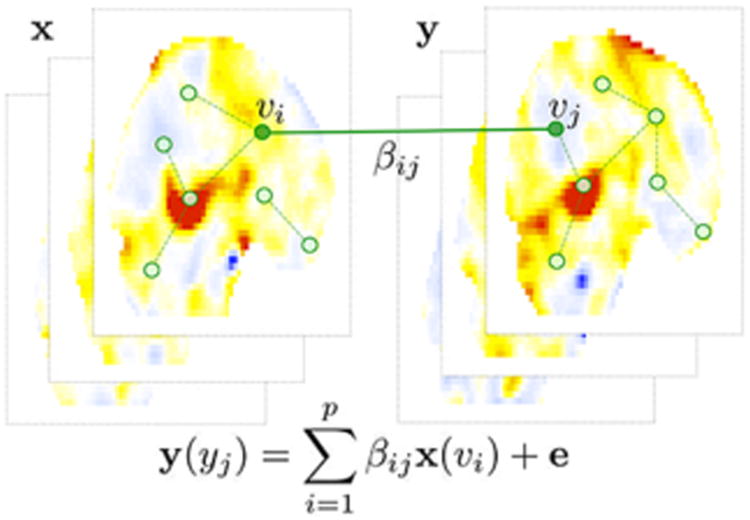
Fig. 1
Fig. 1
The schematic of hyper-network construction on paired image vectors x and y. The image vectors y at voxel υj is modeled as a linear combination of the first image vector x at all other voxels. The estimated parameters βij give the hyper-edge weights.
Fig. 2
Fig. 2
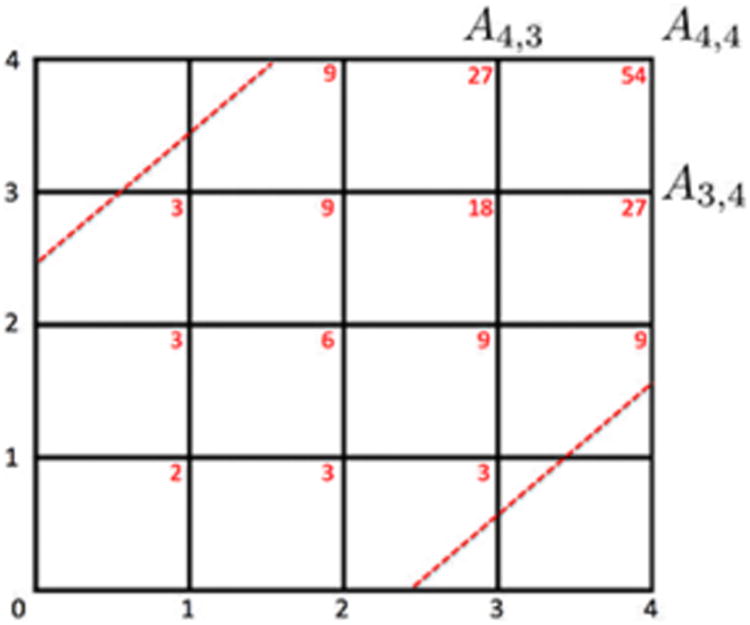
Au,υ are computed within the boundary (dotted red line). The red numbers are the number of paths from (0, 0).
Fig. 3
Fig. 3
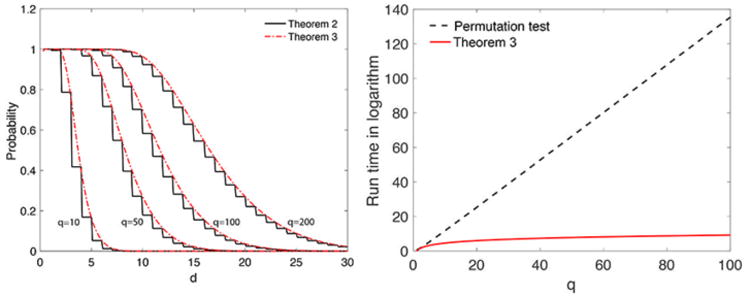
Left: Convergence of Theorem 2 to Theorem 3 for q = 10, 50, 100, 200. Right: Run time of permutation test (dotted black line) vs. the combinational method in Theorem 2 (solid red line) in logarithmic scale.
Fig. 4
Fig. 4
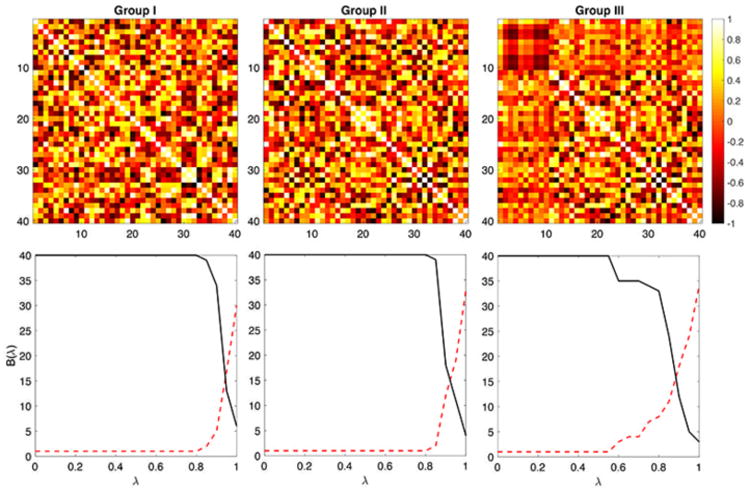
Simulation studies. Group I and Group II are generated independently and identically. The resulting B(λ) plots are similar. The dotted red line is β0 and the solid black line is the size of the largest connected component. No statistically significant differences can be found between Groups I and II. Group III is generated independently but identically as Group I but additional dependency is added for the first 10 nodes (square on the top left corner). The resulting B(λ) plots are statistically different between Groups I and II.
Fig. 5
Fig. 5
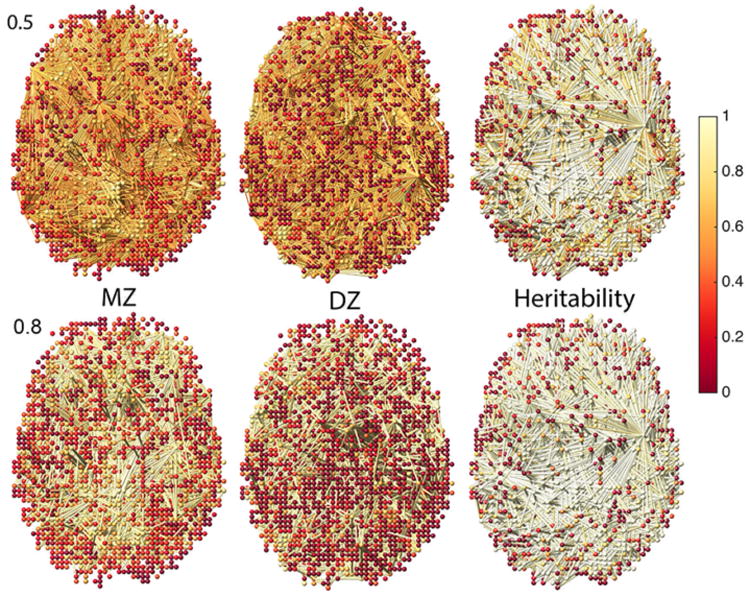
Left, middle: Node colors are correlations of MZ- and DZ-twins. Edge colors are sparse cross-correlations at sparsity λ = 0.5, 0.8. Right: Heritability index (HI) at nodes and edges. MZ-twins show higher correlations compared to DZ-twins. Some low HI nodes show high HI edges. Using only the voxel-level HI feature, we may fail to detect such high-order genetic effects on the functional network.
Fig. 6
Fig. 6
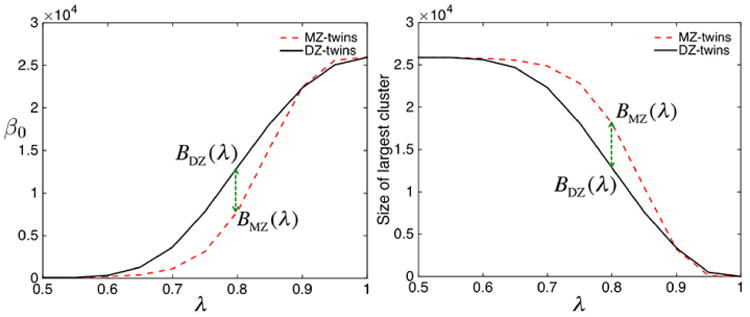
The result of graph filtrations on twin fMRI data. The number of connected components (left) and the size of the largest connected component (right) are plotted over the sparse parameter λ. For each λ, MZ-twins tend to have smaller number of connected components but larger connected component. The dotted green arrow (Dq) where the maximum group separation occurs.

References

    1. Bezerianos A, Sun Y, Chen Y, Woong KF, Taya F, Arico P, Borghini G, Babiloni F, Thakor N. Cooperation driven coherence: Brains working hard together. 37th Annual International Conference of the IEEE Engineering in Medicine and Biology Society (EMBC) 2015:4696–4699. - PubMed
    1. Böhm W, Hornik K. A Kolmogorov-Smirnov test for r samples. Institute for Statistics and Mathematics. 2010;105 Research Report Series:Report.
    1. Carlsson G, Memoli F. Persistent clustering and a theorem of J. Kleinberg. arXiv preprint arXiv:0808.2241. 2008
    1. Carlsson G, Singh G, Zomorodian A. Computing multidimensional persistence. International Symposium on Algorithms and Computation. 2009:730–739.
    1. Chung MK, Hanson JL, Ye J, Davidson RJ, Pollak SD. Persistent homology in sparse regression and its application to brain morphometry. IEEE Transactions on Medical Imaging. 2015;34:1928–1939. - PMC - PubMed

LinkOut - more resources