


Predictors for earlier return to work of cancer patients
- PMID: 29076003
- PMCID: PMC5884890
- DOI: 10.1007/s11764-017-0655-7
Predictors for earlier return to work of cancer patients
Abstract
Purpose: This study aims to investigate how perceived work ability, job self-efficacy, value of work, and fatigue predict return to work (RTW) in cancer patients who received chemotherapy.
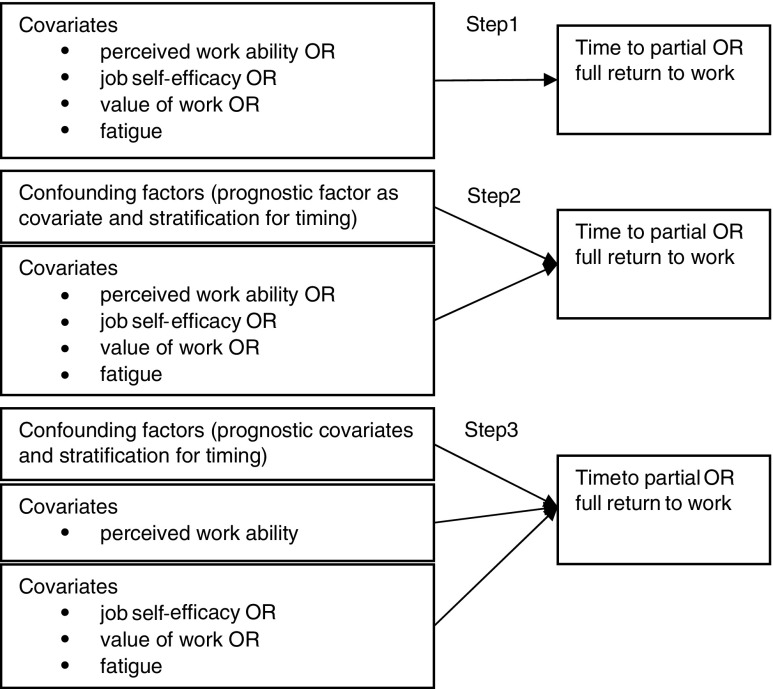
Methods: Data of a before-after study on a multidisciplinary intervention that aimed to enhance RTW was used, consisting of four assessments up to 18 months. Time to partial and full RTW of 76 and 81 participants, respectively, was analyzed in Cox proportional hazard analysis with time-dependent variables. Univariate analyses of work ability, job self-efficacy, value of work, or fatigue as covariates were succeeded by multivariate analyses of work ability and either job self-efficacy, value of work, or fatigue as covariates.
Results: Participants were mostly female (93%), and diagnosed with breast cancer (87%). Most participants were permanently employed (84%) and 48% was sole breadwinner. When adjusted for timing variables and prognostic factors, all hypothesized factors were predictive for earlier RTW (p < .05). In models that also included work ability, only job self-efficacy significantly predicted earlier full RTW: hazard ratio = 1.681; p = .025.
Conclusions: Lower fatigue and higher value of work, work ability, and job self-efficacy of cancer survivors are associated with earlier RTW. Work ability and job self-efficacy seem to be key predictors.
Implications for cancer survivors: Limiting fatigue, increasing value of work, job self-efficacy, and perceived work ability are promising goals for enhancing earlier RTW. Occupational rehabilitation should empower patients to organize appropriate conditions for work and to educate them on rights and obligations during sick leave.
Keywords: Chemotherapy; Fatigue; Occupational health; Return to work; Self-efficacy; Work ability.
Conflict of interest statement
Conflict of interest
The authors declare that they have no conflict of interest.
Ethical approval
All procedures performed in studies involving human participants were in accordance with the ethical standards of the institutional and/or national research committee and with the 1964 Helsinki declaration and its later amendments or comparable ethical standards. Approval by the Medical Ethical Committee of the Academic Medical Center Amsterdam was obtained, as well as from both medical centers that participated (NL 35864.018.11).
Figures
References
Publication types
MeSH terms
LinkOut - more resources
Full Text Sources
Other Literature Sources
Medical
Molecular Biology Databases
