


High-Resolution Multi-Scale Computational Model for Non-Invasive Cervical Vagus Nerve Stimulation
- PMID: 29076212
- PMCID: PMC5895480
- DOI: 10.1111/ner.12706
High-Resolution Multi-Scale Computational Model for Non-Invasive Cervical Vagus Nerve Stimulation
Abstract
Objectives: To develop the first high-resolution, multi-scale model of cervical non-invasive vagus nerve stimulation (nVNS) and to predict vagus fiber type activation, given clinically relevant rheobase thresholds.
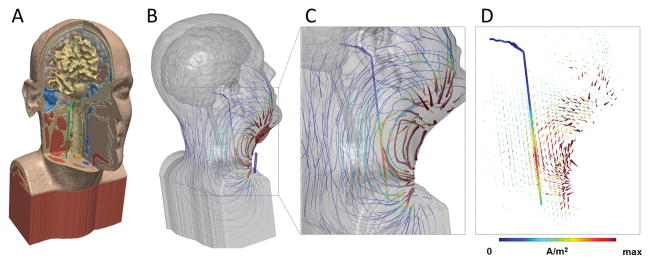
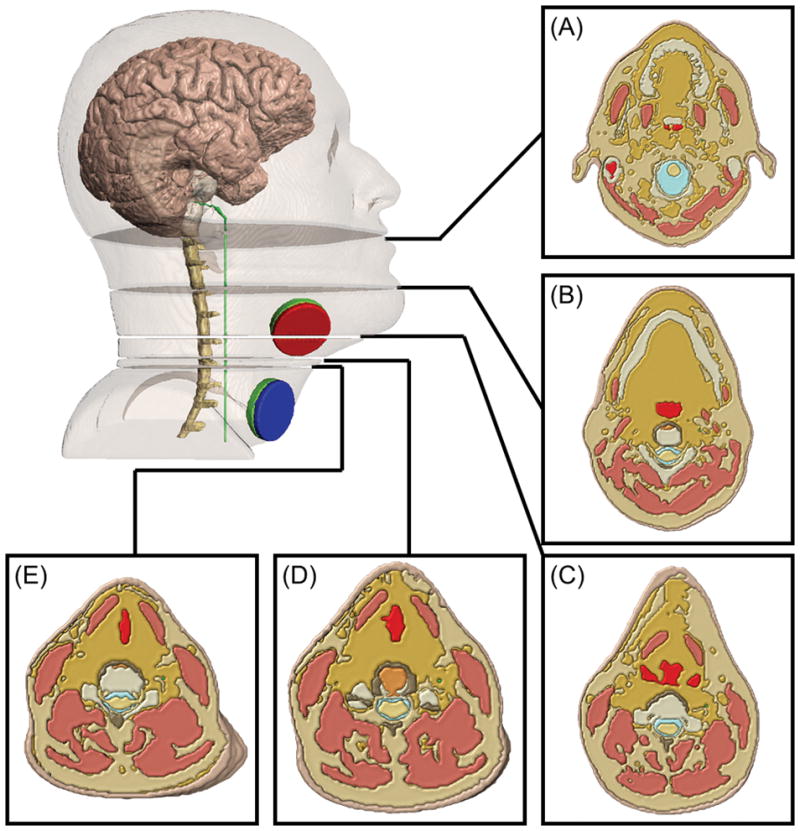
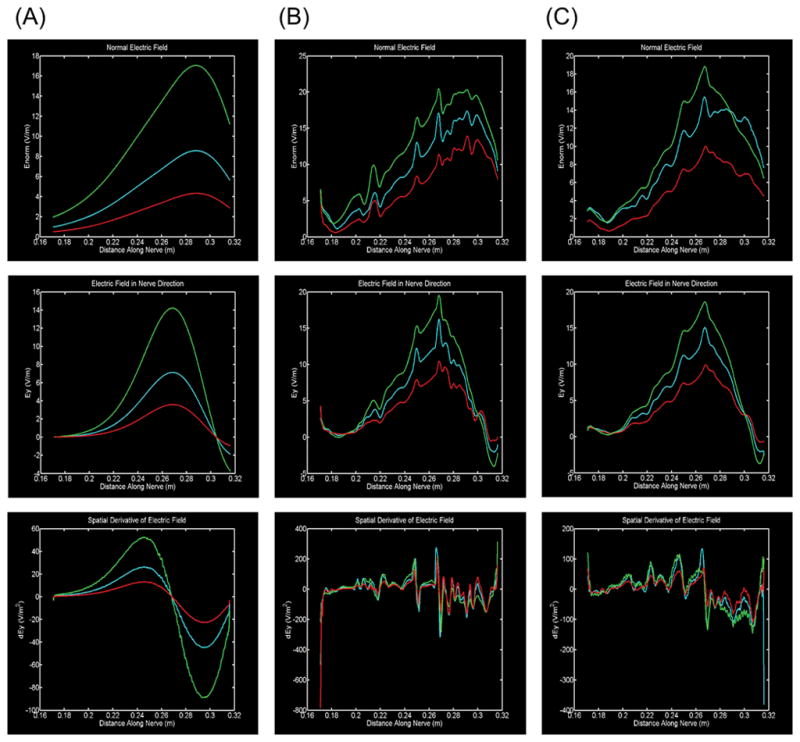
Methods: An MRI-derived Finite Element Method (FEM) model was developed to accurately simulate key macroscopic (e.g., skin, soft tissue, muscle) and mesoscopic (cervical enlargement, vertebral arch and foramen, cerebral spinal fluid [CSF], nerve sheath) tissue components to predict extracellular potential, electric field (E-Field), and activating function along the vagus nerve. Microscopic scale biophysical models of axons were developed to compare axons of varying size (Aα-, Aβ- and Aδ-, B-, and C-fibers). Rheobase threshold estimates were based on a step function waveform.
Results: Macro-scale accuracy was found to determine E-Field magnitudes around the vagus nerve, while meso-scale precision determined E-field changes (activating function). Mesoscopic anatomical details that capture vagus nerve passage through a changing tissue environment (e.g., bone to soft tissue) profoundly enhanced predicted axon sensitivity while encapsulation in homogenous tissue (e.g., nerve sheath) dulled axon sensitivity to nVNS.
Conclusions: These findings indicate that realistic and precise modeling at both macroscopic and mesoscopic scales are needed for quantitative predictions of vagus nerve activation. Based on this approach, we predict conventional cervical nVNS protocols can activate A- and B- but not C-fibers. Our state-of-the-art implementation across scales is equally valuable for models of spinal cord stimulation, cortex/deep brain stimulation, and other peripheral/cranial nerve models.
Keywords: Cranial nerve stimulation; electrode placement; mechanisms of action; neurostimulation; stimulation; vagus nerve stimulation.
© 2017 International Neuromodulation Society.
Conflict of interest statement
Conflict of Interest: Dr. Simon is an employee of electroCore and has shares in the company. The City University of New York has patents on brain stimulation with Dr. Bikson as inventor. Dr. Bikson also has equity in Soterix Medical Inc. and serves as a scientific advisor to Boston Scientific Inc.
Figures
References
-
- Bonaz B, Picq C, Sinniger V, Mayol J-F, Clarençon D. Vagus nerve stimulation: from epilepsy to the cholinergic anti-inflammatory pathway. Neurogastroenterol Motil. 2013;25(3):208–221. - PubMed
Publication types
MeSH terms
Grants and funding
LinkOut - more resources
Full Text Sources
Other Literature Sources
Medical
