


Progression-free survival at 2 years post-autologous transplant: a surrogate end point for overall survival in follicular lymphoma
- PMID: 29076254
- PMCID: PMC5727300
- DOI: 10.1002/cam4.1217
Progression-free survival at 2 years post-autologous transplant: a surrogate end point for overall survival in follicular lymphoma
Abstract
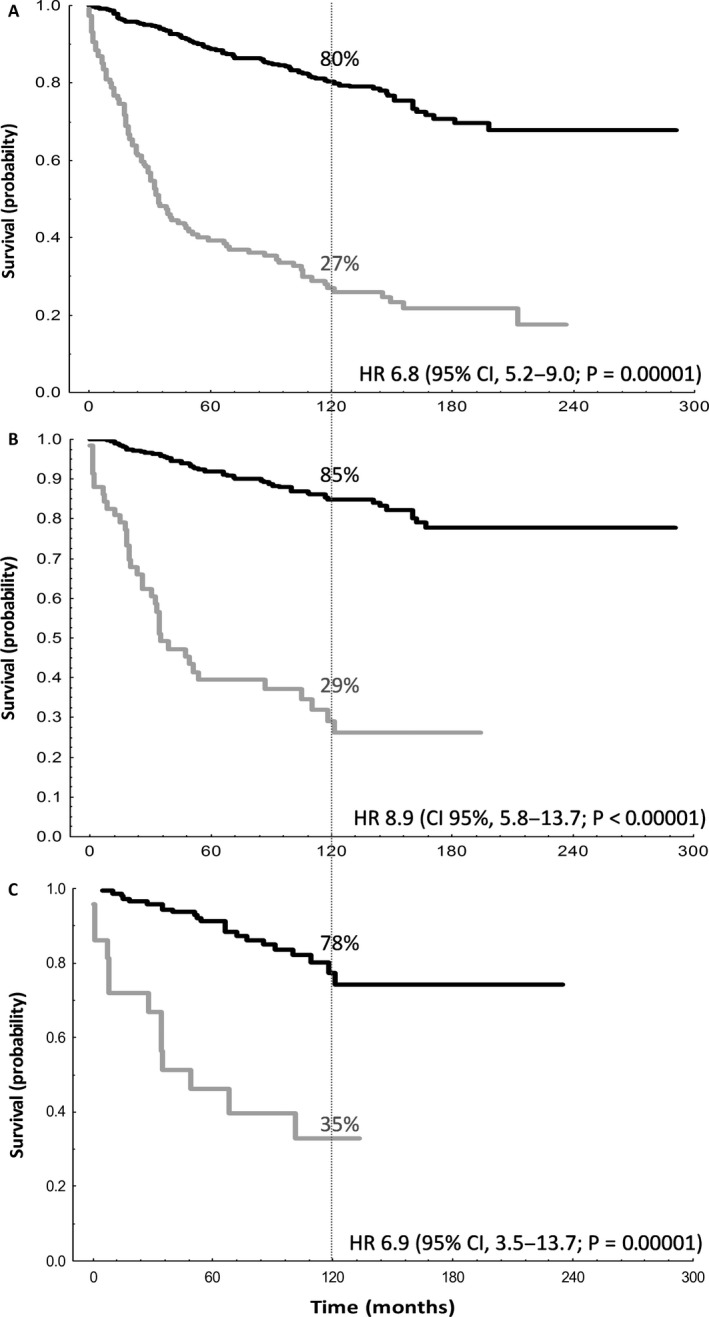
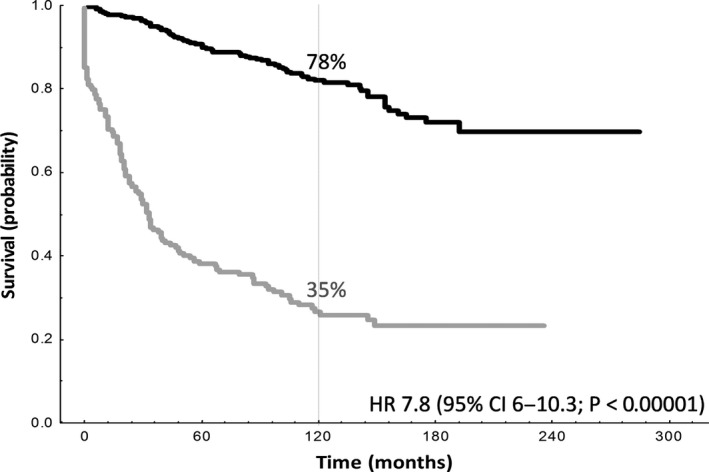
Overall survival (OS) is the gold-standard end point for studies evaluating autologous stem cell transplantation (ASCT) in follicular lymphoma (FL), but assessment may be elusive due to the lengthy disease course. We analyzed the validity of two earlier end points, proposed in the setting of first-line chemo-/immunotherapy, as surrogates for OS-progression-free survival (PFS) status at 24 months (PFS24) and complete response at 30 months (CR30) post-ASCT. We also have investigated the clinical features of patients with early progression after ASCT. Data were available for 626 chemosensitive FL patients who received ASCT between 1989 and 2007. Median follow-up was 12.2 years from ASCT. In the PFS24 analysis, 153 (24%) patients progressed within 24 months and 447 were alive and progression-free at 24 months post-ASCT (26 who died without disease progressions within 24 months were excluded). Early progression was associated with shorter OS (hazard ratio [HR], 6.8; P = 0.00001). In the subgroup of patients who received an ASCT in the setting or relapse after being exposed to rituximab, the HR was 11.3 (95% CI, 3.9-30.2; P < 0.00001). In the CR30 analysis, 183 of 596 (31%) response-evaluable patients progressed/died with 30 months post-ASCT. The absence of CR30 was associated with shorter OS (HR, 7.8; P < 0.00001), including in patients with prior rituximab (HR, 8.2). PFS24 and CR30 post-ASCT are associated with poor outcomes and should be primary end points. Further research is needed to identify this population to be offered alternative treatments.
Keywords: Autologous Stem Cell Trasplantation; CR 30; Follicular Lymphoma; PFS 24; Rituximab.
© 2017 The Authors. Cancer Medicine published by John Wiley & Sons Ltd.
Figures
References
-
- Liu, Q. , Fayad L., Cabanillas F., Hagemeister F. B., Ayers G. D., Hess M., et al. 2006. Improvement of overall and failure‐free survival in stage IV follicular lymphoma: 25 years of treatment experience at The University of Texas M. D. Anderson Cancer Center.. J. Clin. Oncol. 24:1582–1589. - PubMed
-
- Swenson, W. T. , Wooldridge J. E., Lynch C. F., Forman‐Hoffman V. L., Chrischilles E., and Link B. K.. 2005. Improved survival of follicular lymphoma patients in the United States. J. Clin. Oncol. 23:5019–5026. - PubMed
-
- Johnson, P. W. , Rohatiner A. Z., Whelan J. S., Price C. G., Love S., Lim J., et al. 1995. Patterns of survival in patients with recurrent follicular lymphoma: a 20‐year study from a single center. J. Clin. Oncol. 13:140–147. - PubMed
-
- Buyse, M. , Sargent D. J., and Saad E. D.. 2011. Survival is not a good outcome for randomized trials with effective subsequent therapies. J. Clin. Oncol. 29:4719–4720. - PubMed
Publication types
MeSH terms
Substances
LinkOut - more resources
Full Text Sources
Other Literature Sources
