. 2017 Oct 27;9(11):348.
doi: 10.3390/toxins9110348.

The Effects of Melittin and Apamin on Airborne Fungi-Induced Chemical Mediator and Extracellular Matrix Production from Nasal Polyp Fibroblasts

Affiliations

The Effects of Melittin and Apamin on Airborne Fungi-Induced Chemical Mediator and Extracellular Matrix Production from Nasal Polyp Fibroblasts

Seung-Heon Shin et al. Toxins (Basel). .

Abstract

Melittin and apamin are the main components of bee venom and they have been known to have anti-inflammatory and anti-fibrotic properties. The aim of this study was to evaluate the effect of melittin and apamin on airborne fungi-induced chemical mediator and extracellular matrix (ECM) production in nasal fibroblasts. Primary nasal fibroblasts were isolated from nasal polyps, which were collected during endoscopic sinus surgery. Nasal fibroblasts were treated with Alternaria and Aspergillus. The effects of melittin and apamin on the production of interleukin (IL)-6 and IL-8 were determined with enzyme linked immunosorbent assay. ECM mRNA and protein expressions were determined with the use of quantitative RT-PCR and Western blot. Alternaria-induced IL-6 and IL-8 production was significantly inhibited by apamin. However, melittin did not influence the production of IL-6 and IL-8 from nasal fibroblasts. Melittin or apamin significantly inhibited collagen type I, TIMP-1, and MMP-9 mRNA expression and protein production from nasal fibroblasts. Melittin and apamin inhibited Alternaria-induced phosphorylation of Smad 2/3 and p38 MAPK. Melittin and apamin can inhibit the fungi-induced production of chemical mediators and ECM from nasal fibroblasts. These results suggest the possible role of melittin and apamin in the treatment of fungi induced airway inflammatory diseases.

Keywords: Alternaria; Aspergillus; apamin; chemical mediator; extracellular matrix; melittin; nasal fibroblast.


Conflict of interest statement

The authors declare no conflict of interest.

Figures
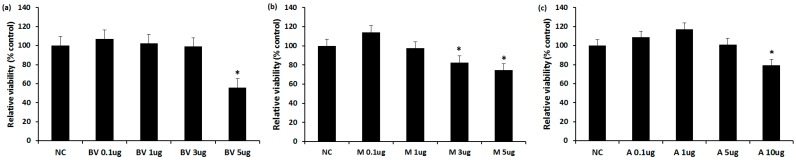
Figure 1
Figure 1
Effect of bee venom, melittin, and apamin on the proliferation of nasal fbroblasts. Nasal fibroblasts were treated with various concentrations of various concentrations of (a) bee venom; (b) melittina; and (c) apamin for 24 h. Values are expressed as the mean ± SE of four independent experiments. 5 μg/mL of BV, 3 μg/mL of melittin, and 10 μg/mL of apamin inhibited the proliferation of nasal fibroblasts. NC: negative control; BV: bee venom; M: melittin; A: apamin; μg: μg/mL; * p < 0.05.
Figure 2
Figure 2
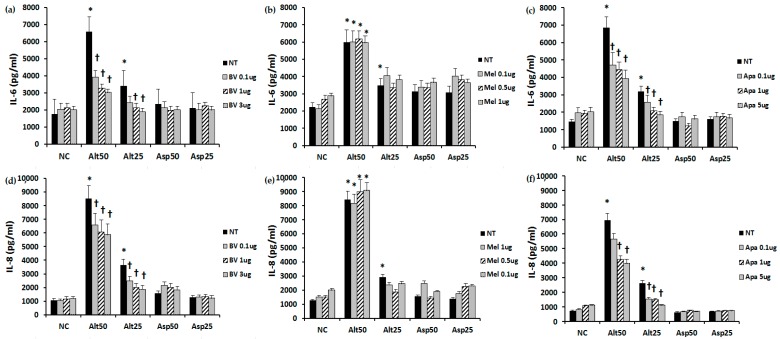
Effect of bee venom, melittin, and apamin on the production of IL-6 and IL-8 from nasal fibroblasts. Nasal fibroblasts were treated with Alternaria and Aspergillus for 24 h with or without various concentrations of these three agents. (a,d) Alternaria enhanced IL-6 and IL-8 production from nasal fibroblasts and the production of IL-6 and IL-8 was significantly inhibited by bee venom and (c,f) apamin; (b,e) Melittin did not influence the production of IL-6 and IL-8 from nasal fibroblasts. Alt 50: Alternaria 50 μg/mL; Asp 50: Aspergillus 50 μg/mL; NC: negative control; NT: non-treated; BV: bee venom; Mel: melittin; Apa: apamin, μg: μg/mL; * p < 0.05 compared with negative control; † p < 0.05 compared with the non-treated group.
Figure 3
Figure 3
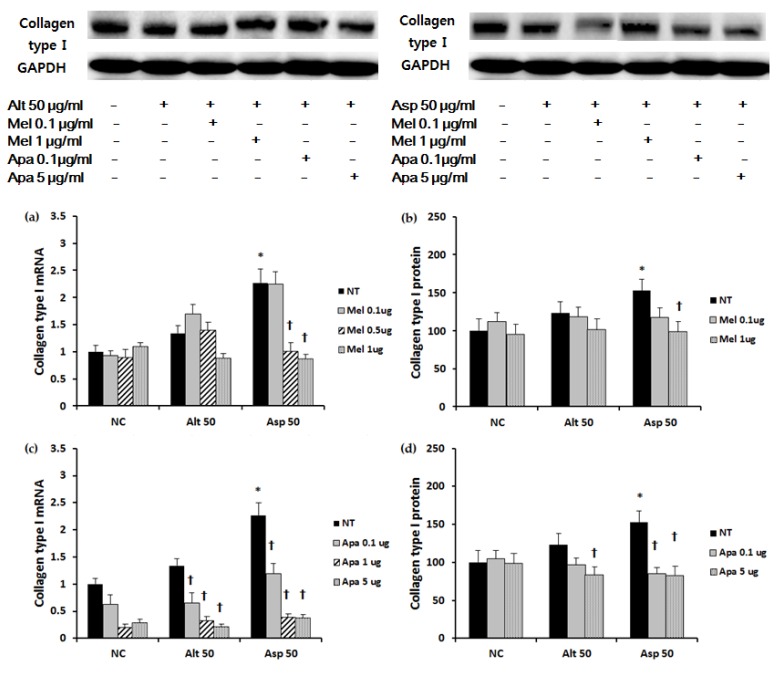
Effect of melittin and apamin on the expression of collagen type I mRNA and protein in nasal fibroblasts. Aspergillus induced collagen type I mRNA and protein expressions were significantly suppressed by (a,b) melittin and (c,d) apamin. Apamin also significantly suppressed collagen type I mRNA expression in negative control and the Alternaria stimulated group. Alt 50: Alternaria 50 μg/mL; Asp 50: Aspergillus 50 μg/mL; NC: negative control; NT: non-treated; Mel: melittin; Apa: apamin; μg: μg/mL; *: p < 0.05 compared with negative control; † p < 0.05 compared with the non-treated group.
Figure 4
Figure 4
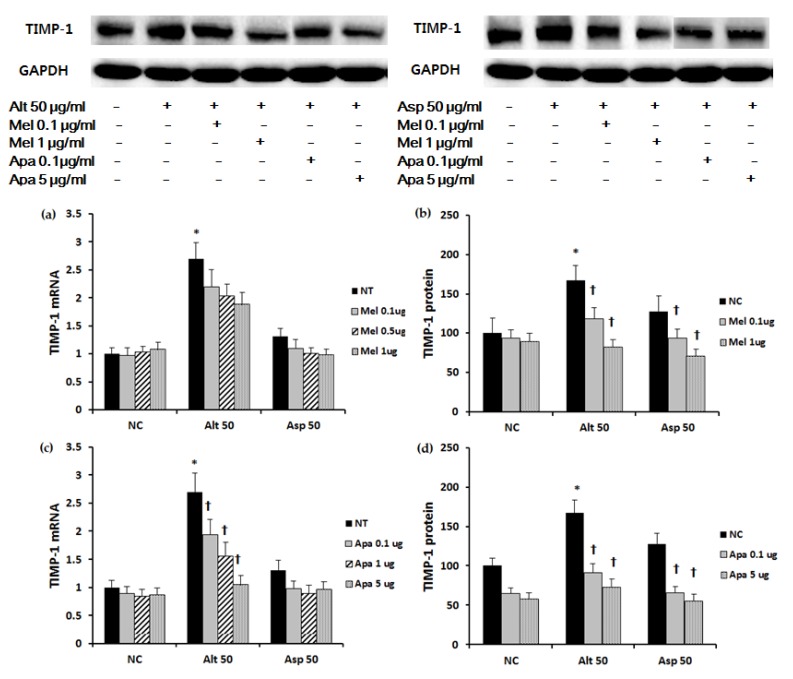
Effect of melittin and apamin on the expression of TIMP-1 mRNA and protein in nasal fibroblasts. Alternaria induced TIMP-1 protein production was significantly inhibited by (b) melittin and (d) apamin; (c) Apamin also significantly suppressed Alternaria induced TIMP-1 mRNA expression; (a) Melittin did no inhibit Alternaria induced TIMP-1 mRNA expression. Alt 50: Alternaria 50 μg/mL; Asp 50: Aspergillus 50 μg/mL; NC: negative control; NT: non-treated; Mel: melittin; Apa: apamin, μg: μg/mL; * p < 0.05 compared with negative control; † p < 0.05 compared with the non-treated group.
Figure 5
Figure 5
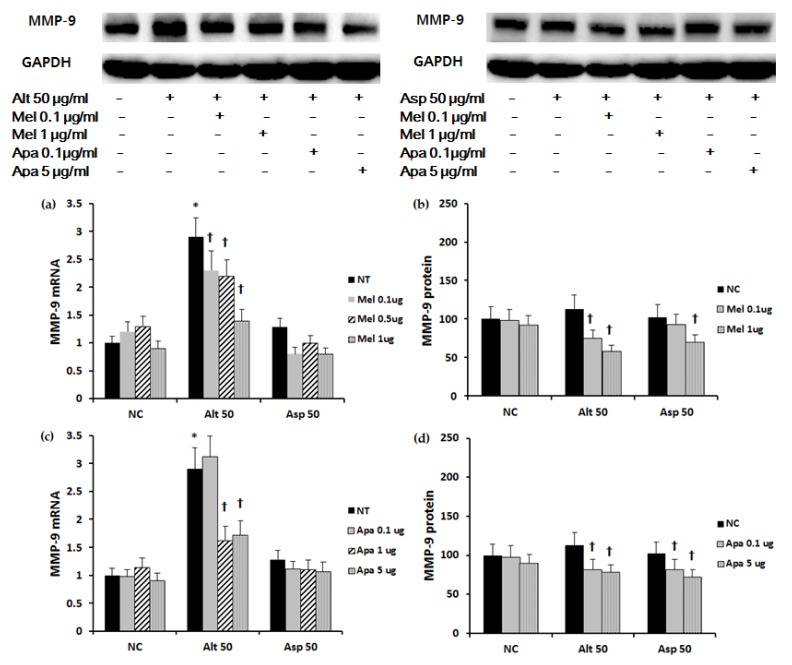
Effect of melittin and apamin on the expression of MMP-9 mRNA and protein in nasal fibroblasts. Alternaria induced MMP-9 mRNA expression was significantly inhibited by (a) melittin and (c) apamin. (b,d) Melittin and apamin tended to inhibit the production of MMP-9 protein. Alt 50: Alternaria 50 μg/mL; Asp 50: Aspergillus 50 μg/mL; NC: negative control; NT: non-treated; Mel: melittin; Apa: apamin; μg: μg/mL; * p < 0.05 compared with negative control; † p < 0.05 compared with the non-treated group.
Figure 6
Figure 6
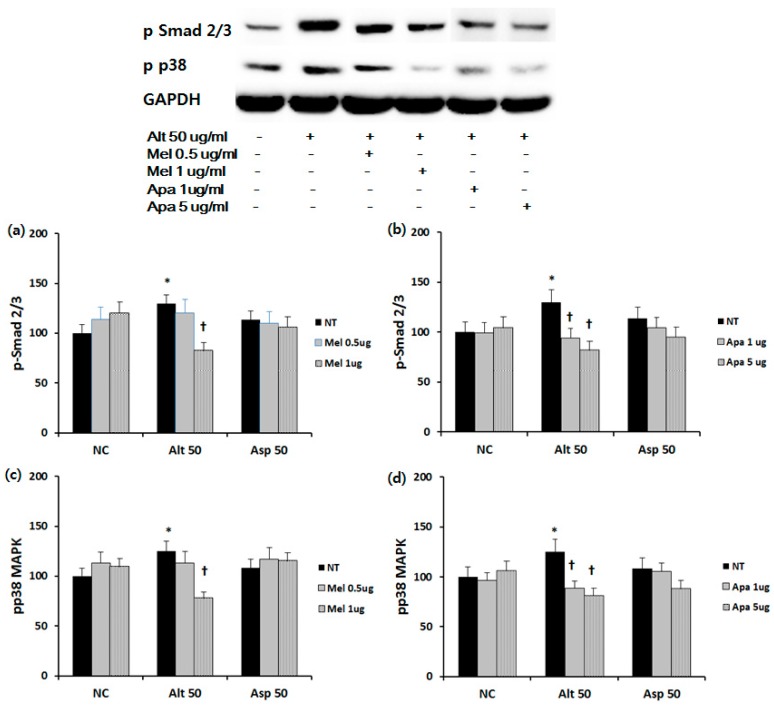
Effect of melittin and apamin on phosphorylation of Smad 2/3 and p38 MAPK expression in nasal fibroblasts. Phosphorylation of Smad 2/3 and p38 MAPK was measured using Western blotting and density analysis. Alternaria induced Smad 2/3 and p38 MAPK phosphorylation was significantly inhibited by (a,c) melittin and (b,d) apamin. Alt 50: Alternaria 50 μg/mL; Asp 50: Aspergillus 50 μg/mL; NC: negative control; NT: non-treated; Mel: melittin; Apa: apamin; μg: μg/mL; * p < 0.05 compared with negative control; † p < 0.05 compared with the non-treated group.

References

    1. Cho J.S., Moon Y.M., Park I.H., Um J.Y., Moon J.H., Park S.J., Lee S.H., Kang H.J., Lee H.M. Epigenetic regulation of myofibroblast differentiation and extracellular matrix production in nasal polyp-derived fibroblasts. Clin. Exp. Allergy J. Br. Soc. Allergy Clin. Immunol. 2012;42:872–882. doi: 10.1111/j.1365-2222.2011.03931.x. - DOI - PubMed
    1. Nakagawa T., Yamane H., Nakai Y., Shigeta T., Takashima T., Takeda Z. Comparative assessment of cell proliferation and accumulation of extracellular matrix in nasal polyps. Acta Oto-Laryngol. Suppl. 1998;538:205–208. doi: 10.1080/00016489850182945. - DOI - PubMed
    1. Shin S.H., Kim Y.H., Jin H.S., Kang S.H. Alternaria induces production of thymic stromal lymphopoietin in nasal fibroblasts through toll-like receptor 2. Allergy Asthma Immunol. Res. 2016;8:63–68. doi: 10.4168/aair.2016.8.1.63. - DOI - PMC - PubMed
    1. Gao F.S., Cao T.M., Gao Y.Y., Liu M.J., Liu Y.Q., Wang Z. Effects of chronic exposure to Aspergillus fumigatus on epidermal growth factor receptor expression in the airway epithelial cells of asthmatic rats. Exp. Lung Res. 2014;40:298–307. doi: 10.3109/01902148.2014.918212. - DOI - PubMed
    1. Roeder A., Kirschning C.J., Rupec R.A., Schaller M., Korting H.C. Toll-like receptors and innate antifungal responses. Trends Microbiol. 2004;12:44–49. doi: 10.1016/j.tim.2003.11.003. - DOI - PubMed

MeSH terms

LinkOut - more resources