Review
. 2017 Nov 1;41(6):923-940.
doi: 10.1093/femsre/fux046.

Repetitive sequences in malaria parasite proteins

Affiliations
Review

Repetitive sequences in malaria parasite proteins

Heledd M Davies et al. FEMS Microbiol Rev. .

Abstract

Five species of parasite cause malaria in humans with the most severe disease caused by Plasmodium falciparum. Many of the proteins encoded in the P. falciparum genome are unusually enriched in repetitive low-complexity sequences containing a limited repertoire of amino acids. These repetitive sequences expand and contract dynamically and are among the most rapidly changing sequences in the genome. The simplest repetitive sequences consist of single amino acid repeats such as poly-asparagine tracts that are found in approximately 25% of P. falciparum proteins. More complex repeats of two or more amino acids are also common in diverse parasite protein families. There is no universal explanation for the occurrence of repetitive sequences and it is possible that many confer no function to the encoded protein and no selective advantage or disadvantage to the parasite. However, there are increasing numbers of examples where repetitive sequences are important for parasite protein function. We discuss the diverse roles of low-complexity repetitive sequences throughout the parasite life cycle, from mediating protein-protein interactions to enabling the parasite to evade the host immune system.

Keywords: Plasmodium falciparum; host-pathogen interaction; low complexity; malaria; protein evolution; protein repeats.


Figures

Figure 1.
Figure 1.
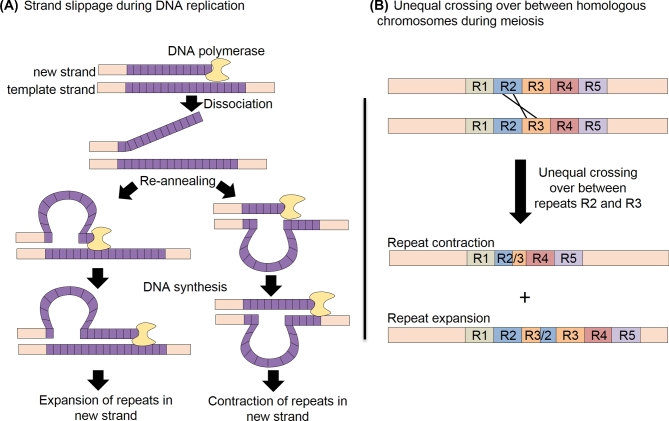
Repeat expansion and contraction during DNA replication and unequal crossing over in meiosis.
Figure 2.
Figure 2.
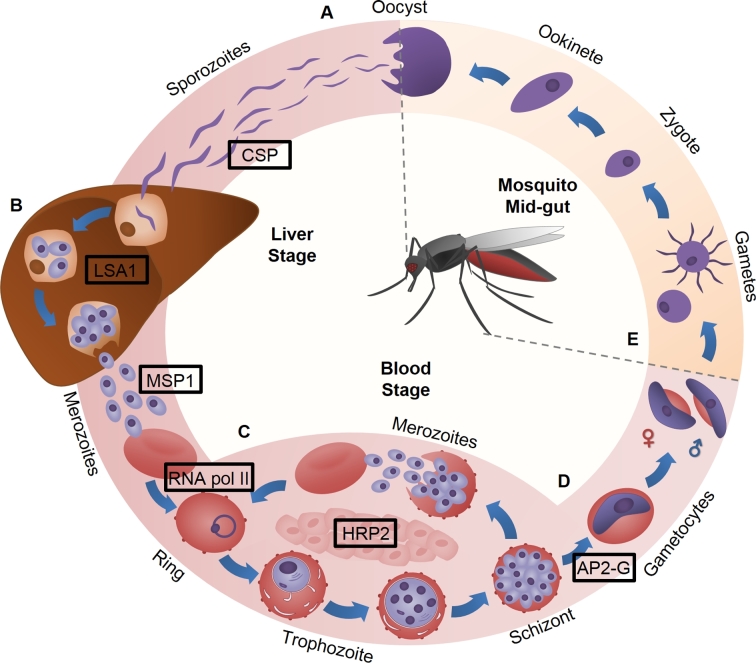
The P. falciparum life cycle. (A) Sporozoites are injected from the salivary glands of the Anopheles mosquito and migrate to the host liver. (B) Upon invasion of hepatocytes, thousands of merozoites are produced and subsequently released into the bloodstream. (C) Merozoites invade host erythrocytes and cycle through the ring, trophozoite and schizont stages before daughter merozoites egress from the host erythrocyte and invade new cells. (D) A small proportion of parasites differentiate into male and female gametocytes. (E) Gametocytes are ingested into the mosquito's midgut as it takes a blood meal where they form gametes and fuse to form a diploid zygote. The zygote differentiates into an ookinete which develops into an oocyst within the midgut wall. Upon oocyst rupture, sporozoites are released into the hemolymph and travel to the mosquito salivary gland. Proteins containing repetitive/low-complexity sequences are labelled at the approximate life stage where they are utilised.
Figure 3.
Figure 3.
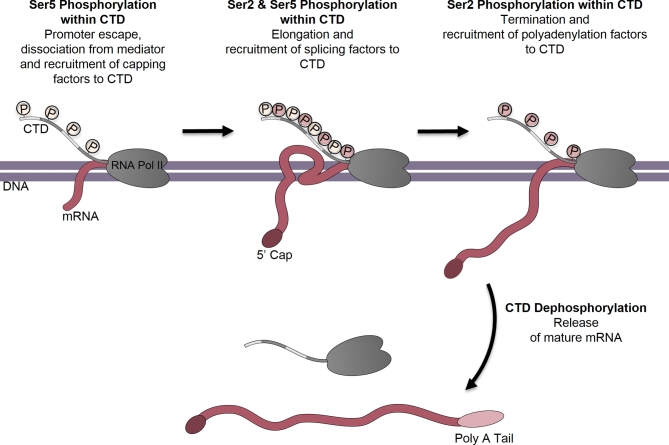
RNA polymerase II CTD—phosphorylation and recruitment of proteins by the RNA pol II CTD during transcription
Figure 4.
Figure 4.
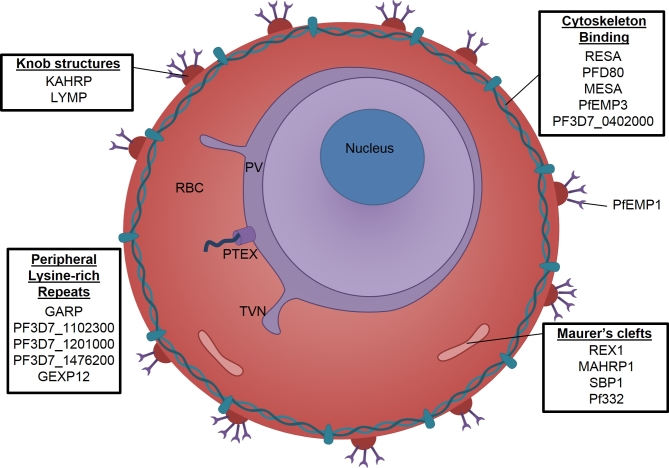
Repetitive proteins exported into the host cell. Many proteins are exported into the host erythrocyte by P. falciparum. These are involved in creating new structures within the host cell: membranous structures called Maurer's clefts (MC) appear in the host cell cytoplasm, a ‘tubovesicular network’ (TVN) extends from the parasitophorous vacuole (PV) and ‘knob’ protrusions form on the cell surface which present the cytoadhesive surface protein PfEMP1. Many repetitive proteins interact with the spectrin cytoskeleton of the erythrocyte resulting in increased cell rigidity.
Figure 5.
Figure 5.
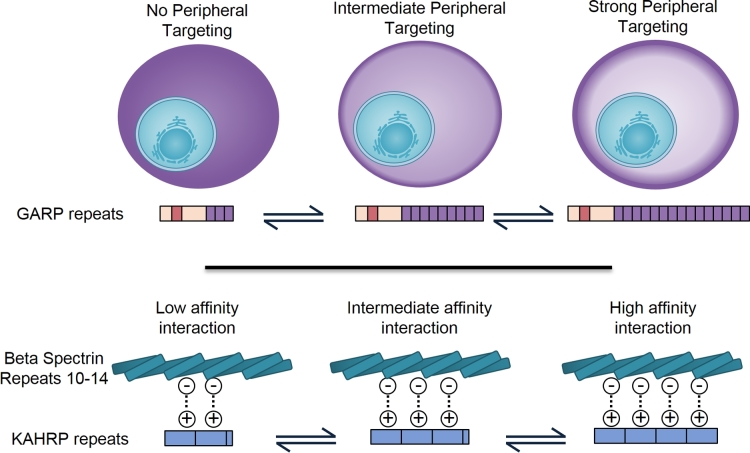
Expansion and contraction of Lys-rich repetitive sequences and changes in protein localization or protein-binding affinity. The top panel illustrates the correlation between the length of a Lys-rich sequence from the protein GARP and the efficiency with which it is targeted to the erythrocyte periphery. The lower panel illustrates the changes in binding affinity between β-spectrin and KAHRP repeats as the number of repeats in KAHRP is altered.

References

    1. Abdallah JF, Okoth SA, Fontecha GA et al. . Prevalence of pfhrp2 and pfhrp3 gene deletions in Puerto Lempira, Honduras. Malaria J 2015;14:19. - PMC - PubMed
    1. Akinyi Okoth S, Abdallah JF, Ceron N et al. . Variation in Plasmodium falciparum histidine-rich protein 2 (Pfhrp2) and Plasmodium falciparum histidine-rich protein 3 (Pfhrp3) gene deletions in Guyana and Suriname. PLoS One 2015;10:e0126805. - PMC - PubMed
    1. Aly AS, Vaughan AM, Kappe SH. Malaria parasite development in the mosquito and infection of the mammalian host. Annu Rev Microbiol 2009;63:195–221. - PMC - PubMed
    1. Amoah LE, Abankwa J, Oppong A. Plasmodium falciparum histidine rich protein-2 diversity and the implications for PfHRP 2: based malaria rapid diagnostic tests in Ghana. Malaria J 2016;15:101. - PMC - PubMed
    1. Andrade MA, Perez-Iratxeta C, Ponting CP. Protein repeats: structures, functions, and evolution. J Struct Biol 2001;134:117–31. - PubMed

Publication types

MeSH terms

Substances