. 2017 Oct 31;114(44):11769-11774.
doi: 10.1073/pnas.1706206114. Epub 2017 Oct 16.

Early rearing history influences oxytocin receptor epigenetic regulation in rhesus macaques

Affiliations

Early rearing history influences oxytocin receptor epigenetic regulation in rhesus macaques

Maggie Baker et al. Proc Natl Acad Sci U S A. .

Abstract

Adaptations to stress can occur through epigenetic processes and may be a conduit for informing offspring of environmental challenge. We employed ChIP-sequencing for H3K4me3 to examine effects of early maternal deprivation (peer-rearing, PR) in archived rhesus macaque hippocampal samples (male, n = 13). Focusing on genes with roles in stress response and behavior, we assessed the effects of rearing on H3K4me3 binding by ANOVA. We found decreased H3K4me3 binding at genes critical to behavioral stress response, the most robust being the oxytocin receptor gene OXTR, for which we observed a corresponding decrease in RNA expression. Based on this finding, we performed behavioral analyses to determine whether a gain-of-function nonsynonymous OXTR SNP interacted with early stress to influence relevant behavioral stress reactivity phenotypes (n = 194), revealing that this SNP partially rescued the PR phenotype. PR infants exhibited higher levels of separation anxiety and arousal in response to social separation, but infants carrying the alternative OXTR allele did not exhibit as great a separation response. These data indicate that the oxytocin system is involved in social-separation response and suggest that epigenetic down-modulation of OXTR could contribute to behavioral differences observed in PR animals. Epigenetic changes at OXTR may represent predictive adaptive responses that could impart readiness to respond to environmental challenge or maintain proximity to a caregiver but also contribute to behavioral pathology. Our data also demonstrate that OXTR polymorphism can permit animals to partially overcome the detrimental effects of early maternal deprivation, which could have translational implications for human psychiatric disorders.

Keywords: epigenetic; maternal care; oxytocin; primate; stress.


Conflict of interest statement

The authors declare no conflict of interest.

Figures
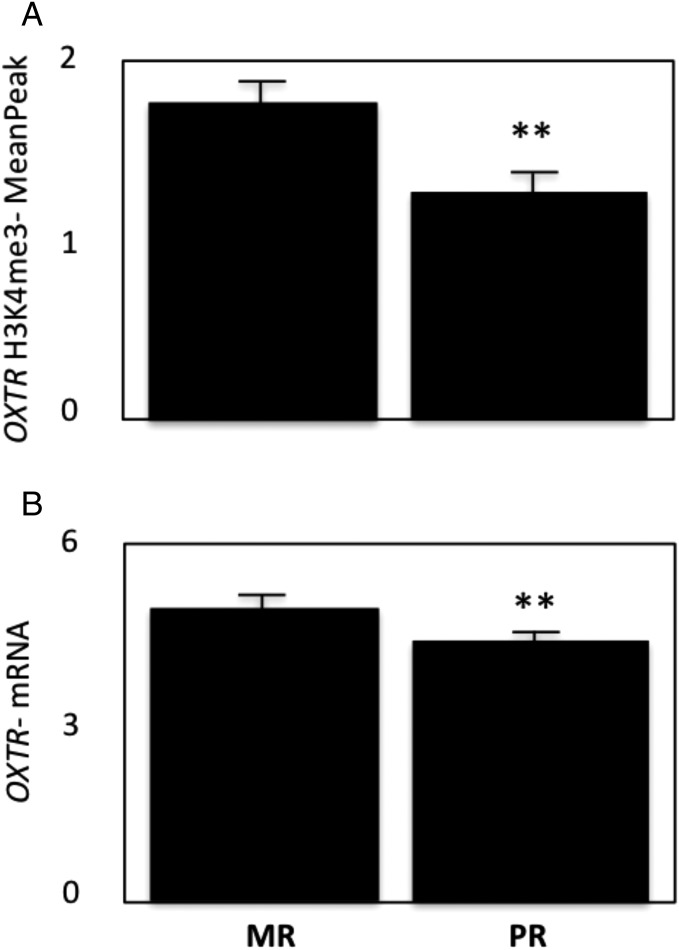
Fig. 1.
Fig. 1.
H3K4me3 binding and OXTR mRNA expression levels are decreased in hippocampus from PR macaques. Shown are H3K4me3 values assessed by ChIP-seq (A) and OXTR mRNA values generated by expression microarray (B). Data are shown as mean readings ± SEM; **P ≤ 0.01.
Fig. S1.
Fig. S1.
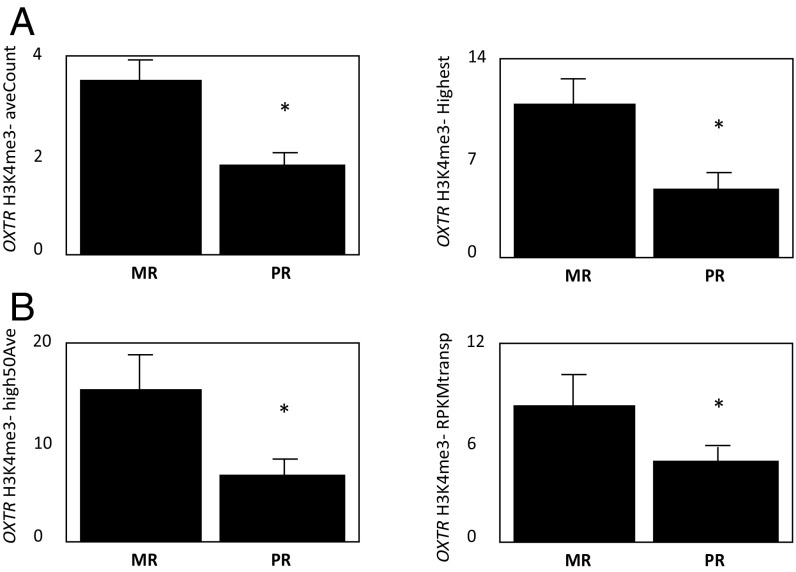
H3K4me3-binding levels are decreased in hippocampus from PR macaques. Shown are the H3K4me3 values assessed by ChIP-seq: aveCount and highest (A) and high50Ave and RPKM transposed (RPKMtransp) (B). Data are shown as mean readings ± SEM; *P < 0.05.
Fig. 2.
Fig. 2.
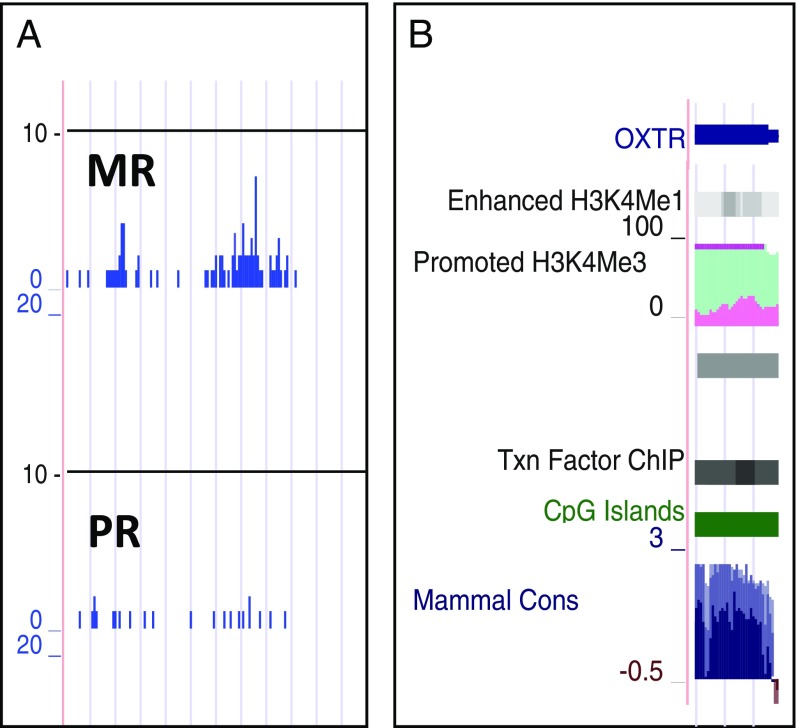
Region of H3Kfme3 binding found in rhesus hippocampus and potential for epigenetic and transcriptional regulation in the corresponding region at human OXTR. (A) Output showing H3K4me3-binding peaks at the OXTR promoter in MR vs. PR macaque hippocampus. (B) UCSC output for human OXTR showing potential sites for epigenetic regulation (H3K4me1, H3K4me3, and CpG islands) and transcription factor (Txn Factor)-binding sites [DNase hypersensitivity clusters and transcription factor ChIP-seq] for human OXTR. Also shown are regions of conservation across species (Mammal Cons).
Fig. 3.
Fig. 3.
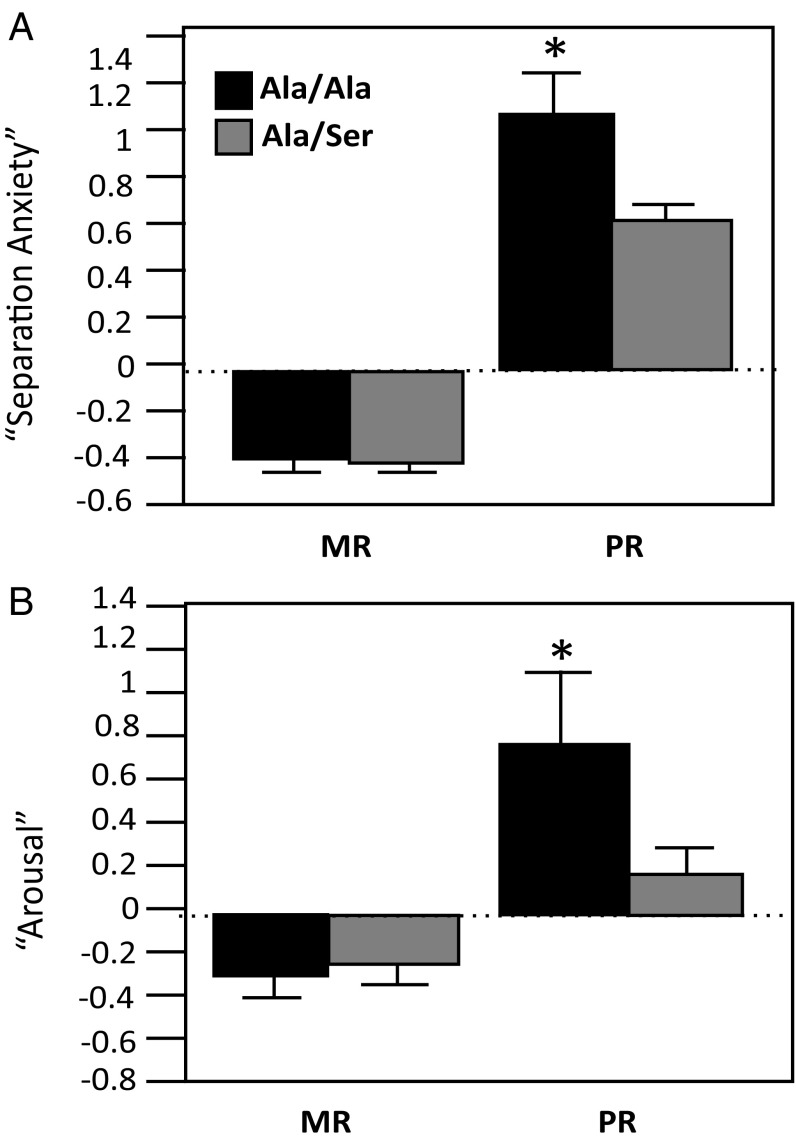
A gain-of-function OXTR polymorphism partially rescues the PR phenotype. Shown are results from ANOVA performed using as dependent variables factors derived from factor analysis of social-separation data averaged from macaques at 6–8 mo of age. In both separation anxiety (A) and arousal (B), PR monkeys that are homozygous for the Ala allele exhibit higher reactivity than the other groups studied, including PR Ala/Ser monkeys; *P ≤ 0.05.
Fig. S2.
Fig. S2.
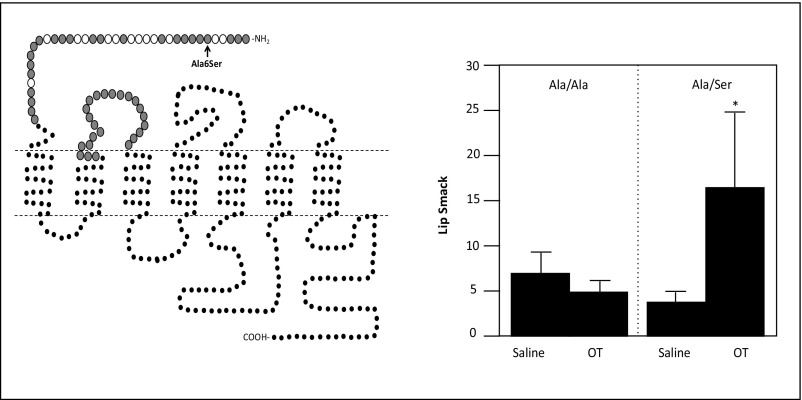
(Left) OXTR typology showing rhesus nonsynonymous changes. Larger circles indicate residues directly involved in ligand–receptor interactions. Gray filled circles indicate residues conserved across species (human, rhesus monkey, pig, bovine, sheep, rat, and mouse). Open circles indicate residues that vary among species, indicating that nonsynonymous changes may be better tolerated without influencing functionality of the receptor. This figure was modified from ref. . (Right) A nonsynonymous SNP (Ala6Ser) in the ligand-binding domain of the rhesus macaque OXTR confers increased sensitivity to exogenous intranasal oxytocin. Shown are infants’ lip-smacks during a face-to-face interaction with a human caretaker at 1 h after administration of saline or oxytocin (OT) to infants with the Ala/Ala and Ala/Ser genotypes. *P < 0.05.
Fig. S3.
Fig. S3.
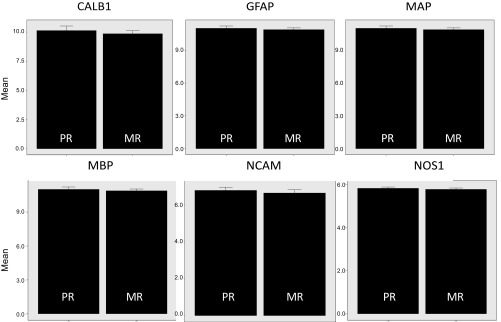
Effects of rearing condition on levels of mRNA expression of six neuronal or glial markers: microtubule-associated protein (MAP), glial fibrillary acidic protein (GFAP), neuronal nitric oxide synthase (NOS1), myelin basic protein (MBP), neural cell adhesion molecule (NCAM), and calbindin (CALB1).

References

    1. McEwen BS. Physiology and neurobiology of stress and adaptation: Central role of the brain. Physiol Rev. 2007;87:873–904. - PubMed
    1. Korte SM, Koolhaas JM, Wingfield JC, McEwen BS. The Darwinian concept of stress: Benefits of allostasis and costs of allostatic load and the trade-offs in health and disease. Neurosci Biobehav Rev. 2005;29:3–38. - PubMed
    1. Maren S, Phan KL, Liberzon I. The contextual brain: Implications for fear conditioning, extinction and psychopathology. Nat Rev Neurosci. 2013;14:417–428. - PMC - PubMed
    1. Neigh GN, Gillespie CF, Nemeroff CB. The neurobiological toll of child abuse and neglect. Trauma Violence Abuse. 2009;10:389–410. - PMC - PubMed
    1. Sinha R. Chronic stress, drug use, and vulnerability to addiction. Ann N Y Acad Sci. 2008;1141:105–130. - PMC - PubMed

Publication types

LinkOut - more resources