. 2017 Nov 7;114(45):E9569-E9578.
doi: 10.1073/pnas.1712396114. Epub 2017 Oct 23.

Numerous interactions act redundantly to assemble a tunable size of P bodies in Saccharomyces cerevisiae

Affiliations

Numerous interactions act redundantly to assemble a tunable size of P bodies in Saccharomyces cerevisiae

Bhalchandra S Rao et al. Proc Natl Acad Sci U S A. .

Abstract

Eukaryotic cells contain multiple RNA-protein assemblies referred to as RNP granules, which are thought to form through multiple protein-protein interactions analogous to a liquid-liquid phase separation. One class of RNP granules consists of P bodies, which consist of nontranslating mRNAs and the general translation repression and mRNA degradation machinery. P bodies have been suggested to form predominantly through interactions of Edc3 and a prion-like domain on Lsm4. In this work, we provide evidence that P-body assembly can be driven by multiple different protein-protein and/or protein-RNA interactions, including interactions involving Dhh1, Psp2, and Pby1. Moreover, the relative importance of specific interactions can vary with different growth conditions. Based on these observations, we develop a summative model wherein the P-body assembly phenotype of a given mutant can be predicted from the number of currently known protein-protein interactions between P-body components.

Keywords: P bodies; RNP granules; mRNA decay.


Conflict of interest statement

The authors declare no conflict of interest.

Figures
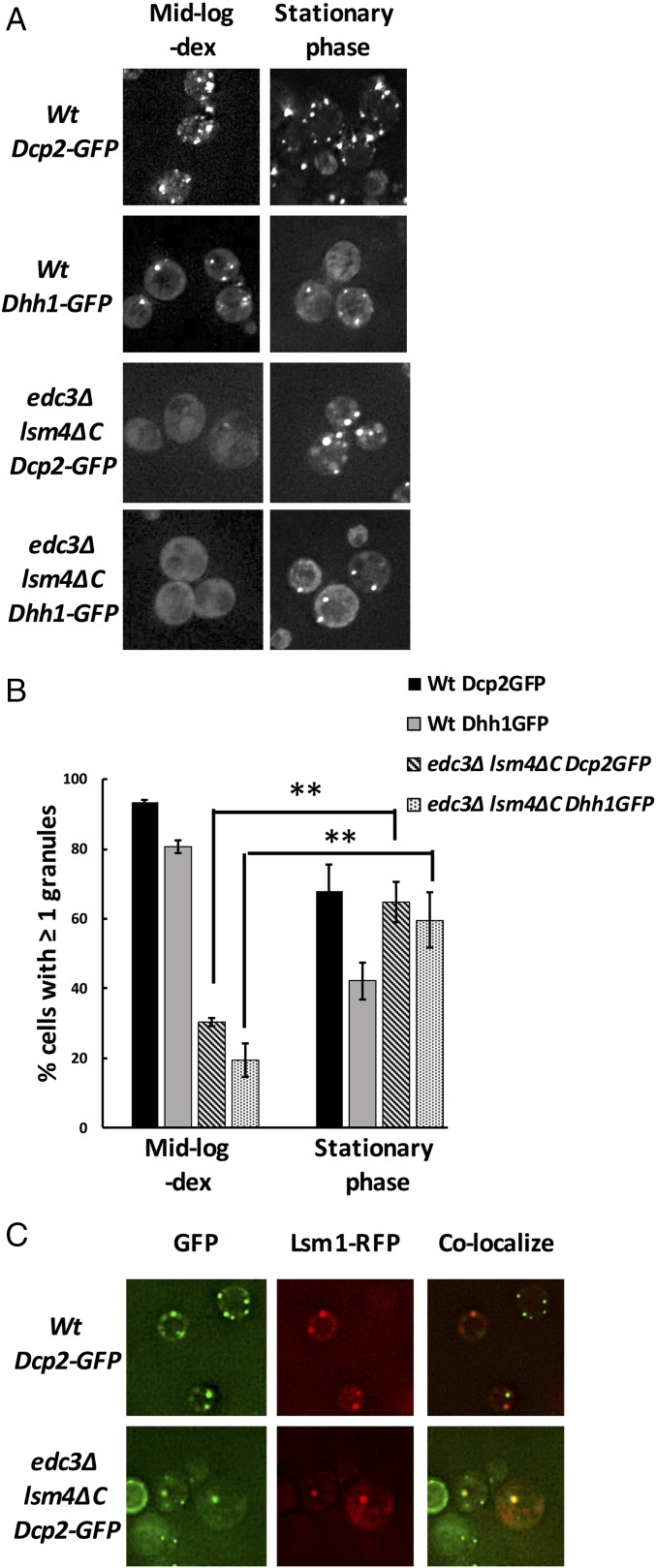
Fig. 1.
Fig. 1.
edc3Δ lsm4ΔC yeast assemble P bodies in stationary phase. (A) Representative images of Dcp2-GFP– or Dhh1-GFP–containing wild-type and edc3Δ lsm4ΔC yeast grown in SComplete media containing 2% dextrose (dex). Images were taken with cells in midlog phase under glucose-depleted conditions and in stationary phase. (B) Quantification of P bodies in cells from the images obtained in A, in which images were similarly thresholded for fluorescence intensity and the percentage of cells with at least one Dcp2-GFP or Dhh1-GFP granule was determined. Error bars indicate the SD of mean values. Statistical significance for changes in cells with at least one P body was determined using a Student’s t test (**P ≤ 0.01). (C) Dcp2-GFP–containing wild-type and edc3Δ lsm4ΔC strains used in A and B were cotransformed with plasmid expressing Lsm1-RFP and grown to stationary phase to test colocalization with Dcp2-GFP granules. (Magnification: A and C, 100×.)
Fig. 2.
Fig. 2.
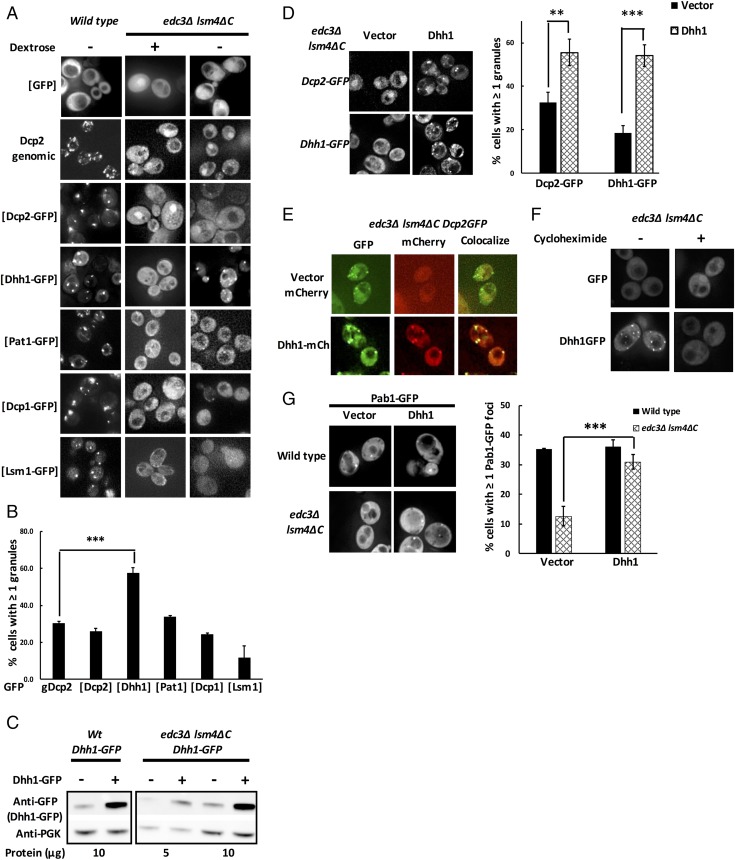
Overexpression of Dhh1 in edc3Δ lsm4ΔC yeast led to partial recovery of P-body assembly under glucose-depleted conditions. (A) edc3Δ lsm4ΔC yeast were transformed with either GFP-only or GFP-tagged variants of Dcp2, Dhh1, Pat1, Dcp1, and Lsm1, and tested for P-body assembly in glucose starvation under midlog growth. Figures contain representative images of cells observed via fluorescence microscopy. For comparison, edc3Δ lsm4ΔC with a genomically GFP-tagged Dcp2 was similarly treated and imaged. (B) Quantification of cells with GFP-positive puncta from A. (C) Western blot indicating two- to threefold overexpression of Dhh1-GFP off a CEN vector. Wild-type and edc3Δ lsm4ΔC yeast containing genomic Dhh1-GFP were transformed with either vector (−) or an additional copy of Dhh1-GFP (+), and expression was tested under midlog growth. (D) Representative images and quantification of overexpression of untagged Dhh1 on a CEN vector in edc3Δ lsm4ΔC Dcp2-GFP or edc3Δ lsm4ΔC Dhh1-GFP. (E) Colocalization of overexpressed Dhh1-mCherry with Dcp2-GFP in edc3Δ lsm4ΔC Dcp2-GFP yeast under midlog glucose-depleted conditions. (F) Dhh1-GFP–overexpressing edc3Δ lsm4ΔC yeast were glucose-starved in the presence of cycloheximide (100 µg/mL) and tested for its effect on P-body formation. (G) Wild-type and edc3Δ lsm4ΔC yeast were cotransformed with an untagged Dhh1 and Pab1-GFP, and tested for stress granule formation (Pab1-GFP foci) after 30 min of glucose starvation. The number of yeast cells with at least one Pab1-GFP stress granule was quantified. Error bars indicate the SD of the mean. Statistical significance was determined using a Student’s t test (**P ≤ 0.01, ***P ≤ 0.001). (Magnification: A and DG, 100×.)
Fig. 3.
Fig. 3.
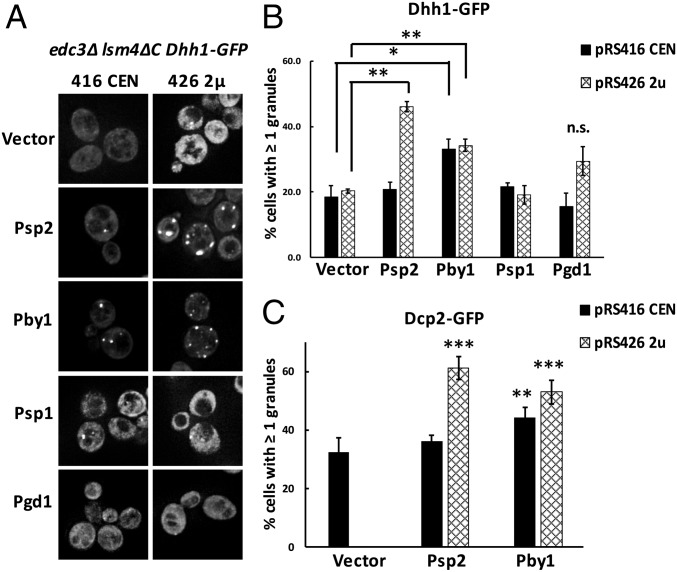
Psp2 and Pby1 overexpression recovers P-body assembly in edc3Δ lsm4ΔC yeast. (A) edc3Δ lsm4ΔC Dhh1-GFP yeast transformed with CEN and 2-μ (2u) vectors containing Psp2, Pby1, Psp1, and Pgd1 were tested for P-body assembly under midlog glucose-depleted conditions. (Magnification: 100×.) (B) The number of cells with at least one Dhh1-GFP–positive P body was quantified. (C) The number of cells with at least one Dcp2-GFP–positive P body in edc3Δ lsm4ΔC Dcp2-GFP yeast transformed with Psp2 and Pby1 on CEN and 2-μ vectors was quantified. Error bars indicate the SD of the mean. Statistical significance was determined using a Student’s t test (*P ≤ 0.05, **P ≤ 0.01, ***P ≤ 0.001; n.s., not significant). For C, the significance was determined by comparing with P bodies in a CEN vector-only control.
Fig. 4.
Fig. 4.
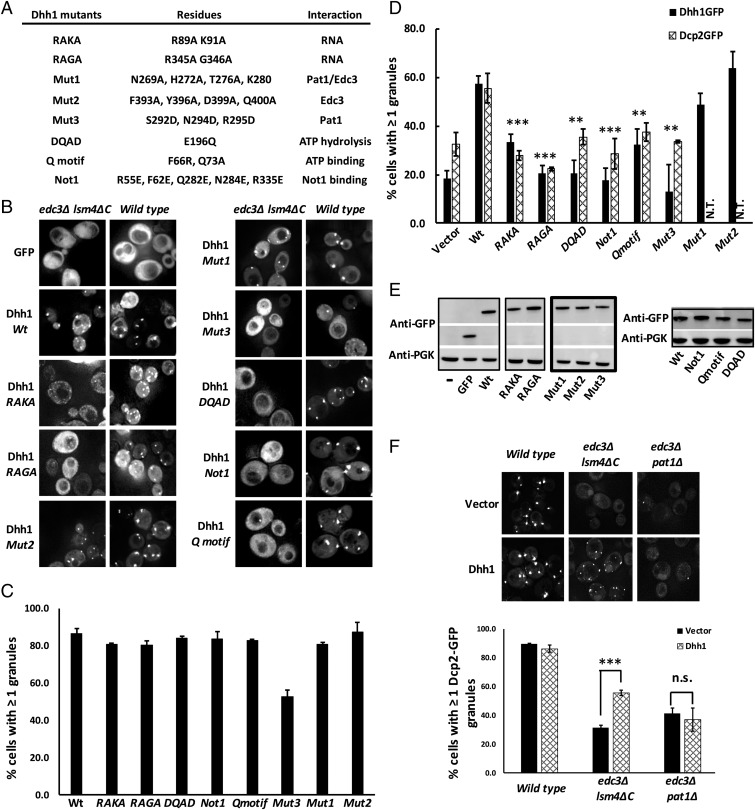
Multivalent interactions of Dhh1 are essential for recovery of P-body assembly. (A) Table showing the mutations made in Dhh1. (B) GFP-tagged wild-type and mutant Dhh1 proteins were expressed in edc3Δ lsm4ΔC and its corresponding isogenic wild-type yeast, and the effect of the mutation on P-body recovery was tested. (C) Quantification of P-body assembly in wild-type yeast using Dhh1-GFP (wild type and mutants) to test recruitment of Dhh1-GFP variants to P bodies. (D) The number of cells with at least one Dhh1-GFP–positive (for tagged wild-type and mutant Dhh1 proteins transformed into edc3Δ lsm4ΔC yeast; black bars) or Dcp2-GFP–positive P body (for untagged wild-type and mutant proteins transformed into edc3Δ lsm4ΔC Dcp2-GFP yeast; patterned bars) was quantified. N.T., not tested. (E) Western blot showing expression of GFP-tagged Dhh1 mutants in edc3Δ lsm4ΔC yeast. (F) Dhh1 overexpression in edc3Δ pat1Δ yeast does not rescue P-body assembly. Wild type, edc3Δ lsm4ΔC, and edc3Δ pat1Δ yeast were cotransformed with plasmids encoding Dcp2-GFP and untagged Dhh1 (or vector-only), and P-body assembly was tested under glucose-depleted conditions. Error bars indicate the SD of the mean. Statistical significance was determined using a Student’s t test (**P ≤ 0.01, ***P ≤ 0.001; n.s., not significant). (Magnification: B and F, 100×.)
Fig. 5.
Fig. 5.
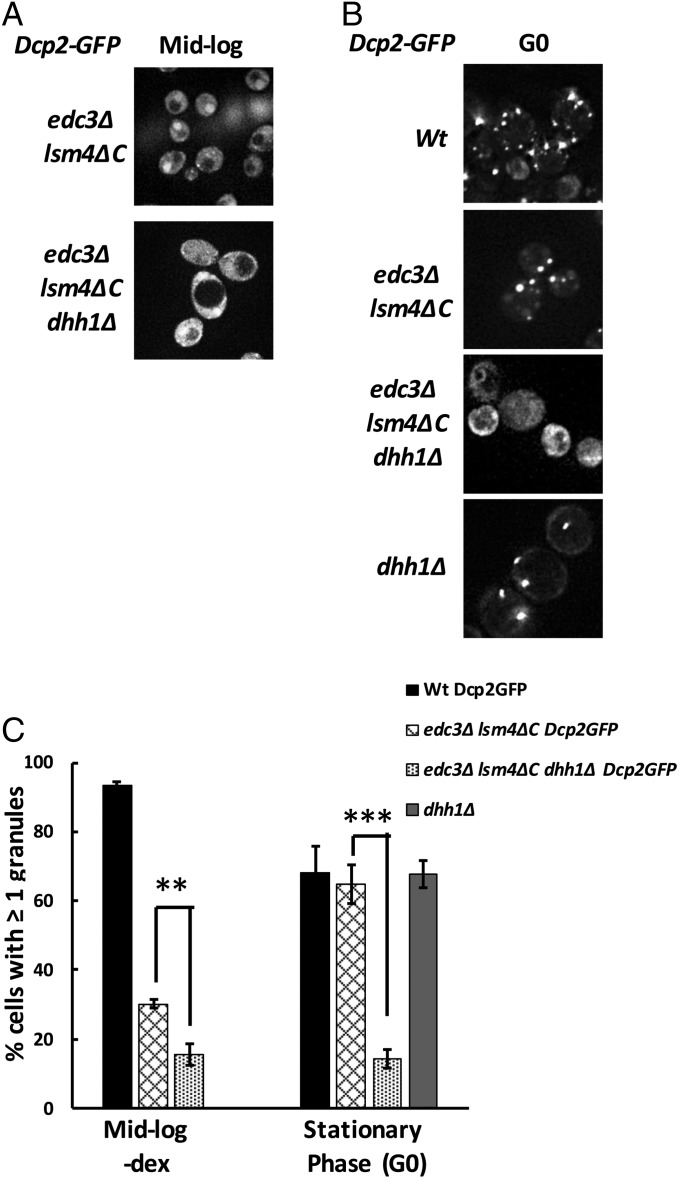
Dhh1 contributes to residual P-body assembly in vivo. (A and B) The contribution of Dhh1-mediated interactions on residual P-body assembly in (A) midlog phase and in (B) stationary phase (G0) was tested. (C) Quantification of P-body assembly by visualizing Dcp2-GFP–positive foci in wild-type, edc3Δ lsm4ΔC, edc3Δ lsm4ΔC dhh1Δ, and dhh1Δ only (stationary phase only). Error bars indicate the SD of the mean. Statistical significance was determined using a Student’s t test (**P ≤ 0.01, ***P ≤ 0.001). (Magnification: A and B, 100×.)
Fig. 6.
Fig. 6.
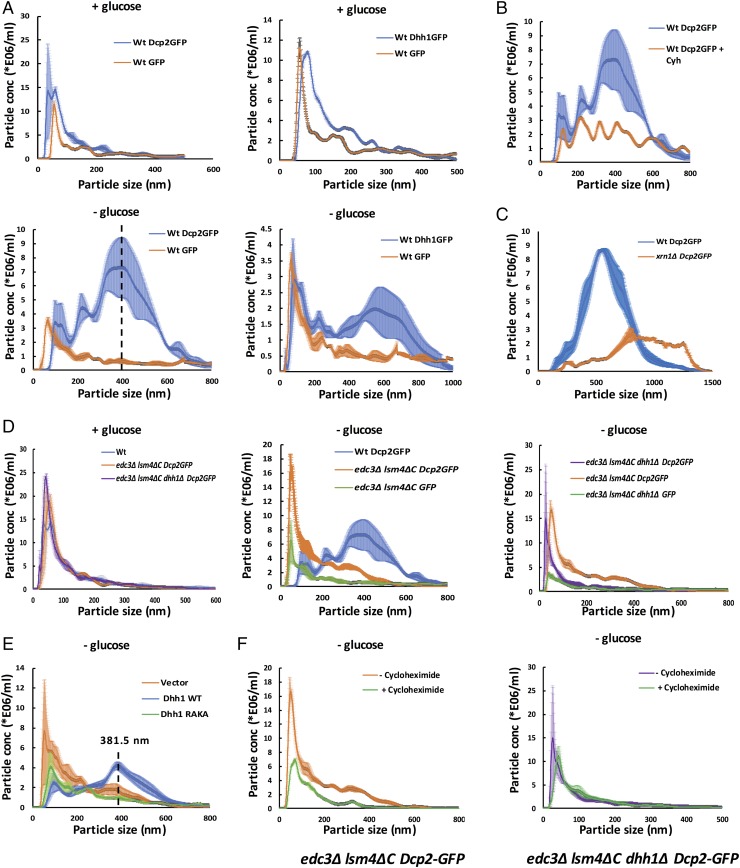
Submicroscopic P body-related mRNP assemblies exist in visible P body-deficient yeast. (A) Traces derived from nanoparticle tracking analysis of Dcp2-GFP, Dhh1-GFP, and GFP-only particles obtained from wild-type (Wt) yeast cells. Total cell lysates derived from yeast grown under glucose-replete (Top; + glucose) and glucose-depleted (Bottom; − glucose) conditions were analyzed using NTA. The dashed line indicates the peak height (395.5 nm) of the largest Dcp2-GFP granule observed in wild type. (B) Cycloheximide (Cyh; 100 μg/mL) treatment reduces P-body assembly as assessed by visualizing Dcp2-GFP particles from wild-type yeast. (C) Deletion of xrn1Δ increases mean P-body size compared with wild type. These experiments were conducted in an alternate yeast genetic background strain. (D) Distinct reduction in the mean size of Dcp2-GFP particles obtained from glucose-starved edc3Δ lsm4ΔC or edc3Δ lsm4ΔC dhh1Δ yeast. The particles observed in edc3Δ lsm4ΔC Dcp2-GFP and edc3Δ lsm4ΔC dhh1Δ Dcp2-GFP yeast exhibit enrichment of Dcp2-GFP over GFP in the corresponding control experiment (green trace; − glucose). (E) Overexpression of wild-type Dhh1 (blue) but not the RNA-binding mutant, RAKA (green), partially restores P-body assembly in edc3Δ lsm4ΔC Dcp2-GFP yeast. (F) Cycloheximide inhibits assembly of Dcp2-GFP particles in edc3Δ lsm4ΔC but not edc3Δ lsm4ΔC dhh1Δ yeast. The shaded area around the trend line in all traces represents the SEM derived from replicates.

References

    1. Buchan JR. mRNP granules. Assembly, function, and connections with disease. RNA Biol. 2014;11:1019–1030. - PMC - PubMed
    1. Protter DSW, Parker R. Principles and properties of stress granules. Trends Cell Biol. 2016;26:668–679. - PMC - PubMed
    1. Jain S, Parker R. The discovery and analysis of P bodies. Adv Exp Med Biol. 2013;768:23–43. - PubMed
    1. Kedersha N, et al. Stress granules and processing bodies are dynamically linked sites of mRNP remodeling. J Cell Biol. 2005;169:871–884. - PMC - PubMed
    1. Brangwynne CP, Mitchison TJ, Hyman AA. Active liquid-like behavior of nucleoli determines their size and shape in Xenopus laevis oocytes. Proc Natl Acad Sci USA. 2011;108:4334–4339. - PMC - PubMed

Publication types

MeSH terms

Substances

LinkOut - more resources